Most people assume that thicker fabric automatically means better insulation. That assumption is why so many rooms still feel cold even after hanging new “thermal” drapes. The real distinction in this thermal curtains buying guide comes down to one thing: whether the curtain traps a still layer of air against the window. Without that sealed air pocket, even triple-layered polyester is just a heavy decoration.
Key Takeaways
- A thermal curtain only insulates when it creates a closed air space — the rod must sit close to the wall, the panel must overlap the frame by several inches on every side, and the fabric must reach the floor or windowsill without gaps.
- The word “thermal” is not regulated, so you must physically check for a foam or flannel lining layer; many thick polyester curtains sold as thermal have no dedicated insulating backing at all.
- Machine washing often destroys foam-backed thermal curtains; always read the care label before buying if you expect to launder them regularly.
The Basics: What Thermal Curtains Actually Do
A window is the weakest thermal point in most rooms. In winter, windows are typically the weakest point in a room’s insulation, because glass conducts heat far faster than an insulated wall. Window coverings can reduce that loss by 10% to 25%, but only when they interrupt the convective loop that forms against cold glass.
Here is the mechanism in plain terms. Warm room air touches the cold windowpane, cools, and sinks. That sinking air pulls more warm air toward the glass, creating a continuous draft cycle. A curtain stops this by holding a layer of still air between the room and the window. Still air is a poor conductor. The curtain itself does not need to be thick to stop that cycle — it needs to hang close enough to the wall and floor that cold air cannot slide around its edges.
That is why a heavy velvet panel mounted on a wobbly rod six inches from the wall often performs worse than a lighter foam-backed panel mounted flush against the frame. The sealed air pocket is the insulation, not the fabric weight.
The Difference Between Thermal and Blackout Curtains
Blackout curtains stop light. Thermal curtains stop heat transfer. Many products claim to do both, but the underlying construction is different. A blackout curtain uses an opaque layer — often a dense, dark yarn woven into the center of the fabric — to block photons. A thermal curtain uses an insulating layer — usually a foam or flannel backing — to slow conduction and convection.
Some curtains combine both: a triple-weave construction with a central layer of black, high-density yarn sandwiched between two outer colored layers provides both blackout and modest insulation. But that triple weave alone does not produce a measurable R-value unless the panel also seals against the window frame. If you need light control, our blackout curtains buying guide covers the difference in more detail.
How Thermal Curtains Reduce Heat Loss
Thermal resistance is measured with an R-value. A higher R-value means the material slows heat transfer more effectively. The inverse metric, U-value, measures heat transmittance — lower is better. A foam-backed curtain typically offers a higher R-value than a plain woven curtain, but that advantage disappears if the curtain is mounted with gaps.
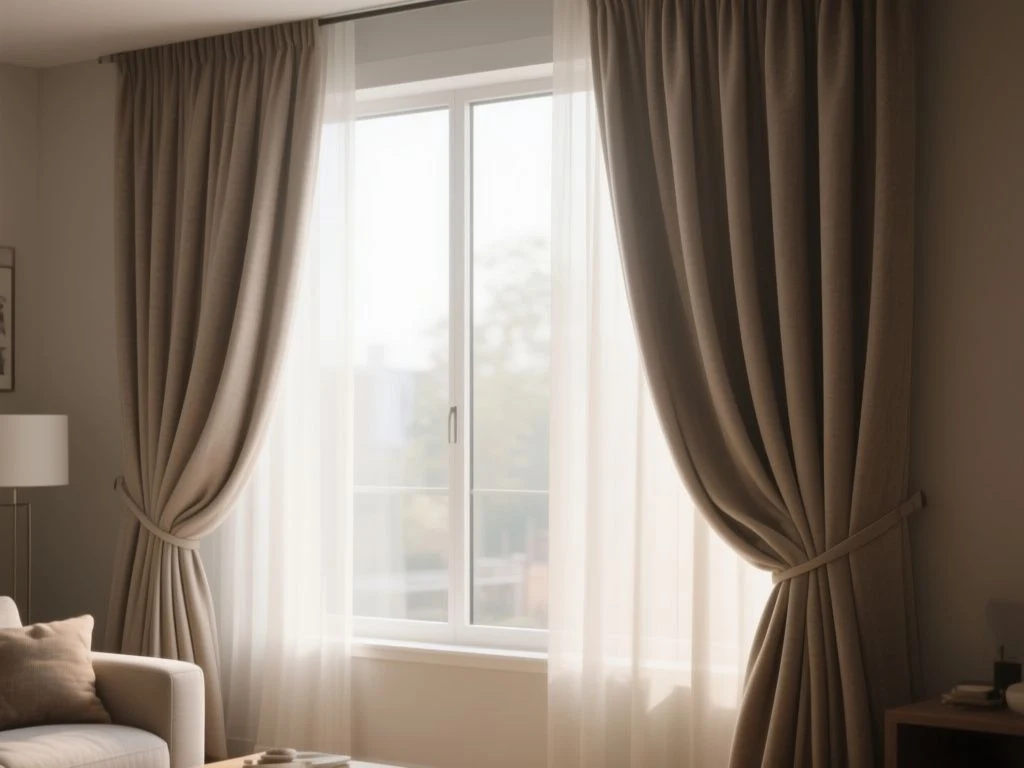
The practical distinction that separates effective thermal curtains from mere fashion drapes is not just fabric weight but the presence and condition of a dedicated thermal lining — typically a foam or flannel layer — and the way the curtain is mounted to seal off the window entirely. Most “thermal” claims in the market are unregulated, so the informed choice hinges on inspecting the sandwich construction: outer fabric, lining, and whether the top edge has a sealed pocket or grommets that allow a full draw across the window. Only a curtain that reaches the floor, overlaps the frame on each side, and sits close to the wall will actually trap a still air space, which is what delivers measurable insulation.
Do They Work in Summer?
Yes, but with a caveat. A thermal curtain blocks radiant heat from the sun during the day, which reduces cooling load. However, if the curtain has a dark or dense lining without a reflective outer face, it can absorb solar heat and re-radiate it into the room at night. For summer use, look for a curtain with a light-colored or reflective backing — often described as “reverse” or “reflective” thermal. Without that reflective layer, the curtain works better in winter than in summer.
Getting the Fit Right: Measuring and Mounting
You can buy the most expensive lined curtain on the market and still get zero insulation if it hangs wrong. The fit determines performance more than the fabric does. This section covers the two mistakes that ruin most installations: measuring the window instead of the curtain area, and mounting the rod too far from the wall.
Measure the Window, Not the Curtain
Start by measuring the window opening itself, then add overlap. For the width, measure from the outer edge of the left trim to the outer edge of the right trim, then add at least 4 inches on each side. That extra fabric ensures the panel covers the frame completely when fully drawn. For the length, measure from the rod position down to the floor (for full-length curtains) or to the windowsill (for sill-length). Then add 1 to 2 inches of “break” at the floor so the fabric puddles slightly and blocks the bottom gap.
Never measure only the glass dimensions. Glass is smaller than the frame, and cold air flows around the frame through the wall cavity. The curtain must cover the entire frame, not just the glass.
Mounting Position That Creates a Seal
The rod should sit as close to the wall as possible — ideally 2 to 3 inches from the wall surface. If the rod is mounted 6 inches out on extended brackets, a large gap opens between the curtain and the wall, and cold air flows straight through. Use short projection brackets or a ceiling-mounted track.
Also position the rod above the window frame, not level with the top edge. Mounting the rod 4 to 6 inches above the frame (or as close to the ceiling as possible) allows the curtain to hang down over the top of the frame, closing the gap where warm air rises and escapes. Ceiling-mounted tracks work best because they eliminate the rod projection entirely.
For maximum seal, choose a curtain with a grommet top or a rod pocket. Grommets create evenly spaced folds that sit close to the wall when the rod is mounted tightly. Rod pockets slide directly onto the rod and can be pushed flush against the wall. Avoid tab-top or ring-top styles if insulation is your priority, because those leave small gaps between each attachment point.
Length: Floor vs. Sill
For winter insulation, floor-length curtains beat sill-length every time. A sill-length curtain stops at the window base and leaves a large cold-air gap below. Floor-length panels that touch the floor — or puddle slightly — seal the bottom edge. If you have a radiator below the window, use a sill-length panel but add a draft stopper or door snake along the sill to block the gap.

Advanced Considerations: Linings, Fire Safety, and Summer Performance
Once you understand the fit, the next level is choosing the right construction. This is where most budget options fall short, because the lining layer is the part manufacturers cheap out on.
Identifying a Real Thermal Lining
A genuine thermal curtain has a dedicated lining layer attached to the back of the face fabric. The two most common types are:
- Foam-backed: A layer of high-density acrylic or polyurethane foam is applied or laminated to the back of the fabric. This gives the curtain a slightly spongy feel and provides the highest R-value per thickness. Foam-backed curtains work well for both winter and summer, but they are the most likely to delaminate or crack after repeated washing.
- Flannel-backed: A brushed cotton or polyester flannel layer is sewn to the back. Flannel adds modest insulation and also absorbs some sound. It is more washable than foam, but its R-value is lower.
Some brands, including Sun Zero and NICETOWN, use a triple-weave polyester with a central black yarn as their “thermal” claim. That construction does block light and adds some insulation, but it does not match a true foam-backed panel for R-value. Deconovo and IKEA often sell unlined heavyweight polyester curtains as “thermal” because thick fabric alone slows heat transfer slightly. The term is unregulated, so you must open the package and feel for a fused backing layer or a separate lining panel.
Fire Safety and Flame-Retardant Options
Most standard thermal curtains are made of polyester, which is inherently flame-resistant to a degree but melts and drips when exposed to direct flame. For homes with space heaters, fireplaces, or young children, look for curtains labeled as flame-retardant or fire-retardant treated. The ASTM sets test methods for textile flammability, and many manufacturers test their products to those standards. However, a label saying “flame-retardant” does not guarantee compliance — some budget thermal curtains, including certain MOONDREAM models, lack any fire-retardant treatment altogether. If safety is a concern, verify the specific certification rather than relying on the word “thermal.”
The Consumer Product Safety Commission also provides guidance on window covering cord safety, which applies to any curtain with pull cords. Always choose cordless or motorized options in rooms with children.
Summer Performance and Reflective Backings
As mentioned earlier, a standard dark foam-backed curtain absorbs solar heat and can make a room warmer in summer. For year-round comfort, choose a curtain with a white or metallic reflective coating on the window-facing side. This reflects radiant heat back outside while still trapping a still air layer. Some manufacturers call this “thermal insulated blackout” or “reverse thermal.” Without that reflective layer, the curtain’s summer benefit is limited to blocking direct sunlight, not reducing heat gain.
Washing, Longevity, and Cost Expectations
Thermal curtains are not maintenance-free. The same foam backing that provides insulation is also the most fragile part of the product. Machine washing on a regular or heavy cycle will crack or delaminate the foam layer, leaving you with a lumpy, ineffective curtain. Check the care label before buying. Many foam-backed curtains are dry-clean only or require a gentle cycle with cold water and no spin. Flannel-backed and triple-weave polyester curtains are more washable, but even those should be washed on a delicate cycle and air-dried to prevent shrinking.
Iron-on hemming strips are popular for shortening curtains, but the adhesive can fail in high temperatures — such as near a sunny window or above a radiator. If you plan to hem thermal curtains, sew the hem instead of using iron-on tape.
As for cost, a decent thermal curtain panel (52 x 84 inches) with a genuine foam or flannel lining typically runs between $25 and $60 per panel. Below that price point, you are usually buying unlined heavyweight polyester with a “thermal” label and no real insulation. Above that, you are paying for designer fabric or extra features like motorized tracks. Two panels per window plus a properly mounted rod will cost $70 to $150 total — reasonable given the 10% to 25% reduction in window heat loss that a correctly installed curtain can provide.
Frequently Asked Questions
Why does my room still feel cold even with thermal curtains?
The most common reason is a mounting gap. If the rod sits more than 3 inches from the wall, or the curtain stops at the windowsill, cold air flows around the panel. Check that the curtain overlaps the frame by at least 4 inches on each side and reaches the floor. Also verify that the panel actually has a foam or flannel lining; many “thermal” curtains are just thick polyester with no insulating layer.
Can I wash thermal curtains in the machine?
It depends entirely on the lining. Foam-backed curtains should never go through a regular wash cycle — the agitation cracks the foam. Read the care label; many are dry-clean only or gentle cycle with no spin. Flannel-backed and triple-weave polyester curtains are more washable but still benefit from cold water and air drying. If the label is missing, err on the side of dry cleaning for any curtain with a spongy back.
How much should I expect to pay for decent thermal curtains without breaking the bank?
Expect to pay $25 to $60 per panel for a genuine foam- or flannel-lined thermal curtain in a standard size. Below $25 per panel, the “thermal” claim is usually meaningless — the fabric is just thick polyester. Two panels plus a properly mounted rod will run $70 to $150 per window, which is a fair price for reducing window heat loss by 10% to 25% in winter. For more guidance on window coverings that also block light, see our guide to blackout curtain selection.