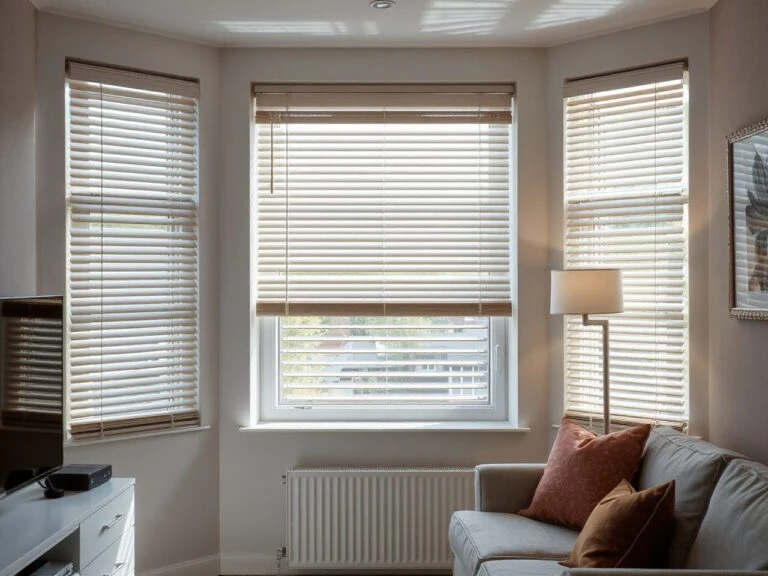

A standard blind size is not a standard window rule. Common ready-made dimensions describe what suppliers frequently stock, while the correct fit depends on the blind type, mounting position, and window shape. The important distinction is between a common ready-made dimension and a universal sizing rule: standard blind sizes describe what is commonly supplied, while the correct fit still depends on the blind type, mounting position, and window shape. A careful guide also separates the labelled blind width from the actual fabric or slat coverage and checks clearance for handles, hinges, and other frame obstructions.
That distinction matters because a blind can match a familiar width and still come off the wall badly. Every fitting should be assessed first by whether it can be removed cleanly later, without forcing hardware past a handle, trapping a chain, or leaving a headrail wedged into an imperfect recess.
Key Takeaways
- Standard sizes are common ready-made dimensions, not universal measurements for every blind or window.
- Measure the recess or frame at multiple points, then check handles, hinges, trim, depth, and operating clearance.
- The listed width may describe the finished blind or headrail rather than the full fabric or usable slat area.
What standard blind sizes actually mean
Common dimensions are product-range conventions
People usually mean ready-made widths and drops that appear repeatedly within a supplier’s range when they talk about standard blind sizes. Those dimensions are designed for common window openings, but there is no universal dimension shared by every blind type or manufacturer.
Frequent length selections include 48, 64, 72, and 84 inches. Standard window widths in the United States commonly fall within 24 to 60 inches, while ordinary ready-made combinations often include 24 x 36 inches, 36 x 60 inches, and 48 x 48 inches.
These figures are useful for narrowing the field, not for skipping measurement. A stated size may refer to the complete finished blind, the headrail, or another part of the assembly, so the label alone cannot tell you how much glass the covering will block.
Why one size does not suit every blind type
Roller blinds, Venetian blinds, vertical blinds, and Roman blinds use different construction layouts. A roller blind may have fabric that is narrower than the stated blind width because the operating hardware occupies space at the sides. Venetian blinds may list the headrail width while the slats sit within that assembly. Vertical blinds depend on the position of the track and the way the vanes move across the opening.
Roman blinds also need room for their folded fabric and operating hardware. A window may accept the width of a ready-made covering but lack the depth or clear space needed for the blind to fold, stack, roll, or tilt correctly.
Standard blind sizes describe commonly supplied products rather than a universal measurement system. That sentence is the useful answer to the basic question because it prevents a common mistake: treating a stock dimension as proof that a blind will fit a particular window.
What a size label may include
Read the manufacturer’s measurement note before comparing a label with the window. Check whether the stated width describes the headrail, the finished blind, the fabric, or the slat area. Roller blind fabric is often narrower than the finished blind because the brackets and control mechanism need space at the sides.
Slat size changes the visual coverage as well. Wood or faux wood blinds may be offered with 2-inch or 2.5-inch slats, while smaller slats such as 1-inch or 2-inch varieties leave reduced gaps between slats. The choice affects the pattern of light and the amount of visible spacing, but the label still does not replace a physical clearance check.
If you want a concise overview of construction differences before measuring, the guide to window blind types and their basic fit requirements provides useful context. The measurement method should follow the chosen blind, not the other way around.

How to choose a standard size for your window
Step 1: Decide on inside mount or outside mount
An inside mount sits within the window recess. An outside mount sits on the wall or window frame, covering the opening and some surrounding area. The two approaches use different reference points, so measuring the wrong surface can produce a blind that looks close on paper but cannot operate properly.
For an inside mount, start with the recess rather than the whole visible frame. Measure the clear opening across more than one point, then check the height at more than one point. Recesses are not always perfectly square, and a narrow point can prevent the headrail from dropping into place.
For an outside mount, inspect the full area you want the blind to cover, including the frame and the nearby wall. The blind must have a clear path for its headrail, fabric, slats, or vanes, and the wall must provide a sound place for the brackets.
Step 2: Measure multiple points
Use a steel tape measure and record each reading rather than relying on a single line across the opening. Measure the width near the top, middle, and bottom, then check the height at both sides and through the centre. A window frame that looks square can still have small changes that affect a tight inside mount.
Do not quietly round a measurement to make it match a shelf label. Compare the readings with the supplier’s fitting instructions and confirm whether the supplier makes a deduction for an inside mount. The manufacturer’s stated convention controls the final order or selection because ready-made ranges do not all describe their dimensions in the same way.
Multiple measurements reveal whether a recess is square enough for an inside-mounted blind. That check matters more than finding a familiar size on a chart because a tight headrail has no useful room to correct for a crooked opening.
Step 3: Check the obstacles before checking the range
Handles, hinges, vents, trim, and nearby walls can stop an inside-mounted blind from operating correctly. A handle may project into the path of a roller blind, while a hinge can interfere with a slat tilt or prevent a headrail from sitting flat.
Open the window as far as you normally use it and trace the movement of the blind in your mind. Check where a chain will hang, where a cord could fall, and whether the blind needs to project beyond the recess to clear a handle. A clean removal later starts with brackets mounted where they can be reached without dismantling surrounding trim.
Step 4: Compare the measurements with common stock dimensions
Once the opening and obstructions are recorded, compare the figures with the ready-made range. Common combinations such as 24 x 36 inches, 36 x 60 inches, and 48 x 48 inches can help identify a likely starting point, while frequent length selections of 48, 64, 72, and 84 inches explain why those drops appear regularly in shops.
A close match is useful only if the blind can cover the intended area and operate freely. A made-to-measure covering may be the cleaner answer for an unusually shaped window, a recess with a pronounced slope, or an opening crowded by handles and hinges. The point is not to avoid standard stock; it is to use it only where the opening and hardware agree.

Why a blind fits the width but fails the drop
Width and drop solve different problems
Width controls whether the blind can span the opening or fit inside the recess. Drop controls how far the blind reaches down when closed and how much material must be stored when raised. A width can look correct while the drop leaves exposed glass, touches a sill, or creates a folded stack that collides with a handle.
Roller blinds need room for the rolled fabric and its hardware. Roman blinds need space for their folded sections. Venetian blinds need enough clearance for the slats to tilt and lift, while vertical blinds need a clear track and a suitable area for the vanes to gather.
A blind can match the window width and still fail because its drop or operating space is unsuitable. Width is only one part of fit, and the hardware around the opening often decides whether the finished covering works.
Fabric and slat coverage can be narrower
The stated blind width may describe the headrail or the complete finished product instead of the usable coverage. This difference is especially important with roller blinds, where the fabric can sit inside side brackets and therefore cover less than the outer measurement suggests.
Slats may also sit within a headrail that extends beyond the slat field. If privacy and light control depend on covering the full glass, inspect the actual slat or fabric width in the product information rather than assuming the outer label shows the visible coverage.
Window shapes that challenge ready-made sizes
Bay windows can create several adjoining openings with different angles and recess depths. A single standard blind may fit one section but obstruct the neighbouring blind or leave an awkward gap at the corner. The guide to bay window curtains and blinds explains why each section needs its own clearance plan.
Arched, unusually shallow, deeply recessed, or uneven windows also deserve extra care. A standard size may cover the glass but fail to sit level, clear the frame, or leave enough room for the control. The shape of the opening is part of the measurement.
Mounting, safety, cleaning, and long-term upkeep
Inside mount versus outside mount
An inside mount keeps the blind within the recess and can give the window a contained appearance. It also leaves less room for error because the headrail, fabric, or slats must share the opening with handles, hinges, vents, and uneven surfaces.
An outside mount places the covering over the frame or wall and can help cover more of the surrounding opening. It requires a secure fixing surface and enough surrounding room for the blind to operate. The chosen position should also allow the brackets to be reached later if the blind needs removal or repair.
An inside-mounted blind must clear every obstruction inside the recess throughout its normal movement. That includes the window handle, not just the glass area visible when the window is closed.
Controls and child-safe planning
Cords and chains need deliberate placement because window coverings can create a strangulation hazard for children and pets. The U.S. Consumer Product Safety Commission provides consumer safety information for window coverings, and its guidance should be checked alongside the manufacturer’s fitting instructions.
Keep the control path away from places where a child or pet could become entangled. Do not treat a blind as safely installed merely because the headrail is secure; the operating chain or cord also needs a suitable position and restraint method specified for that product.
Safety claims about a particular blind should come from its instructions and the responsible safety body, not from a generic size chart. If the product information does not explain the control arrangement clearly, pause before drilling and seek the manufacturer’s instructions.
Cleaning without damaging the fit
Dust the slats, fabric, headrail, and brackets using the cleaning method permitted by the manufacturer. A soft brush attachment or dry cloth may suit some coverings, but fabric, wood, faux wood, and operating mechanisms do not all tolerate the same treatment.
Do not soak a blind unless the instructions specifically allow it. Water can affect fabric, finishes, cords, and mechanisms, while aggressive rubbing can distort a fabric edge or move slats out of alignment. Cleaning should also include a visual check for loose brackets, a strained chain, or a headrail that has shifted from level.
Standard-size blinds do not automatically have lower long-term maintenance costs than made-to-measure blinds. Maintenance depends on the material, control system, access, cleaning method, and ease of replacing or removing the covering. A stock blind that is difficult to remove can be less convenient to maintain than a correctly fitted custom blind.
For a broader explanation of common fitting errors, see different types of window blinds and the mistakes to avoid. The useful test is practical: can the blind be dusted, checked, and removed without forcing its brackets or damaging the surrounding wall?
When a standard size is the wrong choice
Choose a made-to-measure route when the recess changes noticeably from one point to another, when the opening has unusual angles, or when handles and hinges leave no clean operating path. The same applies when the available stock dimensions would require a large visible gap or leave fabric and slats short of the intended coverage.
A ready-made size remains sensible when the opening corresponds closely with the product range and the mounting area is clear. The decision should follow the measurements and the hardware inspection, not the name printed on the package.
Frequently Asked Questions
What do people mean by standard blind sizes?
Standard blind sizes are commonly supplied ready-made dimensions within a particular product range. Frequent length selections include 48, 64, 72, and 84 inches, while common ready-made combinations include 24 x 36 inches, 36 x 60 inches, and 48 x 48 inches. These dimensions are useful reference points, but they are not universal rules shared by every blind type or manufacturer.
Are standard sizes the same for every type of blind?
No. Roller, Venetian, vertical, and Roman blinds use different headrails, fabrics, slats, tracks, and operating clearances. The labelled width may describe the complete finished blind or headrail rather than the usable fabric or slat area. Always check the product’s measurement definition and compare it with the mounting position, recess shape, and surrounding hardware.
Should I measure the window recess or the full window frame?
Measure the recess for an inside mount and the intended coverage area around the frame for an outside mount. Check the width and height at multiple points because a recess or frame may not be perfectly square. Record handles, hinges, vents, trim, and nearby walls as part of the measurement process because those features can stop the blind from operating.
Why can a blind fit the width but not the drop?
Width and drop control different parts of the installation. A matching width may still leave the fabric short, cause the blind to meet a sill, or fail to leave room for a rolled or folded stack. Roller, Roman, Venetian, and vertical blinds each store or move differently, so the drop and operating path must be checked separately from the span across the window.
How should standard-size blinds be cleaned and maintained?
Follow the manufacturer’s cleaning instructions for the particular fabric, slats, headrail, and control system. Use only an approved dry or damp method, and avoid soaking or aggressive rubbing unless the instructions permit it. During cleaning, check that brackets remain secure, the headrail is level, and cords or chains are positioned safely away from children and pets. A stock size does not guarantee lower maintenance costs than a made-to-measure blind.