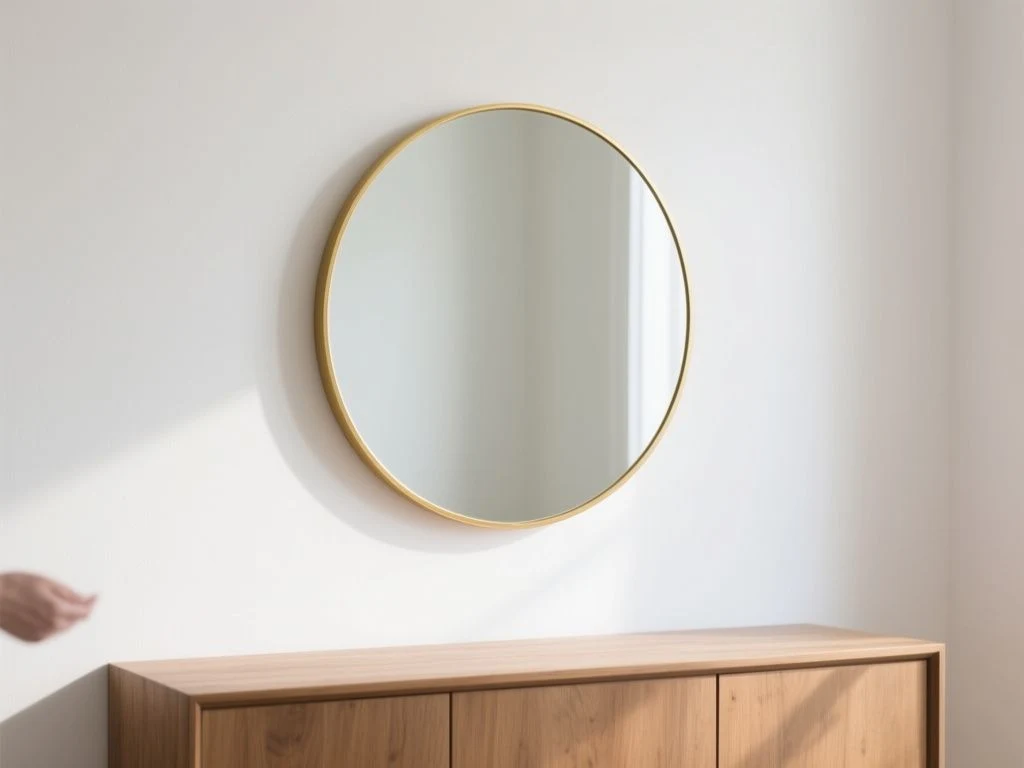
A quarter-inch wall mirror weighs roughly 3 pounds per square foot, since glass runs about 156 pounds per cubic foot. That means a 24-by-36-inch mirror pushes close to 18 pounds, and a 36-by-60-inch statement piece is closer to 45. The wall you hang it on needs to know that number before you do. This wall mirror buying guide starts with that weight, not frame shapes or trending finishes, because the mirror’s only job is to stay on the wall while reflecting the room.
Key Takeaways
- Weight decides everything: a quarter-inch mirror runs about 3 lbs per square foot, and drywall anchors alone fail fast on anything over 6 square feet.
- Unsealed silver backing is the single most common reason a mirror develops black edges and dark spots within a few years.
- Large mirrors over 6 square feet often require tempered or laminated glass to meet building codes, not just a sturdier hanger.
Wall Mirror Buying Guide: Start With the Wall, Not the Frame
Most people begin by picking a shape they like. That is backwards. The wall’s structure, the doorway clearance, and the room’s proportions dictate what mirror you can actually install. A small-space realist measures the doorway before admiring the sofa, and the same principle applies to a mirror that has to be carried in, lifted, and hung.
Measure the Wall and the Doorway First
You need three numbers before you open a catalog. The wall’s width, the wall’s height, and the narrowest doorway the mirror must pass through to reach that wall. A mirror wider than your hallway door is a delivery problem, not a style statement. Most interior doors are 30 to 32 inches wide, so a 36-inch-wide mirror will not fit through without angling, and angling glass through a tight frame is exactly how corners chip.
Write the measurements down. Then subtract 4 inches from the wall width for breathing room on each side. That gives you the maximum mirror width that will not crowd the wall. For height, measure from the floor to the ceiling and decide where the mirror’s center line should sit—eye level for most adults is 57 to 62 inches off the floor, but that shifts in a bathroom when a vanity is involved.
Correct Mirror Size for the Room
A mirror should sit between 25 and 31 inches on each side to blend into a room without dominating it. That rule works for entryways, hallways, and bedrooms. Over a bathroom vanity, the mirror should be 2 to 6 inches narrower than the sink or vanity top. So a standard 24-inch vanity takes a mirror between 18 and 22 inches wide. The standard wall mirror sold in most stores is 24 by 34 inches, which fits a wide range of walls but looks lost over a double vanity.
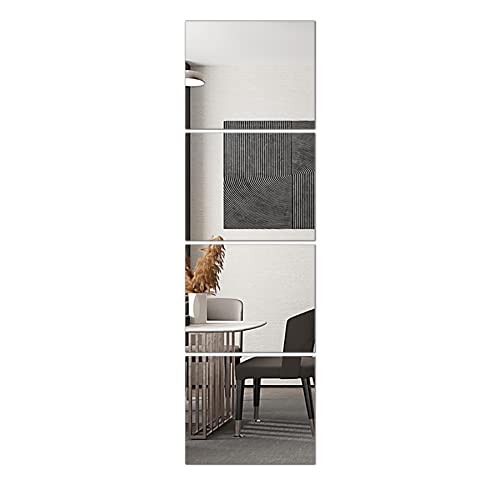
For a dressing table or console, typical dimensions run from 28 by 14 inches up to 33.5 by 37.5 inches. A walk-in closet mirror is commonly 18 by 36 inches, narrow enough to mount on a door but tall enough to check a full outfit. Shower wall mirrors, if you want one, usually come in 12 by 24 inches and need special mounting adhesive rated for wet, warm conditions.
If you are comparing framed and frameless options for a bathroom, our bathroom mirror buying guide covers the moisture-specific mistakes that a general guide skips.
Frame or Frameless: What Actually Matters
A frameless mirror has polished or beveled edges and mounts directly to the wall with clips, mastic, or a French cleat. It looks clean and modern, but the edge is exposed, so any chip is visible. A framed mirror wraps the glass in wood, metal, or resin, which protects the edge and adds visual weight. For a small room, a frameless mirror reads lighter and makes the space feel larger, which is why a small-space realist leans that way. For a traditional or high-traffic area, a frame earns its cost by hiding edge flaws and making the mirror safer to handle.
Frame material matters less than the backing it covers. A cheap frame over an unsealed mirror edge does nothing to stop tarnishing. Check the back of any framed mirror: the silver coating should be fully covered by paint or foil, not just at the corners.
Glass, Backing, and the Edge You Can Actually See
The reflective surface is not one material. It is a sandwich: a layer of float glass, a microscopically thin coat of silver or aluminum, and a protective seal coat, usually copper sulfate followed by paint. Every decision you make about thickness, backing metal, and edge treatment changes how long the mirror stays clear and how true the reflection looks.
Float Glass, Thickness, and Optical Distortion
Almost all wall mirrors use float glass, which is made by floating molten glass on a bed of tin to create a perfectly flat sheet. That flatness is what gives you an undistorted reflection. Quarter-inch-thick glass is the minimum you want for a wall mirror that will not appear wavy or curved when you look at it head-on. A minimum thickness of three-eighths of an inch is recommended for quality mirrors, especially in sizes over 24 by 36 inches, because thinner glass flexes slightly and that flex shows up as a funhouse reflection at the edges.
If you see a distorted image, the glass is either too thin, badly installed with uneven pressure, or not actually float glass. Tempered glass is heat-treated and can have a slight roller wave pattern, but it is far safer for large panels. Laminated glass, two sheets bonded with a plastic interlayer, holds together if broken and is often required for mirrors over a certain size in commercial spaces.
Silver vs Aluminum Backing and Why the Seal Coat Matters
A silvered mirror uses silver nitrate deposited on the glass, then sealed with copper sulfate and paint. Silver gives the brightest, truest reflection but tarnishes to black if moisture or cleaning chemicals reach the backing through an unsealed edge. Dark spots or black edges on an older mirror are almost always silver tarnish, not dirt. An aluminum-backed mirror uses a vaporized aluminum layer instead. Aluminum is cheaper, slightly less reflective, and does not tarnish the same way, but it can corrode to a dull gray if the seal fails.
The difference is mostly about longevity and brightness. For a bathroom, a well-sealed silver mirror outperforms aluminum over a decade. For a dry hallway, aluminum is perfectly fine and costs less. Always look for a mirror whose backing paint wraps around the edges or whose frame fully covers the glass perimeter. An exposed silver edge is a countdown to black spots.
Beveled Edge vs Polished Flat Edge
A beveled edge is ground at an angle, usually 1 to 1.5 inches wide, creating a decorative frame effect inside the glass itself. A polished flat edge is cut straight, then smoothed, and it is the standard for frameless mirrors. Beveling adds cost and a touch of formality, but the bevel also reflects light at a different angle, which can create subtle double lines around the mirror’s perimeter. If you want a clean, modern look, a flat polished edge is the better choice. If you want a traditional or transitional feel, a bevel works.
The bevel does not make the mirror safer. It is purely optical. A polished flat edge is just as resistant to chipping if the glass is thick enough and the mounting hardware does not pinch the corners.
Hanging Hardware, Safety Glazing, and the Stud Problem
This is where most mirrors fail, literally. The glass itself is rarely the weak point. The weak point is the wall anchor, the adhesive, or the person who assumed a 30-pound mirror would hang like a 2-pound picture frame.
D-Rings, Mastic, and Standoff Mounts: When to Use Each
D-rings are metal loops screwed into the mirror’s back frame or into a wooden cleat attached to the glass. They work with picture wire or direct screws, but picture wire is a bad idea for anything over 10 pounds because the wire can cut into the frame and creates a single stress point. For heavier mirrors, use two D-rings mounted on the sides and hang them directly on screw heads or wall hooks. That spreads the load.
Mirror mastic is a heavy-duty adhesive used for frameless mirrors that are glued directly to the wall. It creates a permanent bond and works on drywall, plaster, tile, and painted surfaces, but it is unforgiving: once set, you cannot adjust the mirror without breaking it. For large mirrors, mastic alone is not enough. Combine mastic with a mechanical support like a J-channel or bottom clips.
Standoff mounts are decorative bolts that hold the mirror slightly off the wall, creating a floating effect. They look sharp in modern spaces but require drilling into the wall and into the glass, so they only work with tempered or laminated mirrors that can withstand the hole positions. Never drill into annealed float glass; it will shatter.
ANSI Z97.1 and Building Codes for Large Mirrors
In the United States, safety glazing for architectural glass is governed by standards like ANSI Z97.1 and the Consumer Product Safety Commission’s rules, which you can review at cpsc.gov. The practical takeaway: many building codes require tempered or laminated glass for any glazed panel larger than 9 square feet located within 18 inches of a walking surface or in a hazardous location like a bathroom door. Mirrors over 6 square feet are often treated the same way in residential installations when mounted near a bathtub, shower, or where a falling person might strike the glass.
So if you are buying a 48-by-60-inch mirror, you likely need tempered glass. Tempered glass shatters into small rounded pieces instead of sharp shards, which is why it is mandated. Laminated glass cracks but stays in one piece, also safe. Standard annealed float glass is fine for small mirrors in low-risk spots, but it is the wrong choice for a full-length bedroom mirror near a doorway.
Mounting Over a Fireplace or Behind a Sink
A mirror over a fireplace is a classic move, but heat rising from the firebox will accelerate tarnishing on a silver-backed mirror and can weaken adhesive. Keep at least 12 inches of clearance between the top of the firebox opening and the bottom of the mirror, and use a metal frame or a tempered glass mirror rated for heat exposure. Behind a sink, the biggest risk is splashing water and cleaning chemicals running down the wall and pooling at the mirror’s base. Use a mirror with a fully sealed back and a small gap between the mirror bottom and the countertop to allow airflow. If you are also considering integrated lighting, our lighted bathroom mirror buying guide walks through the electrical requirements and common mistakes to avoid.
Cleaning, Maintenance, and Removing an Old Mirror
A wall mirror should last 20 to 30 years if the backing is sealed and the mounting hardware stays tight. The two things that kill a mirror early are ammonia and moisture. Cleaning with an ammonia-based glass cleaner attacks the copper sulfate seal coat and the silver layer underneath, leading to black edges within a few years. Always choose a non-ammonia glass cleaner, or simply use warm water with a drop of dish soap and a microfiber cloth.
Streak-Free Cleaning Without Damaging the Backing
Spray the cloth, not the mirror. Excess cleaner running down the glass is exactly what seeps behind the frame and reaches the backing. Wipe in an S-pattern, not circles, and finish with a dry microfiber cloth. Never use paper towels, which leave lint and can scratch the glass over time. Avoid vinegar as a regular cleaner; its acidity is mild but repeated exposure will dull the silver over years.
For hard water spots on a bathroom mirror, a paste of baking soda and water works, but rinse it off completely and dry the edges with a hairdryer on low if the mirror is framed. Standing water at the frame joint is the enemy.
How to Remove an Old Mirror Without Breaking It
If the mirror was glued with mastic, you cannot simply pry it off. The glass will flex and shatter. The safest method is to protect the floor with a drop cloth, tape the mirror in a grid pattern with duct tape to hold the pieces together if it does break, and then cut through the mastic using a long thin blade like a putty knife or a piano wire saw. Work slowly from the top down. If the mirror is clipped or hung with D-rings, remove the hardware first and lift the mirror straight up and out.
Once the wall is bare, you will likely find glue residue and damaged paint. Scrape off the glue, patch any gouges, and repaint before installing a new mirror. A slightly textured wall or a paint color with a satin sheen can hide minor imperfections that a flat finish would show.
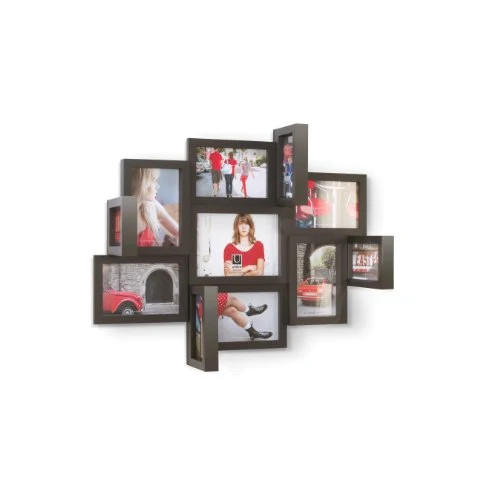
Adjacent decisions like wall sconce placement, paint color, and the height of door and cabinet hardware all affect how a mirror integrates. If you are replacing wall art at the same time, our Umbra wall art review has practical guidance on hanging heavy decorative pieces without damaging the wall.
Frequently Asked Questions
How big should the mirror be for my wall?
For a general wall, aim for 25 to 31 inches on each side so the mirror reads as intentional without overwhelming the space. Over a vanity, keep the mirror 2 to 6 inches narrower than the sink or vanity top. A standard 24-by-34-inch mirror works in most hallways, while a 36-by-60-inch mirror is a statement piece that needs a stud-mounted installation.
What is the difference between a beveled edge and a polished flat edge?
A beveled edge is ground at an angle, usually 1 to 1.5 inches wide, creating a frame effect inside the glass and adding a traditional look. A polished flat edge is cut straight and smoothed, giving a clean modern silhouette. The bevel reflects light differently, which can create subtle double lines, but neither edge affects safety or durability more than the other.
Why does my mirror have dark spots or black edges?
Dark spots or black edges are tarnishing of the silver backing, not dirt on the glass surface. It happens when moisture or cleaning chemicals reach the silver layer through an unsealed edge or a failed protective paint coat. Once tarnish starts, it cannot be cleaned off; the only fix is re-silvering the glass or replacing the mirror. Preventing it is simple: buy a mirror with a fully sealed back and use non-ammonia cleaner.
Can I hang a heavy mirror on drywall without hitting a stud?
A mirror over 6 square feet should be anchored to a stud or use a French cleat that spans two studs. Drywall anchors, even heavy-duty ones rated for 30 pounds, can pull out over time, especially if the mirror is bumped. If no stud is available, use a metal wall channel that distributes weight across a larger area, and never rely on adhesive alone for anything over 10 pounds.
What should I look for in a wall mirror buying guide to avoid early damage?
A useful wall mirror buying guide will tell you to check three things: the glass thickness (quarter-inch minimum, three-eighths recommended), the backing seal (paint or foil must cover all silver edges), and the mounting hardware (mechanical fasteners for heavy mirrors, non-ammonia cleaner for maintenance). Any guide that skips these and focuses only on frame style is setting you up for a mirror that tarnishes or falls.