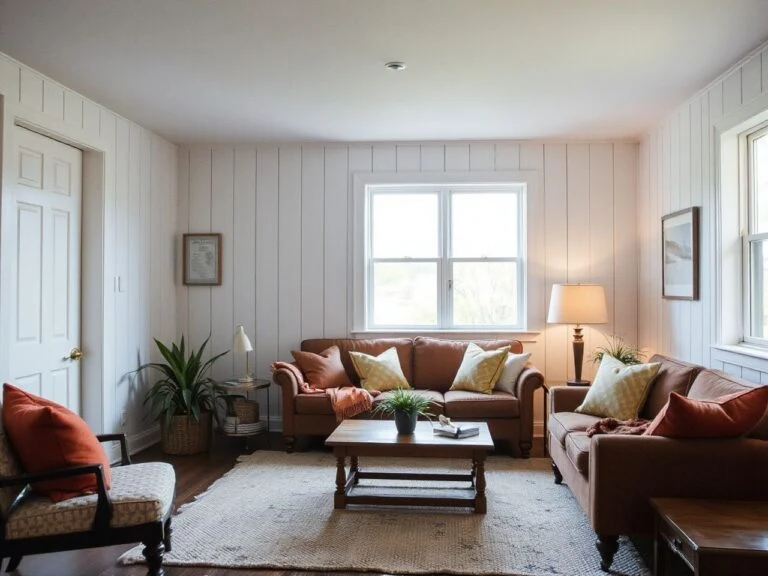
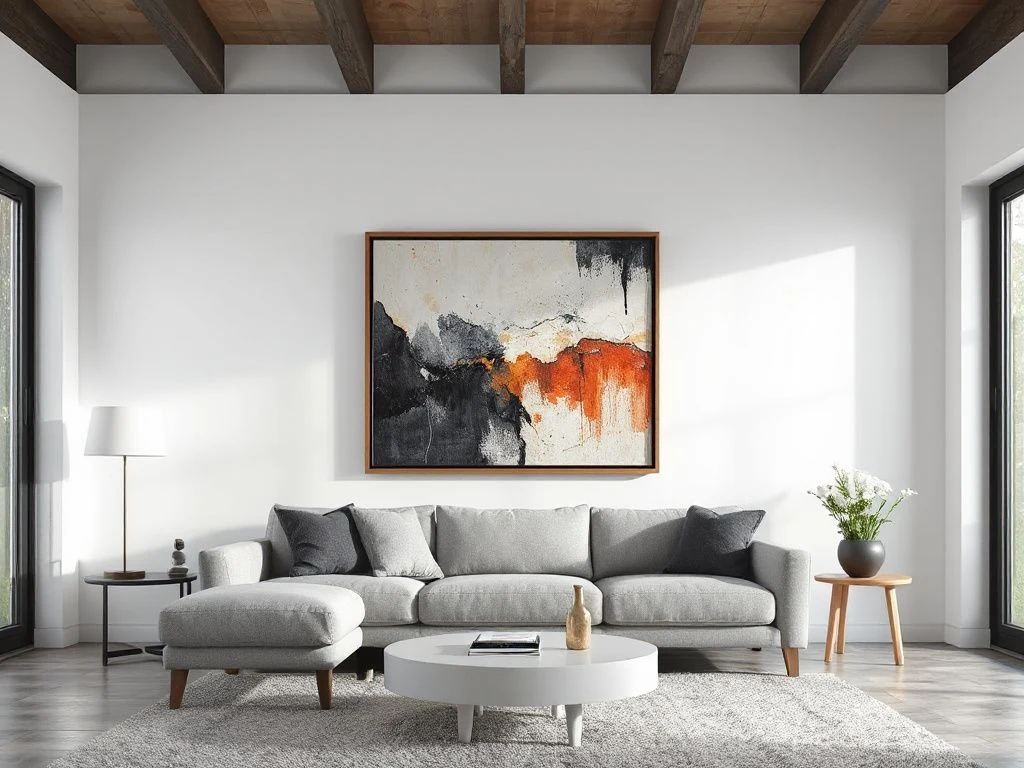
Most art above sofas hangs too high. The error comes from measuring the wall instead of the sofa, and the result is a piece that floats disconnected from the furniture below. If you are trying to work out how high you should hang art above a sofa, the correct approach treats the sofa back as a reference point, not the floor.
Key Takeaways
- The bottom of the frame should sit 6 to 8 inches above the top of the sofa back for a connected, intentional look.
- The art’s vertical center should land between 57 and 60 inches from the floor for average standing eye level, but adjust slightly when seated viewing is primary.
- The art’s width should be roughly two-thirds to three-quarters of the sofa’s width; wider pieces overwhelm, narrower ones look lost.
The 6-8 Inch Rule Is a Starting Point, Not a Law
Every design guide repeats the same number: hang art 6 to 8 inches above the sofa back. That range exists for a reason. When the gap falls below six inches, the sofa’s cushions and the frame’s lower edge start to merge visually, especially if the piece has a dark bottom third. When the gap climbs above eight inches, the art begins to feel like it belongs to the wall rather than to the seating area, and the room loses its anchor.
The actual distance you choose within that band depends on two measurements that change from room to room. First, measure the height of the sofa back from the floor to its top edge. A low-profile mid-century sofa might top out at 28 inches. A tall-backed sectional can reach 36 inches or more. That difference shifts where the art’s center ends up even if you keep the same six-inch gap.
Second, check the standing eye level for the people who use the room most. The commonly cited range for average eye level is 57 to 60 inches from the floor. The center of the art, not its top or bottom, should sit near that height in a living room where guests stand and walk around. A piece with its center at 57 inches above a low sofa back will have a larger gap than a piece centered at 60 inches above a tall back.
The distinction that matters: hanging height is not determined by standing eye level alone, but by the interaction between the sofa back height and the art’s center. The bottom of the frame should sit 6 to 8 inches above the back of the sofa, and then the art’s center should be visually checked against the viewer’s eye level when seated and standing. Beginners often overcorrect by hanging art too high because they measure from the floor, or they hang it too low because they ignore the sofa’s visual weight.

Measuring and Marking Without Second-Guessing
You need three tools: a tape measure, a pencil, and a level. A laser level helps if you are hanging multiple pieces in a row, but a standard bubble level works for a single frame.
Step 1: Find the Sofa’s Back Reference Point
Don’t measure from the floor. Measure from the top edge of the sofa back to the point where you want the bottom of the frame to land. Mark that height on the wall with a light pencil line, using a level to keep it straight. This line becomes your datum, and every other decision builds from it.
Step 2: Locate the Art’s Hanging Hardware
Flip the frame over and measure the distance from the top of the frame to the point where the hanging wire or D-ring will catch the hook. That measurement is your offset. Subtract the offset from the top-of-frame height to get the exact hook placement on the wall.
For example, if the sofa back is 32 inches high and you want a 7-inch gap, the frame bottom sits at 39 inches from the floor. If the frame is 24 inches tall, the top is at 63 inches. If the hanging wire, when taut, sits 3 inches below the top of the frame, the hook goes at 60 inches from the floor.
Step 3: Mark the Hooks, Not the Frame
Many people mark the corners of the frame on the wall and then try to line up the edges. That works poorly because frames are not perfectly square and walls are never perfectly vertical. Mark the hook positions instead. For a single wire, mark the center point. For two D-rings, measure the distance between them and mark two points at the same height, using a level to confirm.
Choosing the Right Art Width for Your Sofa
Height is half the story. Width controls whether the art feels like it belongs to the sofa or was borrowed from another room. The accepted proportion is that the art’s total width, including the frame, should equal roughly two-thirds to three-quarters of the sofa’s width.
For a standard 84-inch three-seat sofa, that means a piece between 56 and 63 inches wide. A 72-inch loveseat calls for art between 48 and 54 inches wide. Measure the sofa’s full width, not just the seating area between the arms.
If your art is narrower than two-thirds of the sofa, it will look like a postage stamp on an envelope, and the empty wall on either side will pull the eye away from the piece. If it is wider than three-quarters, the sofa appears smaller than it is, and the room can feel top-heavy. In a small living room, this proportion matters even more because there is no extra wall space to absorb the mismatch.
For a sofa against a long wall with no side tables, you can push the art up to 80 percent of the sofa width, especially if the piece has a thin frame and a busy composition that benefits from scale. But that is the upper limit, and only works when the wall itself is tall and wide enough to give the art breathing room above.
Hardware That Holds Without Damaging the Wall
The wrong hook is the fastest way to see your art tilted, fallen, or torn out of the drywall. Weight determines the hardware, and the wall material determines the fastener.
Light Pieces Under 10 Pounds
A single OOK picture hanger rated for the piece’s weight works on drywall and plaster if it has a small nail angled into the wall. For rental walls where you cannot make holes, adhesive strips rated for the piece’s weight and size are the standard alternative. The Command wall art options reviewed here break down the weight limits and wall-type compatibility for adhesive hanging, which matters more than the package claims suggest.
Medium Pieces 10 to 20 Pounds
Use two D-ring hangers screwed into the frame’s vertical sides, spaced at one-third and two-thirds of the frame width. Run picture wire between them, with enough slack that the wire forms a shallow V when lifted from the center. Hang the wire on two hooks set into the wall. Two hooks distribute the load and stop the frame from tilting sideways when someone brushes against it.
Heavy Pieces Over 20 Pounds
Skip the wire and hang the D-rings directly on two wall anchors or toggle bolts. Each anchor must be rated for at least half the piece’s weight, because the load splits between two points only if the frame is perfectly level and the hooks are at identical heights. If the frame dips on one side, that anchor carries more than its share. The U.S. Consumer Product Safety Commission maintains guidance on wall anchor installation and weight limits at cpsc.gov, and the key point is that a toggle bolt rated for 50 pounds in drywall is not rated for 50 pounds in plaster or hollow-core board.
Drywall vs. Plaster Walls
Drywall holds screws and anchors predictably, with hollow cavities behind the surface. Plaster over lath is harder and more brittle, and a nail driven straight in can crack the surface. For plaster, drill a pilot hole with a masonry bit and use a plastic anchor or a molly bolt that expands behind the lath. Never use adhesive strips on textured or painted plaster, because the bond fails at the paint layer, not the strip.
Use a stud finder to locate a stud behind the wall whenever possible. Screwing a D-ring directly into a stud eliminates the need for an anchor entirely and gives you the most secure hanging point in any room. For a 30-pound mirror above a sofa, a stud is the only hardware choice to trust.
Common Mistakes That Make Art Look Wrong Above a Sofa
The mistakes are predictable because they all come from measuring the wrong thing or using the wrong tool. Here are the four that appear most often, and how to correct each one.
Hanging Too High
The classic error. The bottom of the frame ends up 14 inches above the sofa back because the owner measured to the top of the frame at eye level. The fix is simple: mark the bottom of the frame first, using the sofa back as the reference, then work upward to find the hook position. If you already hung it too high, lower it until the gap falls between 6 and 8 inches, and the art will suddenly feel anchored to the sofa.
Ignoring the Sofa’s Visual Weight
A bulky, overstuffed sofa with high rolled arms has more visual mass than a slim, low-back bench. The art above a heavy sofa should sit slightly lower within the 6-8 inch band, closer to 6 inches, to visually connect with the furniture. Above a delicate sofa with a thin back, 8 inches looks better because the art has less mass to counteract.
Forgetting to Account for Cushions and Throw Pillows
The sofa back is taller when fully fluffed. If you measure the gap when the cushions are compressed, the art will sit too high once someone sits down and the cushions puff up. Take the measurement with the cushions in their normal, used position, not their showroom pose. A 7-inch gap over flattened cushions becomes a 4-inch gap over a day’s worth of sitting.
Not Leveling the Frame After Hanging
Even with two hooks, the frame can sit slightly crooked because the wall is not perfectly vertical or the wire has uneven tension. After hanging, place a bubble level on the top edge of the frame and adjust one hook up or down by a fraction of an inch until the bubble centers. Then step back and check from the sofa’s seating position, because a frame that looks level from standing may look tilted from a lower angle.
Adjusting for Tall Sofa Backs, Kids, and Rental Spaces
The 6-8 inch rule assumes a standard sofa back height between 28 and 34 inches. Tall backs change the math, and so do small hands and lease agreements.
Tall-Back Sofas
If your sofa back measures more than 36 inches from the floor, the art’s center will sit higher than 60 inches if you keep a 7-inch gap. That is fine if the room is only used for seated conversation, because the seated eye level is lower. But if guests stand and walk around, the art will look slightly high. In that case, reduce the gap to 5 inches, but never less than 4, or the cushion tops will crowd the frame. The taller the back, the tighter the gap needs to be to keep the art visually attached.
Homes with Kids or Pets
A sofa is a launchpad. Kids climb on it, and a low-hung frame becomes a scratching post for a dog or a head-bump zone for a toddler. The practical fix is to hang the art at the upper end of the band, 7 to 8 inches above the back, and to use a frame with rounded corners rather than sharp metal edges. A wide Museum Putty strip on the bottom corners keeps the frame from swinging outward if it gets bumped, which is a simple addition that prevents most tilting.
Rental-Friendly Options
If you cannot put holes in the wall, a gallery wall rail system gives you adjustable hooks that hang from a ceiling-mounted track, but that requires drilling into the ceiling, which most leases also prohibit. The better option is to use adhesive strips rated for the art’s full weight and the wall’s finish, accepting that you will repaint a small area when you move. The Command wall art review we published compares the real-world limits of adhesive strips on different wall textures, which is the information most package labels skip.
Hanging Multiple Pieces Above a Sofa
A cluster of three or five small frames follows a different rule. The center of the entire cluster should sit at the same height as a single piece—between 57 and 60 inches from the floor—and the bottom of the lowest frame should still respect the 6-8 inch gap above the sofa back.
The spacing between pieces in a cluster should be consistent, typically 2 to 3 inches for small frames and up to 4 inches for larger ones. Measure the total width of the cluster at the end, not piece by piece, and ensure the combined width fits the two-thirds to three-quarters proportion of the sofa. A well-planned gallery wall above a sofa can replace one large piece, but the same height rules apply: treat the group as a single unit.
To plan a cluster without committing, trace each frame’s outline onto kraft paper, cut out the shapes, and tape them to the wall with the 6-8 inch gap from the sofa back. Rearrange the paper templates until the group looks balanced, then mark the hook positions through the paper with a pencil. This method costs nothing and saves you from filling a dozen misplaced nail holes.
Frequently Asked Questions
Should the center of the artwork be at eye level even when it’s above a sofa?
Yes, but ‘eye level’ means two different heights. When standing, the average eye level is 57 to 60 inches from the floor. When seated on a sofa, the eye level drops to around 42 to 48 inches. The art’s center should sit near the standing eye level for a room used by both standers and sitters. If the sofa is the primary seating and the room is small, you can lower the center to 55 inches so the art reads correctly from the couch, but never drop the bottom gap below 6 inches.
How do I make sure the art is perfectly centered over the sofa?
Find the sofa’s center point by measuring the full width and dividing by two. Mark that point on the wall above the sofa back, then mark the center of the art frame. The art’s center should align with the sofa’s center, not with the wall’s center. In a room where the sofa is offset from the wall’s center, hanging art at the wall’s center will make the seating area look lopsided. Use a laser level to transfer the sofa’s center line up the wall, then work outward from that line to place your hooks.
What’s the safest way to hang heavy art without damaging the wall?
For anything over 20 pounds, secure into a wall stud with a screw through a D-ring. If no stud is available, use toggle bolts rated for at least twice the art’s weight, because the load is dynamic when the art swings or gets bumped. Never use a single picture hook for a piece wider than 24 inches, because the frame’s leverage pulls the hook downward and outward at the same time. Two hanging points with a taut wire or two direct D-rings eliminate the tilt and reduce the chance of the frame falling.
Is there a rule for the gap between multiple pieces when hanging a cluster above a sofa?
Yes: 2 to 3 inches between small frames (under 12 by 16 inches) and 3 to 4 inches between larger frames. Consistency matters more than the exact number; if you choose a 2-inch gap, use 2 inches between every piece in the cluster. The bottom of the lowest frame should still sit 6 to 8 inches above the sofa back, and the center of the entire cluster should align with the sofa’s center. Spacing wider than 4 inches makes the group read as separate pieces rather than a single composition.
Measure the doorway before you admire the sofa: that caution applies to art as much as furniture. In a small living room, hanging a piece too high eats the only vertical space you have and makes the ceiling feel lower. Get the 6-8 inch gap right, keep the width proportional, and use hardware rated for more than the frame weighs, and the wall above your sofa becomes the room’s focal point instead of its afterthought.