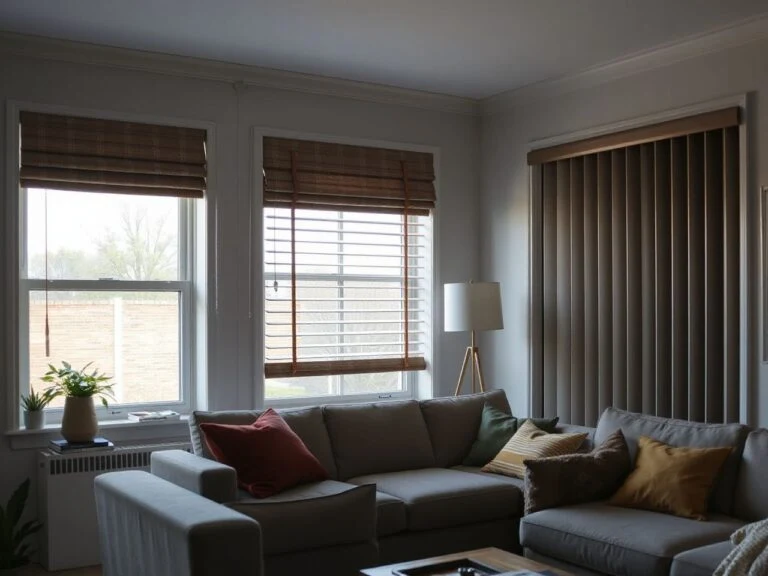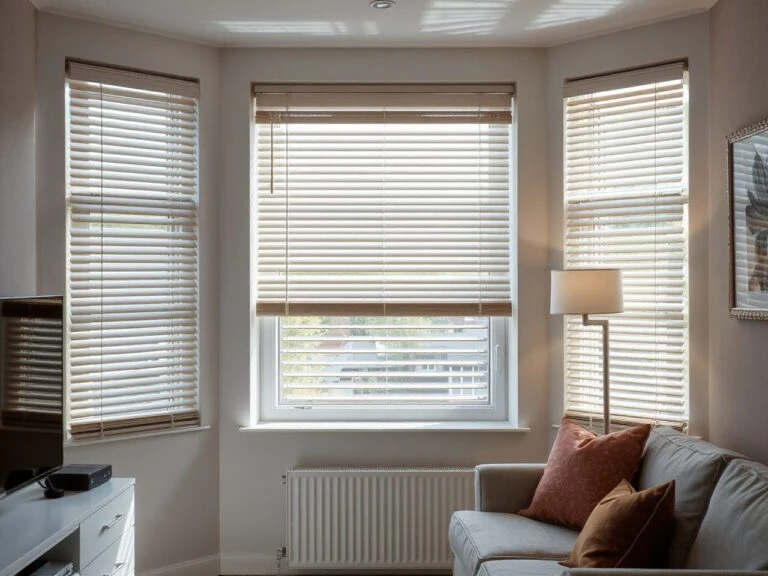

Bay window corners commonly use angles of 150, 135, or 90 degrees, so a treatment that looks simple from across the room may involve several different mounting decisions. The key distinction is between treating the bay as a coordinated group of separate windows and forcing a single covering to follow an awkward shape; the best approach depends on movement, access, privacy, and how the corners are used. A sound guide should assess the window reveal, opening direction, handles, sill, radiator, and mounting surface before discussing fabric or blind style, because those practical constraints determine whether the treatment will operate properly.
That is the practical starting point for bay window curtains and blinds. Check the doorway width before admiring the sofa, and apply the same discipline to the window: measure the route, the obstructions, and the hardware before choosing the finish. A useful curtain and blind comparison for different rooms can help with broad style questions, but a bay window needs its own layout plan.
Key Takeaways
- Measure each pane, reveal, angle, handle, sill, and mounting surface separately.
- Use separate blinds or shades when access and movement matter; use a coordinated track or pole when the corners can support it.
- Plan privacy, daylight, ventilation, moisture, controls, and child or pet safety before selecting fabric or finish.
Beginner: Read the bay before choosing bay window curtains and blinds
Start with the window reveal and mounting surface
A bay window is a group of windows set at changing angles, not automatically one wide opening. Each section may have a different reveal depth, sill position, frame width, and fixing surface, so one overall width cannot replace separate measurements.
Begin by recording the inside width and height of every section. Note where the reveal begins and ends, then mark the angle between adjoining sections. The common inside-corner angles are 150, 135, and 90 degrees, but the visible shape of the bay should decide the measurement rather than an assumption about its design.
Each bay window section requires its own measurements because panes, reveals, and angles are rarely identical. That sentence should guide the whole project.
- Measure the clear area available for the blind, shade, or curtain hardware.
- Record the position of handles and the direction in which each casement opens.
- Check whether the sill projects far enough to interfere with a blind or curtain.
- Look above and beside the window for a secure mounting surface.
- Mark any radiator, furniture, trim, or wall return that could limit movement.
Check opening direction and projecting handles
An inward-opening casement needs room to move. A blind mounted inside the reveal can collide with the handle, while a curtain hanging in front of the opening can restrict access or bunch against the frame. A handle that projects farther than the reveal is especially important because the fabric or slats must clear it during operation.
Open each window as far as the room allows and observe the path. The reader can check this without specialist equipment: if the handle touches the reveal, treatment, or proposed bracket position, the layout needs changing.
Opening casements and projecting handles can obstruct blinds, curtain movement, and mounting brackets. A treatment that looks neat while closed may become difficult to use once the window opens.
Account for the sill and radiator
A deep sill may support a small object, but it can also prevent a blind from sitting close to the glass. A radiator below the bay creates another planning issue. Long curtains may rest against it, while a shade or blind may leave a gap that affects privacy or daylight control.
Do not choose the drop by appearance alone. Decide whether the treatment should finish at the sill, below the sill, or beyond the lower trim, then check how that position interacts with heat, airflow, furniture, and access to the window.
Intermediate: Choose a coordinated treatment or separate coverings
When separate blinds or shades make more sense
Separate coverings suit bays where the window sections open independently or where each pane has a different angle and reveal. Roller blinds, Venetian blinds, Roman shades, and cellular shades can be fitted as individual units, allowing the room to control one section without moving the others.
This approach can preserve access to an opening casement and reduce the need for a track or pole to turn through tight corners. It also makes measuring clearer because every unit follows one pane rather than a compound shape.
Separate window coverings allow each pane to operate according to its own handle, reveal, and privacy need. That arrangement is often easier to live with than a single covering that must move across every corner.
- Choose separate units where windows open at different times.
- Use individual privacy control where one pane faces a walkway and another faces a private garden.
- Consider a Roman shade when a softer, structured appearance suits the room.
- Consider roller blinds where a simple vertical drop avoids corner movement.
- Consider Venetian blinds where adjustable slats help balance privacy and daylight.
When a single curtain treatment works
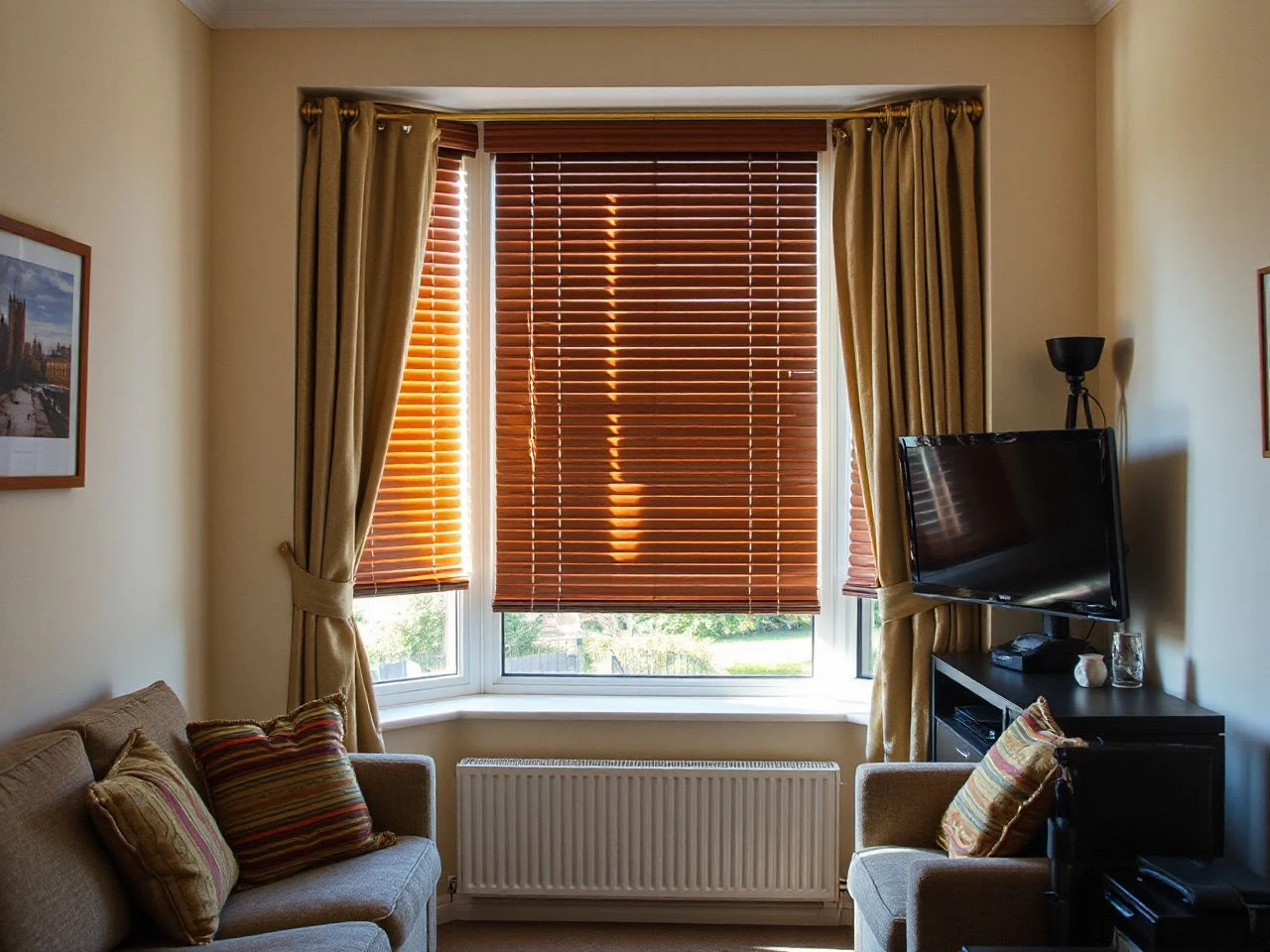
A continuous curtain can make the bay read as one architectural feature, but the hardware must turn the corners without binding. A curtain track or bay window curtain pole needs suitable corner solutions and secure support. The fabric must also clear the wall returns, handles, sill, and any furniture placed near the bay.
Use a single treatment only after checking that the curtains can draw fully away from the glass, stack without blocking access, and travel around each corner. A ceiling-mounted track may help where the wall above the window is narrow, while a wall-mounted pole may suit a bay with a consistent fixing surface. The decision belongs to the structure, not a preferred look.
A curtain track that lacks suitable corner support can bind, pull away from the wall, or leave the curtain uneven. The mounting surface must be strong enough for the hardware and the movement required.
Combine curtains with separate blinds
Layering can provide flexible daylight and privacy control. Separate blinds or shades handle pane-by-pane operation, while curtains soften the wider opening and help frame the bay when closed. This arrangement requires careful depth planning because the blind, curtain, bracket, and handle all occupy nearby space.
Blackout lining may suit a bedroom or media space, but lining changes how the curtain hangs and how much room the fabric needs at the sides. Factors such as cleanability, oil and dust retention, ultraviolet light deterioration, noise absorption, and fire resistance also affect curtain selection. These factors should be weighed against the room’s use rather than treated as decorative details.
A guide to different blind types and common fitting mistakes can help clarify the differences between blind mechanisms, but the bay layout still determines whether a particular style will clear the handles and corners.
Balance privacy and daylight
Privacy does not always require a fully closed treatment. A blind or shade can cover the section that faces outside attention while the side sections remain open. Adjustable Venetian slats can change the view and light direction, while a roller blind or Roman shade can be positioned at the level that blocks sight lines without covering the entire pane.
Consider the room from outside as well as inside. Check the sight line while standing at the usual seating height and while moving around the room. A treatment that protects privacy at night may need a different position during daylight.
Advanced: Measure corners, plan hardware, and solve movement problems
Measure each angle and recess systematically
Use a steel tape, pencil, paper, and a straightedge. A phone photograph can also record where handles, trim, radiators, and brackets sit, but photographs should support written measurements rather than replace them.
- Label each section. Call the left, centre, and right panes something clear, then mark any additional side sections.
- Measure each reveal. Record the available width and height inside every section, including changes caused by trim or a deep sill.
- Record the corners. Note whether the corner is close to 150, 135, or 90 degrees, then check the actual meeting point of the walls or frames.
- Mark obstructions. Write down handle positions, opening arcs, radiator locations, sill projections, and furniture edges.
- Plan the fixing line. Identify whether the bracket can attach to the wall, ceiling, frame, or another suitable surface without interfering with the window.
- Check the finished path. Use a temporary paper or card guide to follow the proposed blind, shade, track, or pole route.
Window recess measuring is most useful when each section receives its own record. A single total width can hide a narrow return or a corner that will prevent a blind from operating.
Fit a curtain track around bay corners
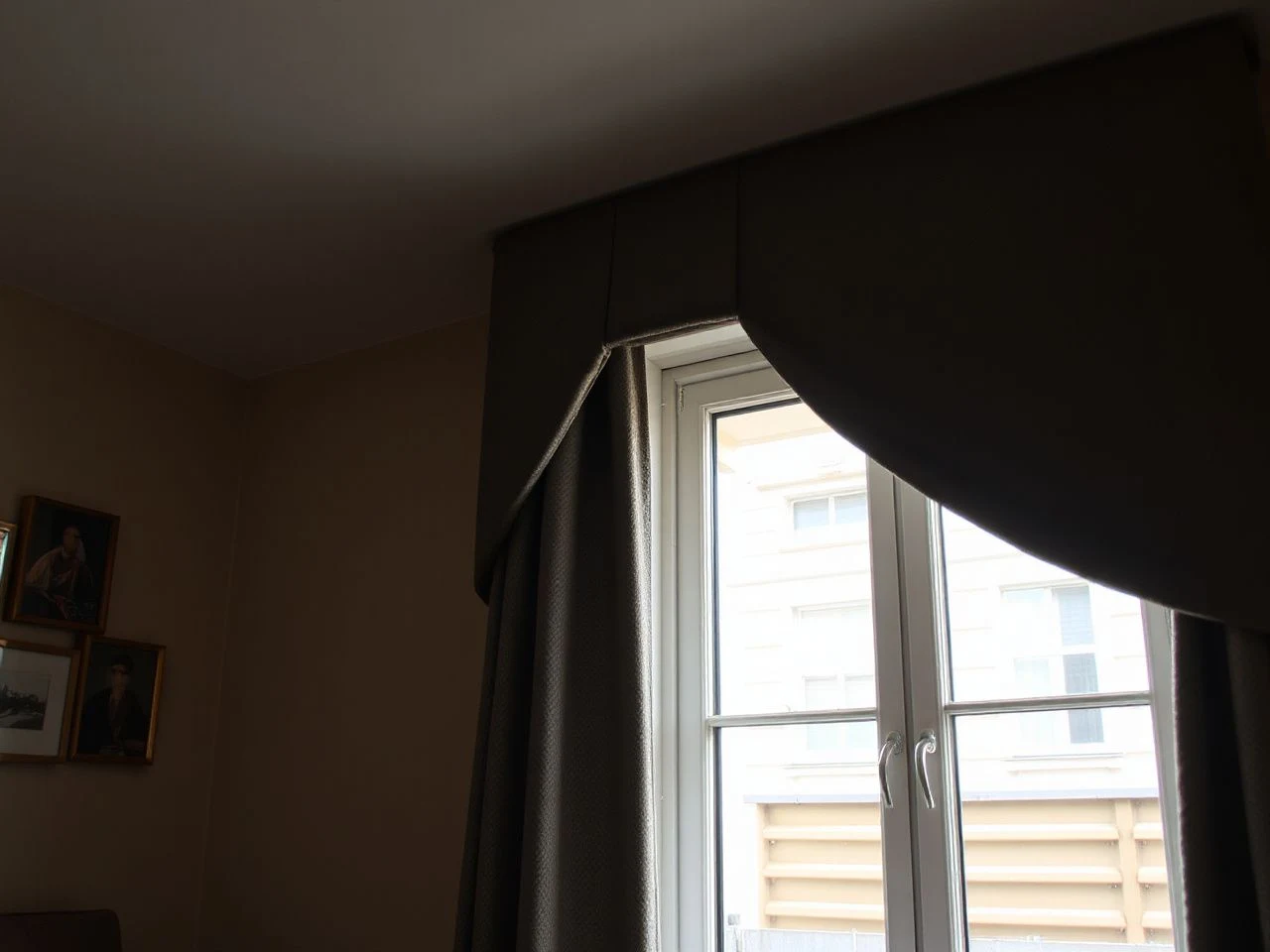
A track must follow the bay without forcing the curtain carrier through an abrupt turn. Check the corner pieces, joints, fixing points, and end returns before installation. The track should sit on a line that keeps the curtain clear of the handles and allows the fabric to stack where the wall gives enough room.
Ceiling-mounted tracks can be useful where the wall above the bay is interrupted or shallow. Wall-mounted tracks and poles can work where there is a continuous, secure surface. Neither option solves a poor layout by itself.
Measure the corner from the intended centre line of the hardware, not just from the glass. This leaves room for the curtain to travel around the angle. If the fabric catches on the wall, the corner is too tight, the return is too short, the track is not aligned, or the stack lacks clearance.
Fit a bay window curtain pole without uneven hangs
A bay window curtain pole needs secure supports and a corner arrangement that matches the shape. Uneven curtain hangs often begin with supports placed at inconsistent heights or with a pole that does not follow the window’s true line. Fabric can also catch where the pole turns too sharply or where a return meets the wall.
Before fixing the supports, mark a continuous level line across the bay and compare it with the sill, trim, and ceiling. Check that the pole will not strike the handles and that the curtain can pass each corner. If a section needs to remain accessible, plan the opening point there rather than assuming the curtain must draw from the centre.
Manage draughts, glare, heat, and condensation
Window treatments can change how air moves around the glass. A close-fitting blind or heavy curtain may restrict airflow behind the treatment, allowing condensation to remain on the window surface. Moisture can affect fabrics, linings, and blind components, particularly where ventilation is poor.
Keep the window area ventilated according to the room’s normal requirements, and inspect the glass, sill, fabric, and mechanism for dampness. Do not allow a curtain to cover a vent or obstruct access to an opening window. Thermal curtains and draught reduction should be planned alongside safe operation rather than added as an afterthought.
Glare control depends on the direction and strength of daylight, the screen or work surface nearby, and the ability to adjust each pane. A single blackout lining may block light effectively, but it can remove useful daylight from the whole bay. Separate blinds or shades allow finer control where the room has changing light conditions.
Choose materials and controls with maintenance in mind
More affordable blinds commonly use polyester, aluminum, or PVC. Faux wood combines natural wood particles with man-made materials, and faux wood blinds may have UV ratings reaching a maximum of 500. High-moisture settings or rooms with large temperature swings can be suitable locations for faux wood window blinds, although the bay still needs adequate ventilation.
Maintenance cost depends on how easily the treatment can be cleaned, how exposed it is to dust and sunlight, and whether the mechanism is simple to reach. A fabric curtain may need careful attention to its lining, while slatted blinds require cleaning between the slats. Follow the care instructions supplied with the treatment and avoid soaking components unless the instructions allow it.
Clean curtains without stressing the lining, and clean blinds without bending slats or wetting mechanisms. A soft brush or suitable vacuum attachment can remove loose dust, while a lightly damp cloth may suit some surfaces; the product instructions decide what is safe.
Keep controls and loose fabric safe
Cord and chain controls require appropriate child and pet safety measures. The U.S. Consumer Product Safety Commission provides consumer safety information on window-covering hazards, so use its guidance when checking cords, chains, and accessible control loops.
Small children face a lower strangulation hazard when cordless blinds are used. Loose curtains should not obstruct access to an opening window, and cords or chains should not hang where a child or pet can reach them. Keep control hardware secured according to its instructions and check that the fixing remains firm after normal use.
Window coverings should never turn a required escape or ventilation path into a blocked opening. A safe layout preserves access first and appearance second.
Preventive measures for a bay treatment that stays usable
Inspect the hardware and fabric regularly
Look for a track that has begun to pull away, a pole that has shifted, a bracket that moves, or a blind that no longer sits square. Uneven movement is an early sign that the hardware line, corner support, or fabric clearance needs attention.
Check the back of curtains and shades for dampness, especially where the treatment sits close to cold glass. Condensation can mark lining and fabric, while restricted airflow can leave moisture near blind components.
- Open and close every pane without forcing a handle.
- Move each blind or shade through its normal range and listen for scraping or binding.
- Check that curtains pass the corners without pulling the track or pole.
- Inspect cords, chains, and safety devices for looseness or damage.
- Remove dust before it becomes embedded in fabric or between slats.
Match the treatment to the room’s daily pattern
A sitting room may need privacy at one side of the bay and open daylight at another. A bedroom may need stronger light control, while a kitchen or damp room places greater demands on cleanability and ventilation. The correct arrangement is the one that remains easy to operate during ordinary routines.
Ask how often each window opens, which pane receives direct sun, where people sit, and whether furniture will move closer to the bay. Those answers help determine whether separate blinds, Roman shades, rollers, or a curtain layer will remain practical.
Maintenance over the useful life is usually governed by access, cleaning needs, sunlight exposure, moisture, and mechanism complexity rather than appearance alone. A treatment that is easy to reach and clean may require less ongoing effort than one with hidden corners and difficult controls.
Know when a professional fitting check is sensible
A fitting check is sensible where the bay has unusual angles, limited fixing surfaces, heavy curtains, deep reveals, or opening casements that come close to the proposed treatment. The key information to provide is not only the window width but also the section-by-section measurements, corner angles, handle positions, sill depth, radiator location, and intended mounting line.
Ask for the proposed operating path to be shown before the hardware is fixed. The reader should be able to see how the curtain turns the corners, where the fabric stacks, how each blind clears its handle, and whether the window can still open.
The ASTM International website is a useful place to identify voluntary technical standards bodies and terminology, but the treatment’s own installation instructions remain essential for fitting and care decisions.
Frequently Asked Questions
Should a bay window use one curtain or separate blinds?
Use separate blinds or shades where panes open independently, handles project into the reveal, or each section needs different privacy control. Use one curtain treatment where a suitable track or pole can turn the corners, remain securely supported, and allow the fabric to stack without blocking access. A coordinated combination can work when separate blinds manage each pane and curtains provide a soft outer layer.
How do I measure angles and recesses for bay window curtains and blinds?
Label every window section and measure its reveal separately. Record width, height, sill projection, handle position, opening direction, and the mounting surface. Note the corner shape rather than relying on a total width; common inside-corner angles include 150, 135, and 90 degrees. Draw the proposed hardware path and check that each blind, shade, or curtain clears the opening arc.
What provides privacy without blocking all daylight?
Separate roller blinds, Venetian blinds, or Roman shades can cover only the pane that needs privacy. Adjustable slats can change the view and light direction, while a curtain can remain open at the sides during daylight. Check the sight line from inside and outside, then choose the control position that blocks unwanted views without covering every section of the bay.
Why do bay window curtains hang unevenly or catch on the walls?
Uneven hangs commonly result from inaccurate section measurements, supports fixed at different heights, a pole or track that does not follow the true bay line, or corners that are too tight. Fabric may also catch on handles, wall returns, or trim. Recheck each corner, support, and clearance, then correct the hardware path before altering the curtain length.
How can I reduce draughts and heat loss without causing condensation?
Thermal curtains and close-fitting shades may reduce the exposed glass area, but the treatment should not block ventilation or remain damp against the window. Keep access to opening windows, inspect the glass and lining for moisture, and allow airflow behind the treatment where possible. The right balance depends on the room, window construction, and daily ventilation pattern.
How should curtains and blinds be cleaned?
Follow the care instructions for the specific fabric, lining, slat, or mechanism. Remove loose dust gently before using any damp method, and avoid wetting components unless the instructions permit it. Inspect the back of the treatment for condensation or marks, since moisture can affect fabrics, linings, and blind parts when airflow is restricted.
What is likely to cost less to maintain over time?
There is no universal answer because maintenance depends on exposure to dust, sunlight, moisture, and daily movement. Simple, accessible treatments are generally easier to clean and inspect than arrangements with hidden corners or complex hardware. Compare the care instructions, access to each section, and replacement of individual parts before choosing a layout.
How can I keep cords, chains, and loose curtains safe?
Use cordless controls where suitable, secure cords and chains according to the supplied instructions, and keep loose fabric away from accessible opening windows. Check the Consumer Product Safety Commission’s window-covering safety information when planning child-safe blind mechanisms. Inspect safety devices regularly, especially in rooms used by children or pets.
Bay window curtains and blinds work best when the room’s practical route is settled before the decorative finish. Measure the sections, test the opening paths, plan the corners, and preserve ventilation and access. Once those decisions are sound, the choice between a curtain track, bay window curtain pole, Roman shade, roller blind, Venetian blind, cellular shade, or layered treatment becomes far more straightforward.