
You bring a dresser home, load two drawers with folded shirts, and within a month one of them sags, tips toward you when you pull it, or refuses to close flush against the case. That frustration almost always traces back to one decision made in the showroom: judging the piece by its finish instead of its hardware. The single most predictive feature of a dresser’s longevity is not the wood species on the front but how the drawer boxes are joined and how they ride.
Dovetailed boxes on full-extension ball-bearing slides survive decades of loading and several moves. Stapled boxes on friction runners loosen and sag fast. This dresser buying guide is written around that distinction, because it is the one thing the marketing copy never puts up front.
Key Takeaways
- Joinery and slides predict lifespan. Dovetailed drawer boxes riding on full-extension ball-bearing slides outlast stapled boxes on friction runners by decades, regardless of the finish on the front.
- Weight and the feel of an empty drawer expose the truth. A pulled-out empty drawer that flexes or rattles reveals engineered panel with a veneer skin, not solid construction.
- A tall dresser is a tip-over hazard until it is anchored. Anti-tip hardware and wall anchoring are safety requirements under the STURDY Act and ASTM F2057, not optional accessories.
Know What You Are Actually Buying
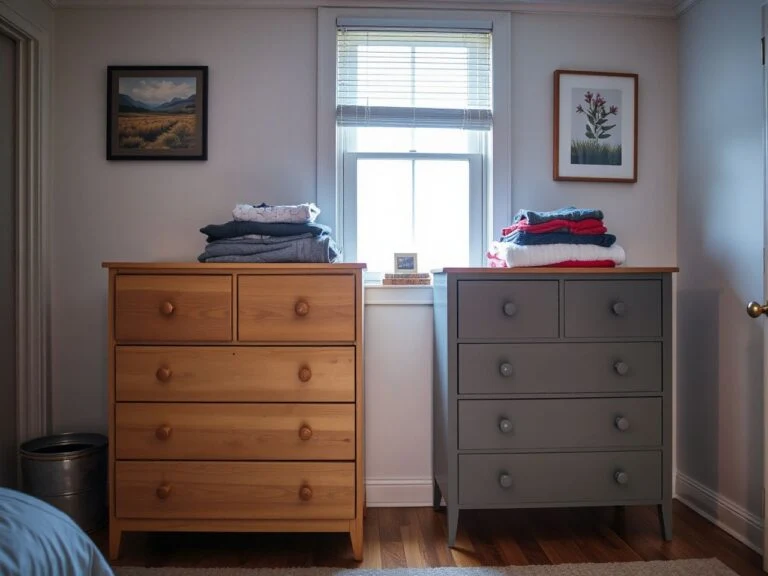
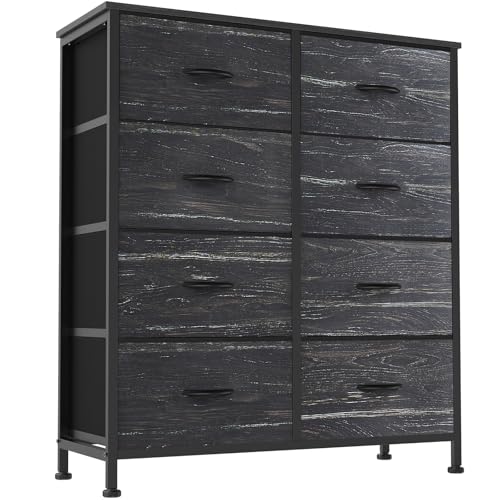
The words on the tag matter, because they change proportions, capacity, and how prone the piece is to tipping. A dresser is wide and low, usually with two to three rows of drawers side by side, built to sit under a mirror or a wall-mounted piece. A chest of drawers is narrow and tall, stacking four to six drawers vertically in a single column.
A highboy takes that stack even higher, sometimes on legs, which puts more weight up top and raises the tip-over risk considerably. Height changes physics, not just looks. The taller and narrower the case, the more it depends on being fastened to the wall to stay upright.
Match The Form To The Room, Not The Photo
A low dresser gives you a usable surface at roughly 32 to 36 inches, comfortable for a lamp or a tray. A chest frees up floor space in a tight bedroom but forces you to reach up for the top drawer. Before you fall for a silhouette, measure the wall, the swing of the closet door, and the clearance a fully extended drawer needs — usually the drawer’s full depth plus your standing room.
The Hardware Tells You Everything
Open a drawer all the way, pull it out if the store lets you, and turn it over. This is where a dresser earns its price or exposes itself. Two features do most of the talking: how the box is joined at the corners, and what it rides on.
Drawer Joinery: Dovetails Versus Staples
A dovetailed corner interlocks the front and side panels with a series of pins and tails, so the joint resists being pulled apart in the exact direction a loaded drawer stresses it every day. English dovetails use larger, hand-cut-style joints visible on the drawer side, while French dovetails slot the front into a routed groove — quicker to machine and common on mid-range pieces. Both beat the alternative by a wide margin.
The alternative is a stapled or glued butt joint, where the side simply meets the front and is pinned with staples or brads. Stapled butt joints are the clearest structural tell of a cheap build, because the fasteners work loose with repeated loading and the front eventually separates from the box. If the corner shows staples, assume the drawer is on borrowed time.
Drawer Glides Decide Daily Usability
The glide mechanism matters more to everyday use than almost any other feature. Full-extension ball-bearing slides let the drawer pull out its entire length, hold weight without sag, and glide smoothly even when loaded — you can reach the back of the drawer without digging blind. Partial-extension slides stop short, leaving the rear few inches trapped behind the case.
Traditional wooden runners are a different animal. Center-mounted wooden runners and wax-coated wooden runners are period-correct on antiques and can run beautifully when fitted well, but they swell in summer humidity and stick, and they carry less weight than steel slides. If a drawer drops or scrapes when you pull it half open, the runner is worn, misaligned, or undersized for the load.

Solid Wood, Or A Veneer Over Engineered Panel
“Solid wood” is one of the most stretched phrases in furniture listings. It frequently means solid-wood drawer fronts and legs over a case built from engineered panel — and that distinction changes durability, weight, and price. Genuine kiln-dried solid wood is dimensionally stable and can be sanded and refinished for generations.
MDF (medium-density fiberboard) and particleboard are engineered panels: dense, flat, and cheaper, but they crush at screw points and swell permanently if they get wet. A veneer skin over MDF can look identical to solid oak from three feet away. The way it feels in the hand does not lie.
How To Tell Real Wood From A Veneered Panel
- Weight. Solid hardwood is heavy. A dresser that a single person lifts easily by one end is almost certainly engineered panel with a veneer skin.
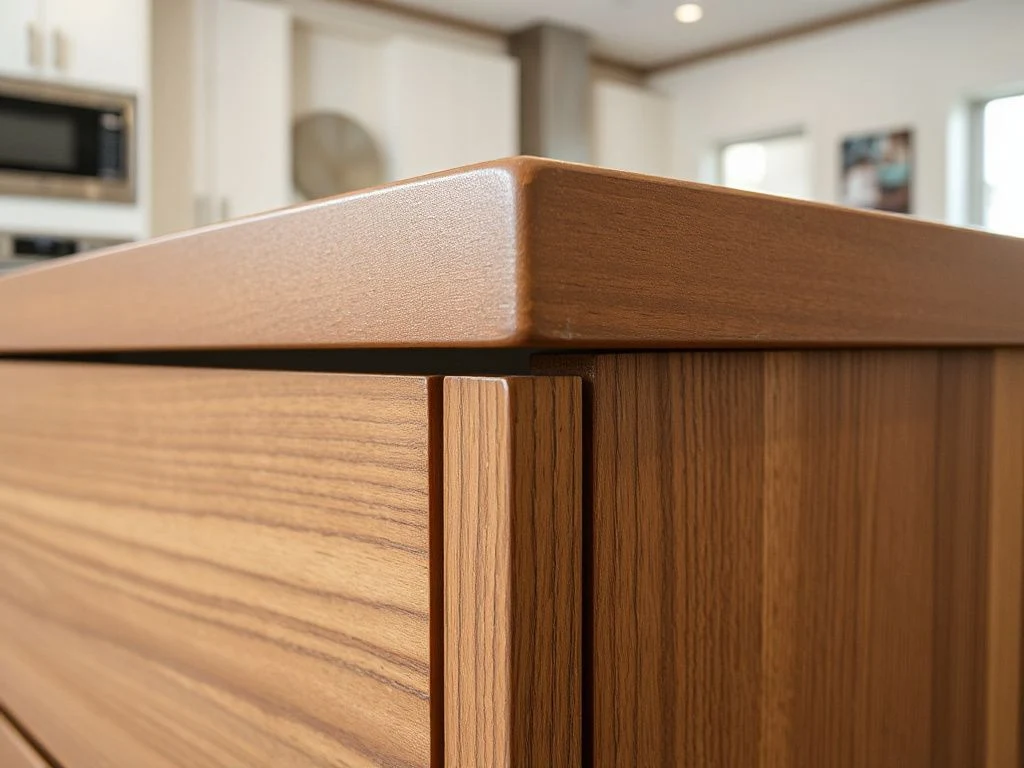
- Edges and end grain. Real wood shows continuous grain wrapping around edges; veneer shows a thin printed or sliced layer that stops at a seam.
- Drawer interiors. Look inside the drawer box, not just the front. Solid pieces use real wood sides; budget pieces reveal raw particleboard or a thin printed liner.
- The empty-drawer feel. An empty solid-wood drawer feels dense and stays rigid when you twist it gently. A veneered-panel drawer feels light and flexes.
None of this makes engineered panel worthless. A well-built MDF-cased dresser with steel slides can serve a guest room for years. The problem is paying solid-wood prices for a veneer skin, or expecting a particleboard case to survive three moves.
Stability Is A Safety Requirement, Not A Preference
A loaded, unanchored tall dresser can tip when a child climbs an open drawer or when the upper drawers are pulled out at once. This is not a rare edge case — it is the defining safety issue of the whole category. The U.S. Consumer Product Safety Commission tracks tip-over incidents and recalls, and the IKEA MALM line became the reference point for anti-tip recalls precisely because tall, light cases without wall anchoring are the highest-risk design.
Federal law has caught up. The STURDY Act directs a mandatory stability standard for clothing storage units, and the industry standard it aligns with, ASTM F2057, sets the test conditions a dresser must pass. You can read the scope of that standard through ASTM International, which publishes the tip-over performance requirements for clothing storage furniture.
What Anti-Tip Anchors Actually Do
An anti-tip kit is a bracket and strap that fastens the top of the case to a wall stud. Anchored to a stud, the strap converts a forward tip into harmless tension instead of a fall. The failure mode to avoid is screwing the anchor into drywall alone, which pulls free under load — the same principle behind choosing the right fixing for anything heavy on a wall, which our breakdown of command strips versus nails walks through for lighter hanging jobs.
The New-Dresser Smell And What It Means
That sharp chemical smell from a freshly unboxed dresser is off-gassing, and in composite-wood furniture it is often formaldehyde released from the resins that bind particleboard and MDF. It is strongest when new and fades over weeks, but it is worth taking seriously in a bedroom where you spend a third of your day.
Regulation exists here. CARB Phase 2 and the federal TSCA Title VI rule cap formaldehyde emissions from composite wood products sold in the United States; the Environmental Protection Agency administers the TSCA Title VI limits. For a stricter bar, a GREENGUARD Gold certification signals the piece was tested for low chemical emissions suitable for sensitive spaces.
How To Reduce Off-Gassing
- Air the piece out in a garage or spare room for a few days before it goes in a bedroom.
- Run the drawers open and keep the room ventilated; warmth and airflow speed the release.
- Prefer solid wood or a certified low-emission composite if anyone in the home has respiratory sensitivity.
Sizing, Capacity, And Fit
Drawer count is a storage question, but drawer depth is the usability question people forget. Standard dresser drawers run roughly 6 to 8 inches deep inside, which stacks two to three layers of folded shirts. Deeper drawers hold more but bury the bottom layer; shallower drawers keep everything visible but need more of them.
A common realistic layout is a six-drawer dresser: two shallow top drawers for small items and four deeper drawers for folded clothing. Before committing, add the drawer’s full extension to the room clearance and confirm you can stand and open it without hitting the bed or a closet door.
Weight Is A Signal, Not Just A Nuisance
Weight tells you what the spec sheet hides. A six-drawer solid-hardwood dresser can run well over 150 pounds, while an equivalent particleboard piece may come in under half that. Heavier is not automatically better, but a suspiciously light dresser at a solid-wood price is a veneer skin over engineered panel, and it will move and creak accordingly. Styling the surface once it is in place is a separate, gentler problem — a low arrangement of frames or greenery reads well, and our comparison of real and faux plants covers what survives a dresser top with little light.
Buying Used Or Vintage
An old dresser can be the best value in the category, because solid-wood cases and dovetailed drawers were once ordinary. The signs a vintage piece is worth keeping: dovetailed drawer corners, a case that stays square when you rock it, and drawers that still run on their original wooden runners without dropping.
The signs it is junk: swollen, water-damaged particleboard; drawer fronts separating at stapled joints; and a case that racks noticeably when you push a top corner. Surface flaws like a cloudy finish or minor veneer chips are cosmetic and fixable. Structural racking and crushed screw points are not worth the refinishing effort.
Why Cheap Dressers Come Apart
Budget dressers sag, wobble, and fail after a couple of moves for predictable reasons. The case is usually cam-lock-assembled particleboard, and every disassembly loosens those fittings. Stapled drawer boxes lose their grip under load, and friction runners without steel slides wear grooves that make drawers drop. The finish looks fine right up until the hardware quits — which is the whole argument for reading the joinery first.
Keeping A Dresser Running
Maintenance for wood drawers is mostly about friction and moisture. Rub a candle or a block of paraffin along wooden runners once or twice a year and the drawers glide again — the wax fills the microscopic grain that catches. For ball-bearing slides, a light wipe keeps grit out of the bearings.
Finishes ask for humidity control more than polish. Solid-wood drawers swell in summer humidity and shrink in dry winter heat, so a stable room keeps them running true. Lacquer and polyurethane resist water but can crack if the wood moves hard against a rigid film; a penetrating oil finish moves with the wood but needs occasional reapplication. Keep the piece off a heating vent and out of direct sun to slow finish cracking.
Frequently Asked Questions
How do I tell if a dresser is real wood or veneered particleboard in the store?
Lift one end and look inside a drawer box. Genuine kiln-dried solid wood is heavy and shows continuous grain wrapping around edges, while a veneered panel is light and reveals a thin sliced layer stopping at a seam. Check the drawer interior specifically — budget pieces expose raw particleboard or a printed liner behind a solid-looking front.
What actually makes a dresser tip over, and do anti-tip anchors work?
A tall, light case tips when weight shifts forward — a child climbs an open drawer, or the upper drawers are pulled out together. An anti-tip anchor fastened to a wall stud converts that forward force into harmless tension, which is why the STURDY Act and ASTM F2057 treat wall anchoring as a requirement. Anchoring into drywall alone fails; the screw must reach a stud.
Why do some dresser drawers glide smoothly while others stick or fall out?
The glide mechanism is the difference. Full-extension ball-bearing slides carry weight without sag and let the drawer pull out completely, while worn or misaligned wooden runners drop and scrape. Wax-coated and center-mounted wooden runners also swell in summer humidity and stick, so a drawer that binds in July often runs fine in dry winter air.
What is the difference between a dresser, a chest of drawers, and a highboy?
A dresser is wide and low with side-by-side drawer rows, a chest of drawers is narrow and tall with a single vertical stack, and a highboy raises that stack even higher, sometimes on legs. Height matters for safety: the taller and narrower the piece, the more it depends on wall anchoring to resist tipping.
Is the smell from a new dresser harmful, and how do I get rid of it?
That smell is off-gassing, often formaldehyde from the resins in particleboard and MDF. It fades over weeks, and CARB Phase 2 and TSCA Title VI limits cap emissions on composite wood sold in the United States, with GREENGUARD Gold indicating a stricter low-emission standard. Air the piece out with drawers open in a ventilated space before moving it into a bedroom.