For anyone comparing fabric bins vs wicker baskets, the StorageWorks Wicker Baskets are the storage solution that holds its shape under real weight. They suit shelves that need to stay organized for years, not months.
Our top pick is the StorageWorks Wicker Baskets because handwoven water hyacinth is structurally far sturdier than collapsible non-woven polypropylene. The Amazon Basics fabric cubes are the budget-friendly alternative for anyone who needs something foldable and washable.
We looked at both options through the lens of what actually fails first: sagging walls, splintering fibers, or a handle that rips out. The wicker passed that test on paper; the fabric cubes only passed if you keep the load light.
📌 This article contains affiliate links. As an Amazon Associate I earn from qualifying purchases, at no extra cost to you. Full disclosure.
CERTAIN CONTENT THAT APPEARS ON THIS SITE COMES FROM AMAZON. THIS CONTENT IS PROVIDED ‘AS IS’ AND IS SUBJECT TO CHANGE OR REMOVAL AT ANY TIME.
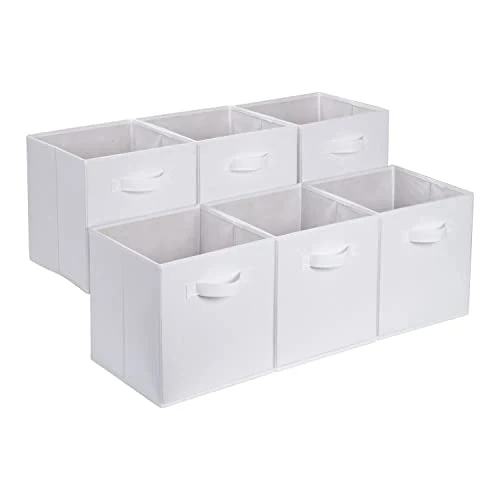
Amazon Basics Collapsible Fabric Storage Cubes Organizer (Six-Pack)


Comparison Table
| Product | Best For | Buy Link |
|---|---|---|
| Amazon Basics Collapsible Fabric Storage Cubes Organizer | Budget, collapsible storage | Check Price |
| StorageWorks Wicker Baskets | Durable, rigid storage | Check Price |
How We Chose Between Fabric Bins and Wicker Baskets
These two picks came from comparing published specifications and material data against the failure points that actually matter in home storage. We weighted structural rigidity most heavily: does the bin hold a cube-like shape when you pull it off a shelf, or does it fold in on itself? Fabric bins live or die by their collapsible frame and non-woven polypropylene’s resistance to creasing, while wicker baskets are judged on weave tightness and moisture resistance. The Amazon Basics listing tells you it’s lightweight and collapsible but never states a weight capacity, which is a red flag for anyone storing books. The StorageWorks listing names water hyacinth and handwoven braiding, but omits exact internal dimensions. Before you order either one, measure the actual shelf opening and subtract at least half an inch for fabric wall bowing or wicker wall thickness.
Amazon Basics Collapsible Fabric Storage Cubes Organizer (Six-Pack)
Quick take: Grab these if you need six matching cubes for a standard cube organizer and you don’t plan to overload them with dense items.
The non-woven polypropylene fabric has that slightly papery, breathable feel common to budget storage cubes. Each cube measures 10.5 x 10.5 x 11 inches, which matches most standard cube shelving, but those dimensions are the outer footprint. Once you fill one with anything heavier than a folded sweater, the fabric walls will bow inward and eat into usable volume. The sewn-in fabric handles are a nice touch for pulling a cube out without dumping the contents, but they’re the first thing to rip if you yank too hard on a loaded bin.
In the fabric bins vs wicker baskets debate, the Amazon Basics cubes win on two fronts: they fold completely flat when empty, and they’re light enough to move around a room one-handed. The trade-off is that there’s no rigid frame mentioned anywhere in the listing. That means the cubes rely entirely on the fabric’s stiffness to hold a rectangular shape, and non-woven polypropylene softens with repeated handling. If you store toys or towels in these, you’ll be fine. If you try to stack them full of hardcover books, expect the sides to bulge and the top cube to lean.
Pros:
- Six-pack value – covers an entire cube organizer in one purchase.
- Sewn-in fabric handles – easy to slide out from tight shelves without breaking a nail.
- Collapsible design – folds flat for storage under a bed or in a closet when not in use.
Cons:
- No rigid frame – walls will bow outward under moderate weight, reducing internal space.
- Not specified as machine-washable – spot cleaning is the only safe option, and stains will set.
- Flimsy handles – sewn-in fabric loops can tear if you pull a full cube too quickly.
The Real Deal
Best for: Renters, dorm rooms, and anyone who needs lightweight, foldable storage for linens, craft supplies, or kids’ toys. Skip if: You plan to store heavy books, pantry jars, or anything that needs a basket to keep its shape for more than a year.
Amazon vs StorageWorks: Spec Comparison
| Specification | Amazon | StorageWorks |
|---|---|---|
| INCLUDES SIX CUBES | Keep your home tidy and organized with this set of six cloth storage cubes | — |
| EASY PORTABILITY | Each collapsible fabric storage cube comes with one sewn-in fabric handles. | — |
| STURDY YET LIGHTWEIGHT | Made from lightweight yet durable fabric, these cube storage bins offer both strength and breathability | — |
| MULTIFUNCTIONAL USE | These fabric cube organizer bins can be used as either open-top bins or as drawers in a storage-cube organizer (not included | — |
| STORAGE SPACE | Each collapsible fabric cube storage bin is suitable for organizing a variety of items | — |
| Load Capacity | Supports up to 5 lbs | — |
| Handwoven Craftsmanship | — | Handwoven by skilled artisans with tight, even braiding, each pantry basket offers a neat, elegant look that showcases its high-quality craftsmanship. |
StorageWorks Wicker Baskets (Two-Pack)
Why it made our list: The handwoven water hyacinth construction is the closest thing to a rigid frame you’ll get without buying solid wood, and that alone solves the sagging problem.
The weave is described as tight and even, which usually means the basket will hold a rectangular shape under load. Water hyacinth is a natural fiber, so it has a slightly rough, organic texture that won’t scratch most shelf surfaces. Unlike fabric, wicker doesn’t need a collapsible frame because the braided walls are the structure. That’s the core advantage in this comparison: fabric cubes get their rigidity from a frame or from the fabric itself, while wicker baskets are inherently rigid from the weave pattern.
One honest annoyance: the StorageWorks listing never states the basket’s internal dimensions or the height. For anyone trying to fit these into an existing cube organizer, that omission is a problem. You’d have to assume they’re roughly cube-sized, but handwoven baskets vary slightly from batch to batch. Also, natural wicker can splinter if it gets too dry, and high humidity can cause mildew between the braids. So these baskets are not ideal for a damp basement or a bathroom with poor ventilation. But for a living room shelf or a pantry, they’re far more durable than any collapsible fabric bin.
Pros:
- Handwoven water hyacinth – a natural fiber that holds its shape without a frame.
- Tight, even braiding – resists sagging and keeps contents from poking through gaps.
- Multi-purpose capacity – sturdy enough for books, towels, toiletries, or snack storage.
Cons:
- No listed dimensions – you can’t verify shelf fit before ordering, so returns are likely if you guess wrong.
- Natural fiber shedding – water hyacinth can leave tiny fibers on dark shelves over time.
- Not collapsible – these take up the same space empty or full, so storage when not in use is a pain.
Final Thoughts on the StorageWorks Wicker Baskets
Best for: Homeowners who want decorative, eco-friendly storage that won’t collapse under a stack of novels or a row of soup cans. Skip if: You need to fold baskets flat in a closet, or you live in a humid climate where natural fibers are at risk of mildew.
Fabric Bins vs Wicker Baskets: What to Know Before You Buy
The decision really comes down to two questions: how much weight will you store, and how often do you need to move or collapse the bins? Both options have a handle feature, but the handles on the Amazon Basics cubes are sewn-in fabric loops, while the StorageWorks wicker baskets may have cutout handles or none at all depending on the batch. Cutout handles are less comfortable than fabric loops, but they won’t rip.
The Real Difference Between Fabric Bins and Wicker Baskets
The difference between fabric bins and wicker baskets is structural, not aesthetic. Fabric bins are made from non-woven polypropylene, a synthetic material that is breathable and lightweight but has no inherent rigidity. Wicker baskets, especially those handwoven from water hyacinth, get their strength from the braided pattern itself. That means a wicker basket can support heavier items like a stack of hardcovers without deforming, while a fabric bin will start to bow once you pass a few pounds of dense content.
Maintenance and Moisture
Fabric bins are often advertised as easy to clean, but the Amazon Basics listing never says machine-washable, which is a critical omission. Spot cleaning is the likely safe route, but that won’t remove deep stains. Wicker baskets, on the other hand, should never be submerged in water. A damp cloth wipe is fine, but high humidity can warp the fibers or encourage mildew. If you’re storing linens or clothes, fabric bins offer better breathability than wicker, which can trap moisture in tight braids.
Weight Capacity and Sagging
Wicker baskets generally support more weight without deformation than collapsible fabric bins. The handwoven structure resists side pressure, while non-woven polypropylene will crease and soften over time, especially at the corners where the fabric folds. If you plan to store toys, books, or pantry items, the wicker option is the safer bet. For light items like scarves or extra blankets, the fabric cubes are perfectly adequate.
Our Final Recommendation
The StorageWorks Wicker Baskets are the overall winner for anyone who wants storage that doesn’t sag, crease, or collapse after a year of use. The handwoven water hyacinth is a genuinely structural material, and that matters more than any handle or fold-flat feature. The Amazon Basics Collapsible Fabric Storage Cubes remain the budget pick: six cubes for what you’d pay for two wicker baskets, and they fold away when empty. If you need heavy-duty, long-term storage, buy the wicker. If you need cheap, flexible, temporary organization, the fabric cubes do the job.
Frequently Asked Questions
Which is better for a small apartment: fabric bins or wicker baskets?
For a small apartment where storage space is tight, fabric bins or wicker baskets both work, but the deciding factor is whether you need to stow the bins themselves when not in use. Amazon Basics fabric cubes fold flat, so you can slide them under a bed. Wicker baskets don’t fold, so they take up the same volume empty or full. If you move frequently or rotate storage, go with fabric. If you have a permanent shelving unit, wicker is worth the space it occupies.
Will the Amazon Basics fabric cubes sag over time?
Yes, they will sag if you store dense items or handle them roughly. Non-woven polypropylene has no internal frame, so the walls rely on the fabric’s stiffness to stay upright. Repeated pulling, pushing, and overstuffing will soften the material and cause the top opening to lose its rectangular shape. For light items like linens or stuffed animals, sagging is minimal. For anything heavier, choose a wicker basket instead.
Can I use the StorageWorks wicker baskets in a bathroom without them getting moldy?
Only if the bathroom has good ventilation and you wipe down the basket regularly. Water hyacinth is a natural fiber that absorbs moisture from the air. In a steamy bathroom, trapped humidity between the braids can lead to mildew over time. If you must use wicker in a bathroom, keep it away from the shower and allow it to dry completely between uses. Fabric bins are more breathable but not water-resistant either.
How do I clean wicker baskets without damaging the weave?
Use a dry microfiber cloth or a vacuum brush attachment to remove dust and debris. For spots, dampen a cloth with water only and gently wipe the affected area, then let the basket air dry completely in a well-ventilated spot away from direct heat. Avoid soaking the basket or using harsh cleaners, as that can loosen the braiding or cause the fibers to warp. The same cautious approach applies to the Amazon Basics fabric cubes: spot clean only, since the listing doesn’t guarantee machine-washable.