A routine shower can push your bathroom’s relative humidity past 90% in under three minutes. That single fact explains why most bathroom storage units fail long before their hinges do. This bathroom storage buying guide will walk you through the decisions that actually matter—starting with moisture, not measurements.
I map bathroom storage by tracing the moisture gradient from floor to ceiling. Where does condensation travel, and which materials will hold their shape when the room steams up during a shower? The real split is between materials that are dimensionally stable even when the air is damp (like marine plywood, teak, or PVC) and ones that washboard or delaminate if any unsealed edge is exposed. Beginners compare looks and price, but I first ask how the unit will sit in the humidity cycle—then match the material to the zone where it’ll actually live.
Key Takeaways
- Choose materials rated for damp conditions—marine plywood, teak, PVC, or properly sealed MR-grade MDF—and avoid standard MDF or unsealed particleboard.
- Wall-mounted storage requires anchors rated for the combined weight of the unit plus its contents, and you must account for tile, plaster, and stud placement.
- Ventilation is a prerequisite: even the best waterproofing fails if the bathroom stays damp for hours after each shower.
- Hardware quality—especially stainless steel hinges and soft-close slides—determines a unit’s real lifespan far more than its finish or brand name.
Getting Started: Mapping Moisture and Matching Materials
Before you measure a single wall, stand in your bathroom after a hot shower. Watch where the mirror fogs, where water beads on the ceiling, and where the floor stays wet. That condensation pattern tells you which storage zones are high-humidity and which are merely splash-prone.
Understanding Your Bathroom’s Moisture Zones
A bathroom breaks down into three moisture zones. The shower zone includes anything within three feet of the showerhead or tub spout—this area sees direct spray and constant steam. The splash zone extends roughly two feet beyond the vanity and toilet, where water droplets land but don’t pool. Everything else is the dry zone, which still experiences high humidity but rarely gets wet directly.
Marine-grade plywood is made with waterproof adhesive and face veneers that resist delamination, so it holds its shape even at 80% relative humidity. Teak contains natural oils that make it nearly impervious to rot, though it will gray over time without oiling. PVC panels and anodized aluminum extrusion are completely inert—they will not swell, warp, or rust in any zone, but they look utilitarian. For the dry zone, FSC-certified hardwood with a polyurethane varnish finish works fine if you reseal it regularly.
Open Shelving vs. Closed Cabinets: A Decision Framework
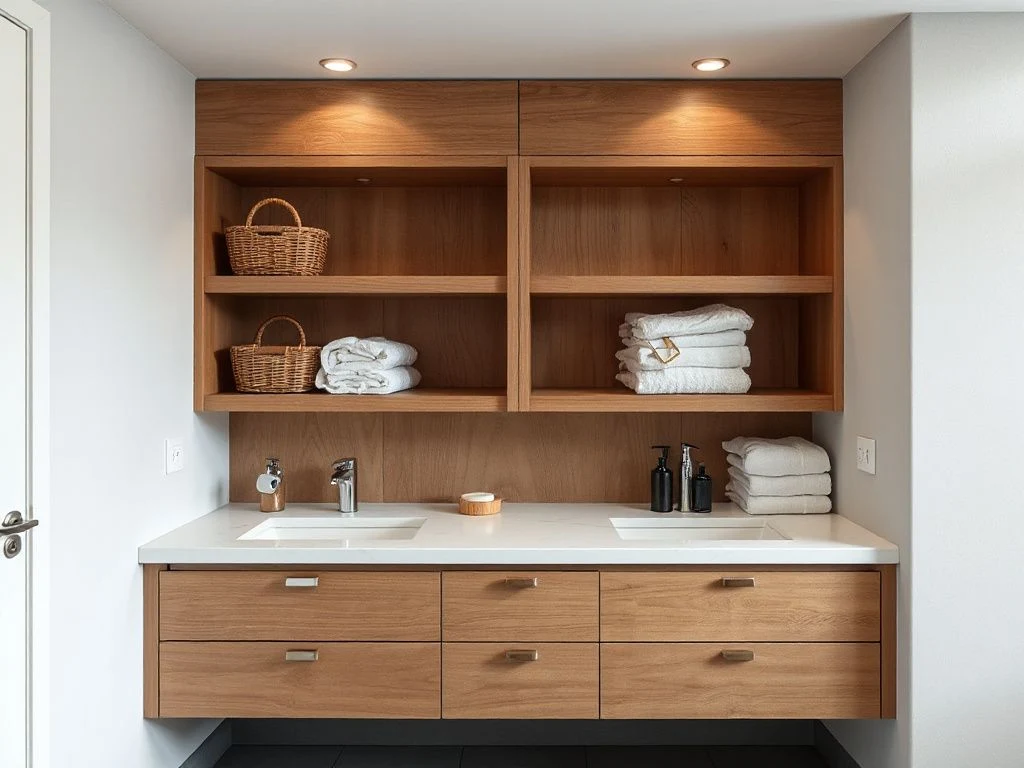
In a tight bathroom, open shelves can make the space feel larger by keeping sight lines unobstructed. But open shelving exposes everything to airborne moisture, and in a windowless bathroom, that means mold on the back of a shampoo bottle within weeks. Closed cabinets protect contents but add visual weight.
Use open shelves only for items you use daily and replace quickly—towels, soap, cotton balls in a sealed jar. Reserve closed cabinets for backup supplies, cleaning chemicals, and anything you don’t want dust or moisture to touch. A clear understanding of home decor styles helps you match shelf brackets and cabinet fronts to the rest of your house, but the moisture decision comes first.
Intermediate Planning: Measuring, Mounting, and Plumbing Clearance
Once you know which materials survive in each zone, you can measure for fit. Accuracy here prevents most returns and wall damage.
Measuring Wall and Floor Area Correctly
Measure the intended spot in three dimensions: width at the narrowest point, height from floor to any overhead obstruction, and depth available before the unit would block a door swing or cabinet drawer. Write down the smallest of each measurement—a wall that is 24 inches wide at eye level but 23.5 inches at the base will reject a 24-inch cabinet. Use a steel tape measure, not a cloth one. Add 1/4 inch of clearance on all sides for shimming and uneven walls.
For floor-standing units, check that the bathroom floor is level. A 1/2-inch slope across four feet will tilt a tall cabinet enough to bind doors and cause gaps. Use a 24-inch level and shims under the base if needed.
Wall-Mounting Without Guessing: Anchors, Studs, and Tile
Wall-mounted shelves and cabinets must be anchored to something solid. A standard stud finder locates framing behind drywall, but tile complicates the signal. Tap the wall gently—solid thuds indicate a stud behind the tile; hollow echoes mean you’re between studs. For heavy loads, drill through tile with a diamond-tipped hole saw, then drive a #10 or #12 stainless steel screw directly into the stud. Do not rely on plastic anchors in drywall for anything heavier than 20 pounds.
If a stud isn’t available where you need the mount, use toggle bolts or molly bolts rated for drywall. A single 1/4-inch toggle bolt holds roughly 50 pounds in 1/2-inch drywall, but two toggles share the load unevenly if the shelf twists. For a cabinet that might hold 60 pounds of towels and bottles, you need at least two mounting points into studs or a French cleat system bolted to studs before adding toggles as secondary support.
Under-Sink Storage When Pipes Eat Your Space
Pedestal sinks and narrow vanities leave awkward plumbing clearances below. The best solution is a modular shelf system that splits around the P-trap. Look for units with a cutout or notch in the back panel, or build your own using two narrow cabinets flanking the pipe. A 12-inch-deep shelf on either side of the trap holds cleaning bottles upright without touching the hot water supply lines. Avoid storing anything that reacts to heat directly under the sink—bleach and ammonia should never share a closed cabinet with a hot water pipe, as fumes concentrate.
Recessed Cabinets and Standard Stud Spacing
Recessed medicine cabinets look sleek but require framing. Standard wall stud spacing is 16 inches or 24 inches on center, measured from the center of one stud to the next. A recessed cabinet wider than 14.5 inches (for 16-inch spacing) will span two stud bays, so you cannot simply cut a hole—you must frame the rough opening with header and trimmer studs to carry the load around the cabinet. Do not cut load-bearing studs without consulting a structural engineer. For a simple retrofit, choose a surface-mount cabinet and save the drywall surgery.
Advanced Choices: Hardware, Sealing, and Long-Term Ownership
This is where most buyers stop looking—and where most units fail within eighteen months.
Soft-Close vs. Standard Hinges: What Actually Matters
Soft-close hinges use a damper to catch the door in the last inch of travel, preventing slamming. In a bathroom, slamming shakes the cabinet, loosens wall anchors over time, and cracks tile grout adjacent to the unit. For a wall-mounted cabinet holding glass bottles, the shock of a slammed door travels straight into the mounting hardware. Blum soft-close hinges are the industry benchmark for a reason—they maintain consistent resistance for tens of thousands of cycles, while cheap copies lose damping force within a year. Spend the extra $15 per hinge. Standard hinges work acceptably on a floor-standing vanity that never gets slammed, but on anything wall-hung or near a toilet paper roll holder that encourages door flicking, soft-close is not optional.
Resealing Wood and Preventing Mold in Windowless Bathrooms
Any wooden shelf or cabinet in a humid bathroom needs a film finish, not an oil. Polyurethane varnish forms a continuous plastic layer; oil soaks into the wood and leaves pores open. Reapply polyurethane every 6 to 12 months depending on bathroom use—if the finish looks hazy or water no longer beads, it’s time. Sand lightly with 220-grit paper between coats.
For mold prevention, ventilation is the real answer. A windowless bathroom with a working exhaust fan that vents outdoors can dry to below 60% relative humidity within 30 minutes. A bathroom with no fan will stay damp for hours after a shower. Install a fan rated for at least 1 CFM per square foot of bathroom floor area. If you cannot add a fan, use a portable dehumidifier after showers and wipe down open shelves weekly with a 1:10 bleach-to-water solution, then dry immediately.
Weight Capacity and Heavy Storage
Before you store a stack of bath towels on a wall shelf, check the shelf’s rated capacity. A typical 24-inch floating shelf with two mounting brackets holds 35 to 50 pounds if installed into studs. The same shelf with drywall anchors drops to 15 to 20 pounds. A folded bath towel weighs about 1 pound, and a full bottle of shampoo is 2 pounds. Eight towels plus ten bottles easily exceed 20 pounds. When storing heavy items, choose a shelf with a continuous steel rail or French cleat rather than point-load brackets, and distribute weight evenly across the full width.
The Real Cost of Ownership
Metal hardware corrodes in salt-laden humid air. Standard zinc-plated screws rust within six months in a coastal bathroom; stainless steel or coated hardware adds a few dollars per unit but prevents staining and failure. Anodized aluminum extrusion won’t corrode at all. For wood units, factor in the cost of polyurethane varnish and sandpaper every year. Tighten hinge screws and drawer slides every three months—the constant expansion and contraction of wood in humidity cycles loosens fasteners. If a drawer starts to stick, wax the slides with paraffin before it becomes misaligned.
One overlooked cost is replacement of the unit itself. A $50 particleboard cabinet in a high-humidity bathroom lasts two years before the bottom panel sags and the doors no longer close. A $200 marine plywood cabinet with stainless hardware lasts twenty years with annual resealing. The math is not complicated.
Common Mistakes That Ruin Bathroom Storage
Even careful buyers make these errors. Recognizing them before purchase saves time, money, and drywall repairs.
- Buying a vanity without checking plumbing cutouts. If the back panel has no opening for the P-trap, you’ll be hacking it out with a jigsaw in the parking lot.
- Ignoring door swing clearance. A cabinet door that opens into the toilet tank or shower door will get dented and eventually break the hinge.
- Choosing glass shelves for a family bathroom. Glass collects water spots and amplifies every bottle clink. Use tempered glass (ANSI Z97.1 certified) only for small display shelves away from daily traffic.
- Mounting a heavy unit on tile without drilling correctly. Tile cracks if you use a hammer drill without water cooling. Use a diamond hole saw at low speed with a spray bottle, then switch to a masonry bit for the substrate.
- Forgetting that over-the-toilet storage must clear the tank lid. Measure from the floor to the top of the tank, then add 2 inches for lid removal. Most units sit too low, blocking the flush lever.
If your bathroom also houses laundry, the same spatial logic applies. Our guide to small bathroom with laundry layouts covers how a single vertical cabinet can serve both functions without cramping the room. And if you’re thinking about the overall aesthetic, remember that bathroom storage decisions echo the same principles of vertical layering used in small-space outdoor design—an awkward corner can become useful with the right shelving, just as a small front yard landscaping plan turns a dead side yard into a garden path.
Frequently Asked Questions
What materials can I use in a humid bathroom without them warping or swelling?
Marine-grade plywood, teak, solid PVC, and anodized aluminum are the most dimensionally stable choices. Marine plywood uses waterproof resin between layers, so it won’t delaminate even at 90% relative humidity. Teak’s natural oils repel water, though it needs periodic oiling to maintain color. PVC and aluminum are completely inert. Medite Tricoya MDF is a modified wood fiber product that resists swelling even on cut edges. Standard MDF, particleboard, and most hardwoods will warp in a damp bathroom unless fully sealed with polyurethane varnish and maintained every 6–12 months.
How do I prevent mold on shelves in a windowless bathroom?
Mold needs three things: moisture, organic food, and still air. You can’t remove the organic material (wood, paper, dust), so you must control moisture and airflow. Install an exhaust fan vented outdoors with a capacity of at least 1 CFM per square foot and run it for 20–30 minutes after every shower. Wipe down open shelves weekly with a diluted bleach solution. For closed cabinets, leave the doors slightly ajar or install small passive vents. If humidity stays above 60% for hours, any storage will eventually grow mold—fix ventilation before buying more cabinets.
Should I spend more on soft-close hinges for bathroom cabinets?
Yes, if the cabinet is wall-mounted or holds fragile items. Soft-close hinges prevent the door from slamming, which reduces stress on wall anchors, tile grout, and glass bottles. Cheap soft-close hinges use plastic dampers that wear out within a year; quality versions like Blum use oil-filled dampers rated for 80,000 cycles. For a low-use floor vanity that never gets slammed, standard hinges are acceptable, but the price difference is small. The hinge is a one-time cost; the anchor repair after a slammed door pulls out is not.