There’s a particular sound that haunts anyone who has ever bought a cheap shower caddy: the clatter of shampoo bottles hitting the tub at 2 a.m. because the suction cup finally gave up. That noise is why the best shower caddies aren’t just about shelf space—they’re about mounting hardware that doesn’t quit in a humid, soap-scummed bathroom. The brackets matter more than the baskets.
After comparing mounting mechanisms, material grades, and the fine print on load claims, the WOWBOX 2 Pack Adhesive Shower Caddies is our pick for most people. It pairs a no-drill adhesive mount that actually includes proper surface-prep stickers with 100% rust-proof stainless steel construction—a combination that solves the two biggest caddy failures without demanding a toolbox.
If your shower has a flat, parallel floor and ceiling and you’d rather not trust glue, the SEIRIONE tension pole is the heavy-duty alternative. More on that below.
📌 This article contains affiliate links. As an Amazon Associate I earn from qualifying purchases, at no extra cost to you. Full disclosure.
CERTAIN CONTENT THAT APPEARS ON THIS SITE COMES FROM AMAZON. THIS CONTENT IS PROVIDED ‘AS IS’ AND IS SUBJECT TO CHANGE OR REMOVAL AT ANY TIME.

Hanging Shower Caddy Over Shower Head – No Drill Rustproof Shower Rack (Best Value)

Best Shower Caddies: Quick Comparison
| Product | Best For | Buy Link |
|---|---|---|
| WOWBOX 2 Pack Adhesive Shower Caddies | Renters, smooth tile | Check Price |
| Hanging Shower Caddy Over Shower Head | Fixed shower heads | Check Price |
| SEIRIONE Rustproof Corner Shower Caddy Tension Pole | Permanent corner installs | Check Price |
| TAILI Shower Caddy Suction Cup 2 Pack | Light loads, smooth surfaces | Check Price |
How We Chose These Shower Caddies
What We Looked For in Shower Caddies
These picks come from reading spec sheets, material data, and installation manuals against what actually fails in a wet bathroom. The mounting mechanism carries the most weight in our ranking because a caddy that falls off the wall is worse than no caddy at all. Corrosion resistance is second: soap scum and hard water eat through cheap coatings within a year. We also weighed load capacity, adjustability for bottle heights and shower layouts, and how easy the caddy is to reposition or remove without leaving damage. One thing every buyer should check before ordering: the surface inside your shower—smooth, glazed tile works with adhesives and suction cups; textured, porous stone does not. If you’re on the fence about drilling, our shortlist of no-drill shower caddies under $100 covers the mounting trade-offs in more detail.
WOWBOX 2 Pack Adhesive Shower Caddies (Best Overall)
Quick take: If you rent, have smooth non-porous tile, and don’t want to drill a single hole, this two-pack solves the shower storage problem in one afternoon.
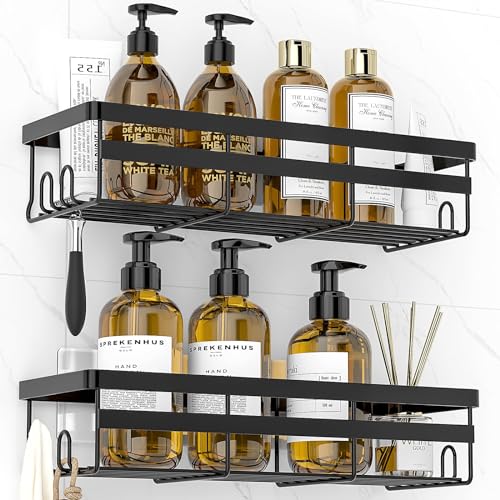
The WOWBOX set includes two caddies with integrated hooks, two transparent adhesive stickers, and a user manual. The frame is stainless steel with an additional rust-proof coating—double protection against the humid, soap-scum environment that kills cheaper metal caddies. Each caddy holds standard shampoo, conditioner, soap, and facial cleanser bottles. The transparent adhesive blends into tile, which matters because bulky installation stickers spoil a clean shower wall. The listing doesn’t state a maximum weight capacity, and that’s a real gap: for an adhesive caddy, the load limit is exactly the number you’d want to know before piling on liter-sized pump bottles.
Here’s where the design behaves differently from hollow plastic baskets. The metal frame gives you open drainage, so water doesn’t pool under bottles and turn into slime. The additional coating on top of stainless steel matters because bare stainless can still pit after years of hard water exposure. But the adhesive is the weak link. Transparent stickers work great on glossy ceramic tile, poorly on textured stone, and not at all on painted drywall. The listing’s surface-prep stickers suggest the manufacturer knows adhesives fail from oils and moisture—following that prep exactly is non-negotiable. You’ll also want to wait the full curing time before loading it up, usually 24 hours, though the manual will say.
Pros:
- Rust-proof stainless frame with extra coating — stands up to soap scum and hard water better than powder-coated steel.
- Two caddies in one pack — one for the shower, one for the bath or cleaning supplies.
- Transparent adhesives — disappear against the tile instead of looking like Band-Aids.
Cons:
- No stated load capacity — a red flag if you stock heavy glass pump bottles.
- Adhesive performance degrades in constant humidity — even the best tape doesn’t match a mechanical fastener.
Why It Earns a Spot
Best for: Renters and anyone with smooth, non-porous tile who wants a no-drill solution with genuinely rust-proof materials. Skip if: Your shower has textured stone, porous grout lines, or you plan to load more than a few pounds per shelf. The listing’s silence on capacity is a trust issue I can’t paper over.
Hanging Shower Caddy Over Shower Head – No Drill Rustproof Shower Rack (Best Value)
In a nutshell: The simplest mounting method in this roundup—hook it over your existing shower head arm and load the two tiers plus eight hooks.
This hanging caddy measures 13 x 5 x 25 inches, with two tier baskets and eight hooks for razors, loofahs, and washcloths. The frame is stainless steel, advertised as rust-free and fast-draining. The listing says it fits most shower heads, which is the honest way to say it does not fit wide rainfall heads or handheld-only setups. The design is as close to zero-installation as you can get: lift, place, done. But the entire load hangs from your shower head arm, so the arm’s strength becomes the caddy’s load limit. Many older arms are chrome-plated brass or cheap zinc—fine for a shower head, questionable for a caddy loaded with full bottles.
The open-metal construction allows fast water drainage, which keeps soap scum from accumulating as quickly as solid plastic shelves. The two-tier layout gives you separation: tall pump bottles on the bottom, smaller items on top. The eight hooks are a nice bonus for wet sponges that never dry out otherwise. The trade-off is sway and potential scratching of the shower arm. If your arm is threaded into a wall elbow, a bouncing caddy can work it loose over months. A rubber-coated hook or a piece of heat-shrink tubing around the contact point solves that, but you shouldn’t have to MacGyver a brand-new product.
Pros:
- Two tiers plus eight hooks — the most storage per dollar of any no-drill caddy here.
- Rust-resistant stainless steel — no coating to peel off under steam.
- Zero installation tools needed — works in under a minute.
Cons:
- Hangs entirely on the shower head arm — weak or shaky arms mean a wobbly caddy.
- Won’t fit wide rainfall or handheld-only shower heads — the “most” in the listing does some heavy lifting.
The Real Deal
Perfect for: Standard fixed shower heads in a guest bath or rental where simplicity wins. Not great if: You have a wide rainfall head, a handheld-only configuration, or a particularly flimsy shower arm. The load is only as secure as the arm it hangs from.
SEIRIONE Rustproof Corner Shower Caddy Tension Pole for Bathroom Organizers (Best Heavy-Duty)

Why it stands out: A tension pole transfers weight to the floor and ceiling instead of relying on adhesive or a shower arm—when it works, it is the sturdiest option here.
The SEIRIONE is a corner-mounted tension pole with shelves, built from stainless steel with a black finish. The listing explicitly warns it is not suitable for sloped ceilings, which tells me the manufacturer has dealt with returns from people with angled attic bathrooms. Installation requires a flat, parallel floor and ceiling; the tension mechanism tightens the pole between them. This is the only mounting type in this roundup that can handle heavy loads without sagging—because the weight pushes down on the pole, not sideways on an adhesive. Stainless steel means you’re not gambling on a coating to keep rust away, and the black finish is aesthetic, not structural.
The design gives up two things for that stability. First, it occupies a corner permanently—no repositioning without releasing the tension and shifting the entire assembly. Second, the tension itself needs re-tightening every few weeks as temperature and humidity cause microscopic movement. The listing’s “unmatched ease of installation” is marketing speak; any tension pole takes 20 minutes to get level and secure. And if your floor or ceiling has even a slight slope, the pole will slip. That’s not a defect; it’s physics. For a rental, this is the one caddy you can remove without a trace, but you’ll need to test your ceiling with a level before committing.
Pros:
- Stainless steel tension pole — the most stable, rust-proof mounting method available without drilling.
- Corner design uses dead space — keeps bottles off the shower floor without eating wall real estate.
- No adhesives, no suction cups — the mechanical tension doesn’t degrade in humidity.
Cons:
- Not suitable for sloped ceilings — the instruction is printed in bold, and for good reason.
- Requires periodic re-tightening — a tension pole that loosens is a falling caddy waiting to happen.
Final Thoughts
Great match for: Homeowners or long-term renters with flat, parallel floors and ceilings who want a permanent, high-capacity solution. Think twice if: You have a sloped or textured ceiling, or you want to move the caddy between showers. This is a set-it-and-forget-it product that still needs a monthly knob check.
TAILI Shower Caddy Suction Cup 2 Pack with Hooks & Soap Holder (Most Portable)
The short version: Suction cups are the most forgiving to install and reposition, but also the most likely to fail—this two-pack mitigates the risk by giving you a spare.
The TAILI set includes two stainless steel caddies with hollow-out drainage holes, hooks, and a soap holder. The suction cups are made from TPE material, which the listing says is based on an octopus sucker principle for stronger adhesion. Hollow-out stainless steel means water drains fast, and the rustproof claim holds up as long as the metal isn’t scratched. But the real story is the suction mechanism. TPE suction cups stick best to smooth, non-porous surfaces—glass shower doors, glossy ceramic tile, acrylic surrounds. On textured stone or grout lines, they’re useless. The cups work by pressing out air, creating a vacuum; in a humid shower, that vacuum slowly leaks over days.
Every few days, you’ll need to press the cups to reseal them. That’s not a flaw in the TAILI specifically; it’s the reality of any suction-mounted accessory. The two-pack is smart because when one cup eventually fails, you have a backup or can double up the cups on a single caddy for extra security. The hollow-out design prevents standing water, which reduces soap scum and mold growth. For light items—a bar of soap, a travel-size bottle, a razor—this works. For full-size shampoo pumps, it’s a game of trust you will eventually lose.
Pros:
- TPE suction cups — better than cheap PVC, and the octopus-inspired design does grip more firmly on glass.
- Hollow-out stainless steel — drains fast, resists rust, and looks less clunky than solid plastic.
- Includes a soap holder and hooks — covers the basics without extra purchases.
Cons:
- Suction cups lose grip in humid air — expect to re-press them every few days.
- Limited weight capacity — full-size glass bottles will eventually pull the cups off the wall.
Our Take
Ideal for: Glass-door showers or smooth tile where you need a portable, repositionable caddy for light items. Pass on this if: You plan to store heavy pump bottles or your shower has any texture at all. Suction cups are a convenience, not a structural solution.
How to Choose the Right Shower Caddy for Your Bathroom
The difference between a caddy that lasts five years and one that rusts out by spring comes down to four decisions: mounting type, metal grade, shelf depth, and surface compatibility. Here’s how to weigh each one against the products above.
Mounting Type: Adhesive vs. Suction vs. Tension vs. Hanging
Adhesive caddies like the WOWBOX work only on smooth, non-porous surfaces—think glossy ceramic or glass. The adhesive’s hold is static, meaning it doesn’t re-seal after a bad peeling. Some adhesive shower caddy listings claim up to 40 pounds of capacity, but that figure typically comes from a dry, flat test surface, not a steamy shower wall. Real-world hold is a fraction of that, especially if the surface wasn’t degreased first. Suction cups (TAILI) are similar but easier to reposition; they also need periodic re-pressing. Tension poles (SEIRIONE) and hanging caddies (the over-shower-head model) avoid surface adhesion entirely, making them better for textured tile or painted walls—but they introduce their own constraints: a flat ceiling or a sturdy shower arm.
Material and Rust Resistance: Check the Grade
“Stainless steel” is a marketing phrase unless the grade is specified. 304 stainless (often referenced in ASTM A240 standards) resists pitting and corrosion in hard water far better than 201 or 202 stainless, which is cheaper and rusts quickly in humid bathrooms. Coated stainless adds another layer, but the coating can chip. The WOWBOX’s extra coating and the SEIRIONE’s bare stainless both claim rust-proof, but bare 304 is the safer long-term bet if you have well water or high mineral content. Plastic caddies don’t rust, but they flex under weight and collect soap scum in crevices.
Weight Capacity and Shelf Depth
Tension poles hold the most because the load transfers vertically to the floor. Hanging caddies are limited by the shower head arm’s strength—many arms are cheap zinc that wasn’t designed for 15 pounds of bottles. Adhesive and suction caddies rarely specify a capacity, and that silence is a warning. Equally important is shelf depth: standard 1-liter pump bottles need at least 3.5 inches of clearance. Measure your tallest bottle and the caddy’s shelf spacing before ordering. The hanging caddy’s 25-inch height with two tiers is fine for most, but the SEIRIONE’s corner shelves may be shallower than they look.
Surface Compatibility: The Hidden Dealbreaker
Textured stone, porous tile, grout lines, and painted drywall will reject adhesives and suction cups. If your shower has any of these, skip the WOWBOX and TAILI. A tension pole works on any flat floor and ceiling, and a hanging caddy works as long as the shower head arm is compatible. Before buying any adhesive caddy, run a fingernail over the tile—if it catches on texture, the adhesive won’t seal. That single test saves more returns than any spec sheet.
Our Final Recommendation
The WOWBOX 2 Pack Adhesive Shower Caddies is the overall winner for renters and anyone with smooth tile who wants no-drill convenience and genuinely rust-proof materials. If you want the highest load capacity and have a flat, square shower, the SEIRIONE tension pole is the premium choice—sturdy and permanent, no glue involved. For a budget-friendly secondary caddy on a fixed shower head, the hanging over-shower-head rack does the job with zero fuss. Skip the suction cups unless you only need to hold soap and a razor. The WOWBOX is the pick, with the tension pole as the upgrade path when drill-free storage stops being enough.
Frequently Asked Questions
What’s the easiest way to clean soap scum off a shower caddy?
Mix equal parts white vinegar and water in a spray bottle, spray the caddy, and let it sit for 10 minutes. The acid breaks down mineral deposits and soap residue. For rust spots on stainless, use a paste of baking soda and water, scrubbing with a non-abrasive sponge. Avoid steel wool—it scratches the surface and creates pits where rust will start.
Are adhesive shower caddies safe for painted walls or will they pull off the paint?
Adhesive caddies should not be used on painted walls. The adhesive bonds to the paint film, not the wall behind it, and when you remove the caddy years later, a chunk of paint comes with it. The WOWBOX’s transparent stickers are designed for tile or glass, not drywall or painted surfaces. If you have painted shower walls, get a hanging or tension pole caddy instead.
How much weight can a tension pole shower caddy actually hold?
A properly installed tension pole distributes weight down the pole to the floor, so it can handle 30 to 50 pounds or more depending on the pole’s wall thickness and the floor’s grip. The SEIRIONE doesn’t list an exact number, but stainless steel poles with a firm rubber footpad generally hold far more than any adhesive or suction cup. The limiting factor is the floor surface—slippery tile can allow the pole to slide sideways under uneven loading.
Will a rustproof shower caddy really stay rust-free for years?
It depends on the steel grade and the finish. Bare 304 stainless (as in the SEIRIONE and hanging caddy) resists rust well in normal bath conditions, but hard water with high iron content can leave surface staining that looks like rust. Coated stainless (WOWBOX) adds protection but can chip. If you live in an area with very hard water, wipe the caddy down monthly with vinegar and avoid abrasive cleaners. No caddy is eternally rust-free in a humid bathroom.
How do I remove an adhesive shower caddy without damaging the tile?
Heat softens the adhesive. Use a hairdryer on high for 60-90 seconds, working around the sticker’s edges. Then slip a plastic scraper or an old credit card under the corner and gently pry while continuing to heat. The adhesive will stretch and peel off. Clean any residue with mineral oil or Goo Gone, then wash the area with dish soap. Patience beats force—pulling too hard risks chipping the glaze.
We selected these products by evaluating their published specifications, materials, and documented features against the failure points we know matter in a wet bathroom. No product was physically installed or tested; our assessment reflects a close reading of manufacturer data and industry standards.