Cheap string lights die ugly. One dead bulb takes out half the strand, the wire kinks, and the plastic housing cracks when you take it down. A string lights buying guide should start with how the lights leave your wall, because if they tear off paint, you paid twice.
Key Takeaways
- Series-wired strings fail catastrophically when one bulb dies; parallel-wired strands keep working.
- Always check the cord tag for maximum wattage before connecting multiple sets.
- Outdoor lights need an IP rating and a GFCI-protected outlet for safety.
- Adhesive hooks and tension rods let renters hang lights without any wall damage.
String Lights Buying Guide: The Wiring Decision That Changes Everything
The practical distinction that beginners miss is the wiring topology: whether the lights are in series or parallel. Series-wired strands are cheaper but fail catastrophically (one bulb kills the string), while parallel-wired strands tolerate individual bulb failure. This choice determines not only maintenance but also how many lights you can daisy-chain and whether you can mix bulb types. A buyer should also recognize that bulb size (S14 vs G40 vs C9) affects both socket compatibility and the spacing of light projection on a wall or railing.
Avoid a series-wired set for a permanent install. The hassle is not worth the few dollars saved. Parallel wiring costs a little more upfront, but you will replace bulbs, not the whole string. Look for the word parallel on the box or in the product listing. If it is not stated, assume series.
Series vs Parallel in Plain English
In a series circuit, electricity flows through each bulb in a single path. One dead bulb breaks the path, and every bulb after it goes dark. In a parallel circuit, each bulb has its own connection to the power source. A dead bulb simply does not light, and the rest stay bright. Parallel wiring also allows you to remove a bulb entirely without affecting the others, which matters for troubleshooting.
Series wiring saves manufacturers money, so cheap sets use it. That is why a $10 string of fairy lights dies completely when one tiny LED fails. Parallel wiring is standard on higher-quality patio lights and commercial-grade strings. The difference shows up on the first repair.
Bulb Size and Socket Compatibility
Bulb size is not just about looks. The socket base usually follows a standard, most commonly E26 in North America. That is the same screw base as a standard household bulb, which means you can swap bulbs between fixtures if the shapes match. The bulb size code (S14, G40, C7, C9) tells you the diameter and shape of the glass or plastic globe. S14 bulbs are small and sleek, G40 globes are classic round balls, and C7 and C9 are the larger traditional Christmas-style bulbs.
Socket spacing matters for the light pattern. A string with sockets every 12 inches will give a denser concentration of light than one with 24-inch spacing. The Feit Electric 48-foot LED string, for example, has sockets every 24 inches, while many G40 globe strings run 12 inches apart. Measure the area you want to cover before you order, because spacing changes how many strings you need to achieve an even glow.
Outdoor vs Indoor: Weather Ratings and Materials
Indoor-only lights have thin insulation, unsealed sockets, and no protection against moisture. Outdoor lights are built with thicker wire, rubber gaskets, and weather-resistant housings. But outdoor does not automatically mean waterproof. You need to look at the IP rating.
What IP65 Actually Means
An IP65 rating means the string is dust-tight and can withstand low-pressure water jets from any direction. That is more than enough for a covered porch or a pergola. If the lights will be fully exposed to driving rain, look for IP66 or IP67, which handle stronger jets or temporary submersion. For a sunny balcony, UV resistance is the bigger concern, because plastic components yellow and crack after months of direct sun.
Check for the UL mark on any string you intend to plug in outdoors. UL certification covers wire gauge, insulation, and socket construction, and it is the baseline safety standard in the United States. A set without that mark is a gamble you should not take on anything connected to house current.
Glass vs Plastic Bulbs
Glass bulbs look richer and stay clear longer, but they shatter if a branch hits them or if you drop the string when taking it down. Plastic bulbs are lighter and more forgiving, but many yellow after a season or two in the sun. For a renter who moves annually, plastic is usually the safer choice. If you want the glass look, choose removable bulbs so you can replace cracked ones individually instead of rewiring the whole string.
LED vs Incandescent
LED string lights cost more upfront but use about one-tenth the electricity of incandescent bulbs for the same light output. They also run much cooler, which reduces the risk of melting plastic sockets or scorching nearby leaves. Incandescent bulbs give that warm, soft glow that many people prefer for evening ambiance, and they are cheaper to replace, but they burn out faster and generate real heat. For a string that stays up all season, LED is the practical choice. For a short-term decorative display, incandescent can be fine.
Do not buy a string with non-replaceable LED bulbs. When one fails, you have to cut it out and splice the wire, which is not a renter-friendly task. Replaceable bulbs cost a little more but pay for themselves the first time a single LED dies.
Light Color, Wire Color, and the Ambiance You Actually Get
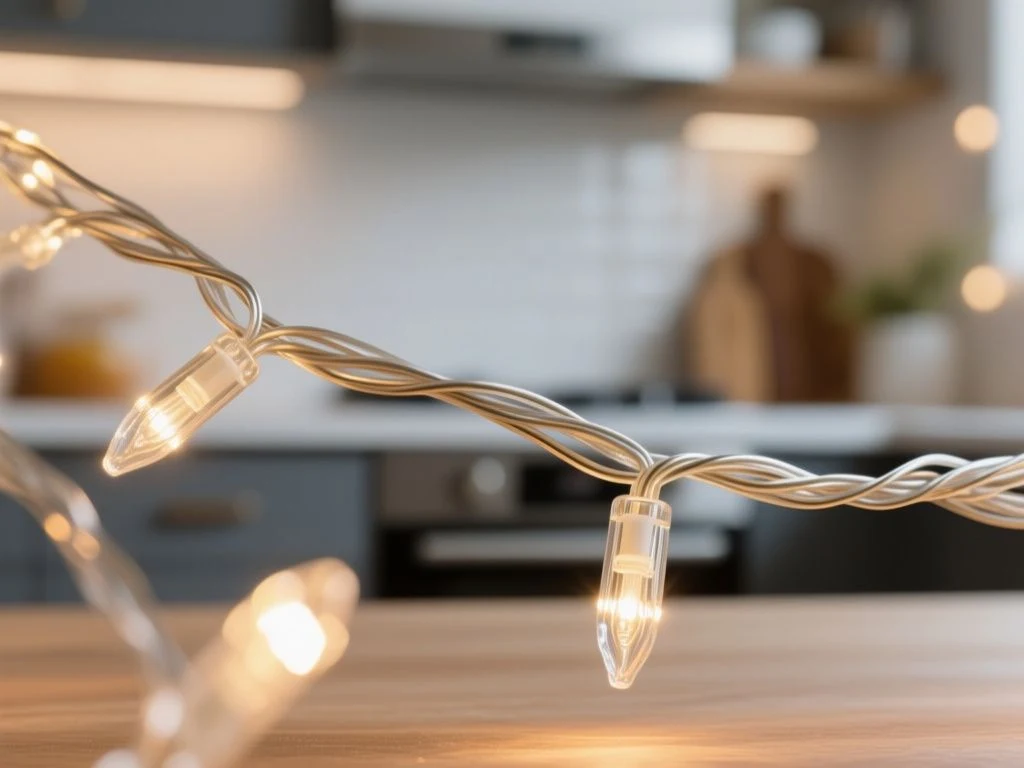
Warm white is the default for a reason. It mimics candlelight and makes skin tones look good. Cool white reads more sterile and works better in task-oriented spaces like a garage or a workshop. If the string will hang over a dining table or a bed, warm white is the safer choice. Many LED strings now offer selectable color temperature, so you can switch between warm and cool without buying two sets.
Wire Color and Visibility
Black wire disappears against dark fences and night skies. White wire shows up on white walls but looks terrible on a dark wood railing. Copper wire is nearly invisible against brick or stone but can tarnish over time. Match the wire to the background surface. If you are hanging lights across a window where the wire will be backlit, a thin clear or white wire will read less. For a boho look, intentional exposed copper wire is fine, but understand it is decorative, not hidden.
Dimmable or Not
Most cheap string lights are not dimmable. They run at full brightness and that is it. If you want to lower the output for a movie night or a dinner party, you need either a dimmable LED string with a compatible dimmer, or a smart plug that supports dimming (though most smart plugs only do on/off, not voltage dimming). Incandescent strings work with most standard wall dimmers if they are plugged into a dimmable outlet, but LED strings need a driver designed for that. Check the listing before buying a dimmer switch.
Hanging Without Holes: A Renter’s Method
Drywall anchors and nails are not your friends when you rent. Every hole must be patched and painted before you return the keys, and that work eats your deposit. The cleanest approach uses tension-based anchors that do not touch the wall surface at all.
Adhesive Hooks and Tension Rods
Adhesive hooks rated for the total weight of your string are the fastest solution. A lightweight 16-foot string of fairy lights might weigh under a pound, so small hooks work. Heavier G40 globe strings with glass bulbs can weigh three to five pounds, so you need hooks rated for at least that much, spaced every three to four feet. Remove the hooks by stretching the adhesive tab downward, not pulling outward, and the paint stays intact. For a more thorough comparison of adhesive strips versus nails for temporary mounting, see our Command Strips vs Nails guide.
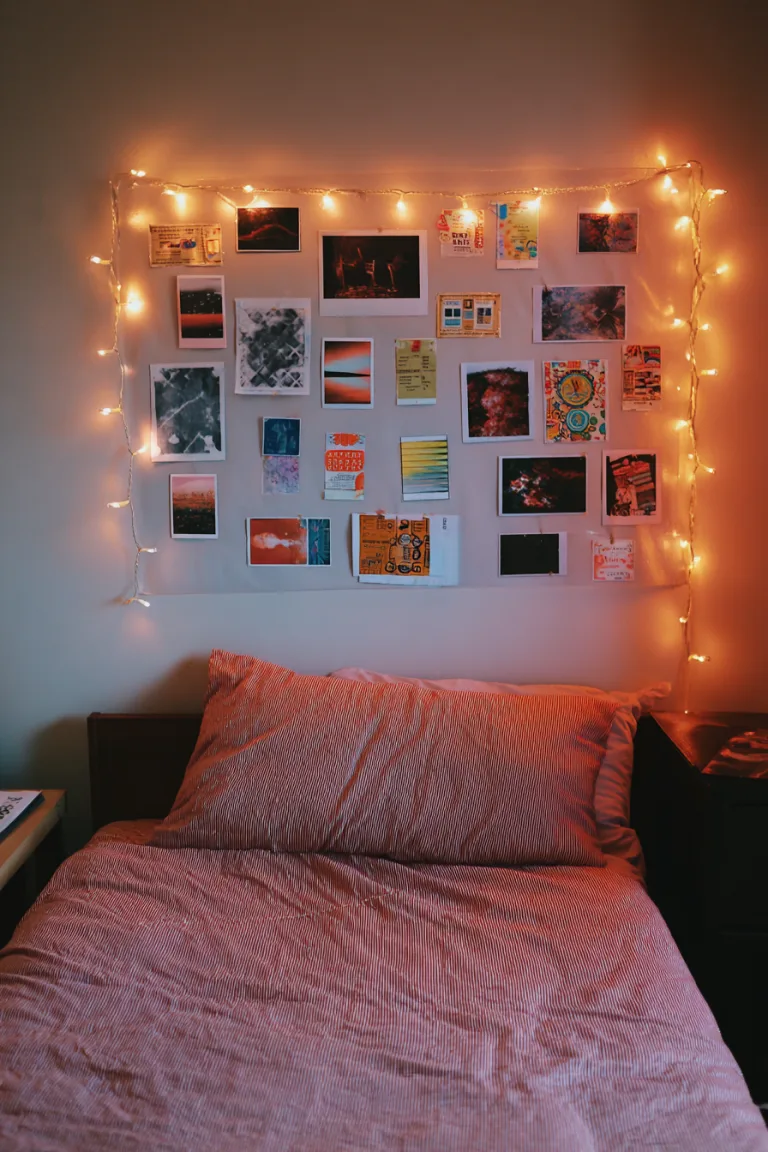
Tension rods are even better for windows, doorways, or alcoves. They press against two surfaces and leave zero residue. You can hang a curtain of lights from a tension rod above a bed or across a closet opening, and when the lease ends, you simply twist the rod out. No marks, no arguments.
Clips and Guides That Leave No Trace
Small plastic clips designed for string lights snap onto gutters, downspouts, or railings without screws. They cost a few dollars per pack and hold the wire securely. For a balcony railing, you can use zip ties, but remove them carefully with scissors to avoid scratching the metal. For a bare wall with no anchors, a strip of paintable caulk-safe adhesive tape works as a temporary wire guide, but test a small patch first on an inconspicuous spot.
If you are using string lights as the main light source on a desk or reading nook, understand they will not replace a proper task lamp. That guide explains the difference between ambient and focused light, and why you need both in a room.
Power Limits, Daisy-Chaining, and Running Costs
Every string has a maximum wattage stamped on the cord tag or listed in the manual. That number is not a suggestion. Exceeding it melts sockets, trips breakers, or starts a fire. If you want to connect multiple strands end to end, you need to know two things: the wattage per strand and the total wattage the first strand’s wiring can handle.
How Many Strands Can You Connect?
Most residential string lights are rated to connect three to five strands end to end, but that rating assumes all strands are the same model and the total wattage stays under the limit. A typical 48-foot LED string draws very little power, so five strands are safe. A string of large incandescent C9 bulbs can draw 175 watts per strand, so connecting three of them hits 525 watts, which is often the safety limit. Always check the tag. If the listing says end-to-end connectivity is supported, it will state the maximum number of strands.
The U.S. Consumer Product Safety Commission (CPSC) advises turning off decorative lights when you leave the room or go to sleep. Even with LEDs, a short in an aged wire can ignite nearby fabric or paper. A simple timer or smart plug removes the risk altogether, and it saves you the step of remembering at midnight.
Extension Cord Safety
Never plug a string light chain into an undersized indoor extension cord that is coiled up. The coil traps heat. Use a cord rated for outdoor use, with a gauge thick enough for the total load. For most LED strings, a 16-gauge outdoor cord is fine. For incandescent strings over 300 watts, step up to a 14-gauge cord. Keep all plug connections off the ground and covered with weatherproof outlet covers if the chain runs outside.
Outdoor outlets must be GFCI-protected. If your porch outlet is not, install a portable GFCI adapter that plugs into the wall first. It cuts power in milliseconds if moisture causes a ground fault, and that is the difference between a tripped breaker and a trip to the emergency room.
Cost to Run for a Season
An LED string that draws 10 watts, run for six hours a night through a three-month summer, uses about 5.4 kilowatt-hours. At the national average of 16 cents per kilowatt-hour, that is under one dollar for the entire season. An incandescent string of the same length might draw 100 watts, using 54 kilowatt-hours and costing closer to nine dollars. The LED set pays for its price premium in the first season alone, before you even consider bulb replacements.
Solar-powered strings have no operating cost, but they only work well in direct sun. A shady yard or a north-facing balcony will give you dim lights that fade by 10 p.m. Buy solar only if your mounting location gets at least six hours of unobstructed sunlight daily. Otherwise, low-voltage plug-in LED is the better investment.
Frequently Asked Questions
This string lights buying guide answers the most common questions from renters and first-time buyers.
What’s the difference between indoor and outdoor string lights?
Indoor lights use thin insulation and unsealed sockets, so moisture can cause shorts. Outdoor lights have thicker wire, rubber gaskets, and corrosion-resistant contacts. Outdoor strings also carry an IP rating (like IP65) that tells you how much water and dust they can handle. Never use an indoor string on a porch, even under an awning, because condensation alone can trip a breaker.
How many strands of string lights can I safely connect together?
Check the tag on the first strand. It states the maximum wattage for the chain and sometimes a maximum number of strands. Most LED strings support three to five end-to-end. Incandescent strings draw more power, so the limit is usually two or three. Never exceed the printed number, and avoid mixing different brands in one chain, because wire gauges and socket types can mismatch.
Why does one dead bulb take out a whole section of my string lights?
That is the signature of series wiring. In a series circuit, the current must pass through every bulb in sequence. One open filament stops the flow to all bulbs downstream. Parallel-wired strings isolate each bulb, so a single failure only darkens that one socket. This is the single most important feature to check before buying, and it is exactly why this guide puts wiring topology at the top.
Can I leave string lights on all night without a fire hazard?
With LED lights on a GFCI-protected circuit and no extension cord hidden under a rug, the risk is low. But any electrical device can fail, and the CPSC recommends turning off decorative lights when unattended. Use a timer or smart plug to shut them off automatically. Incandescent lights generate heat, so leaving them on all night near fabric or leaves is never advised.
How do I hang string lights without drilling holes in my siding?
Use adhesive hooks rated for the total weight, spaced every three to four feet. For vinyl or aluminum siding, clip-style hooks that slide under the panel edge work without any adhesive. A tension rod across a porch ceiling or between two posts holds a string without any attachment to the wall. For a deeper dive into adhesive options versus nails, read our Command Strips vs Nails guide.