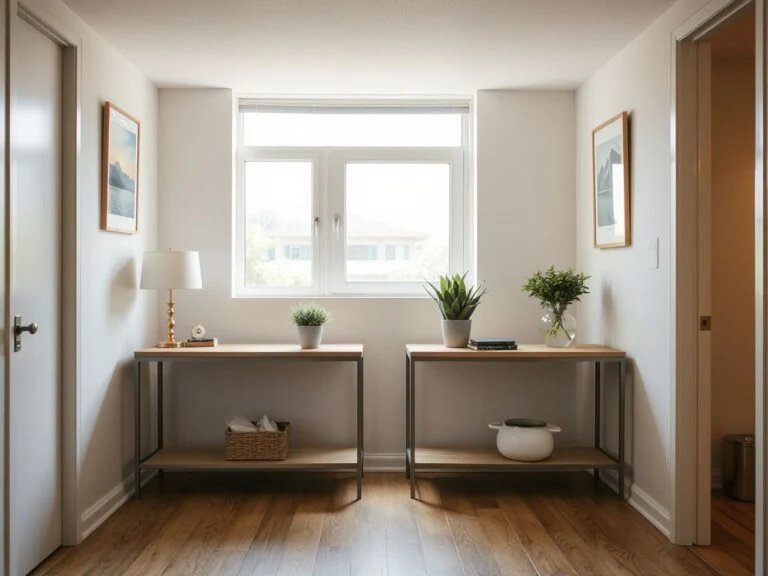
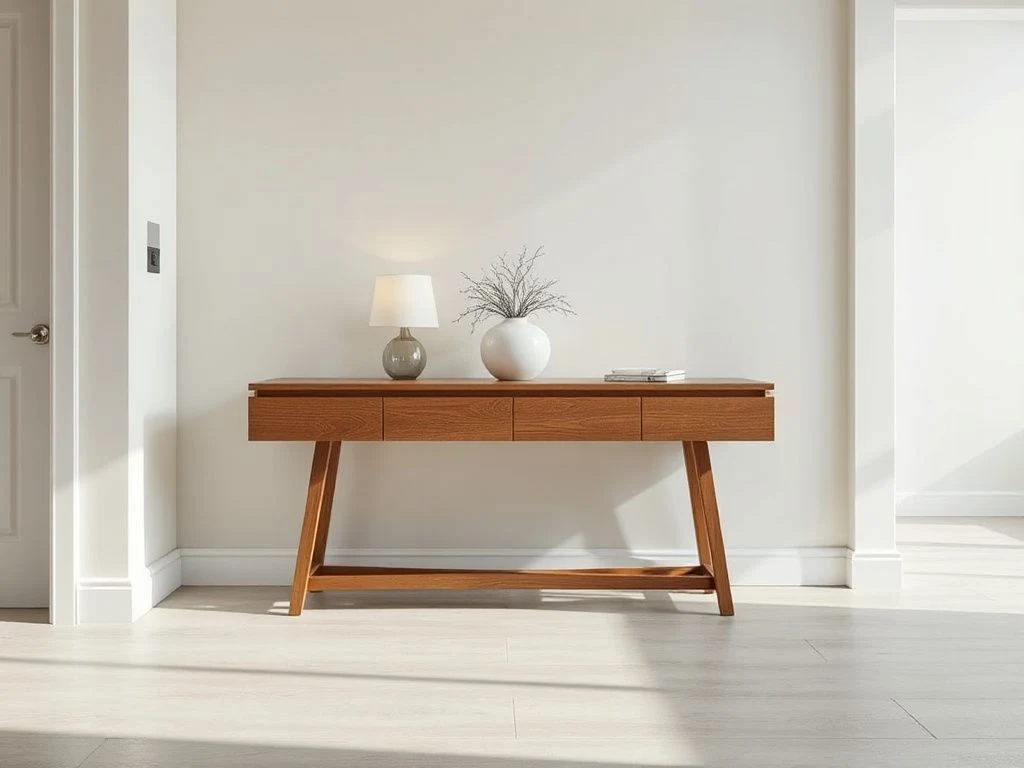
The U.S. Consumer Product Safety Commission tracks furniture tip-over incidents every year, and a striking share of them involve pieces nobody would call heavy or tall. A console table is exactly that kind of piece: long, shallow, top-heavy the second you set a lamp and a stack of books on it. That single fact reframes what a smart console table buying guide should be about.
Most shopping starts with the wrong number. People measure how long a console is and stop there, when the real fit problem is depth — how far the thing juts into a walkway, and whether its height meets the sofa back it sits behind. Construction judgment matters more here than on almost any other furniture, because a console spans a long unsupported top on a shallow base. Joinery type and top material predict sagging and wobble far better than a label reading solid wood.
For renters, it is important to consider whether a piece can be anchored, moved, and un-anchored without damaging a wall. That lens changes what counts as a good buy, and it runs through everything below.
Key Takeaways
- Depth decides the fit, not width. Aim for a 12–16 inch depth in hallways and keep the total clear walkway to around 36 inches.
- Joinery and top material predict failure. Mortise-and-tenon or bolted frames stay tight; a long unsupported veneer or glass top is where sagging and tipping start.
- Height should meet the sofa back. Standard 30–34 inch consoles are built to sit near the top of a sofa; a piece far above or below breaks the visual line.
Start with depth and proportion, not the length on the tag
Width is the number stores lead with because it photographs well. It is rarely the number that ruins a room. Depth is.
A standard console runs 12 to 18 inches deep, and that range exists for a reason. In an entryway against a solid wall you can push toward the deep end for a usable surface. In a hallway, every inch past about 16 inches starts eating the path people actually walk.
Behind a sofa, depth works differently. A sofa table wants to be shallow — often 10 to 14 inches — so it tucks against the back without adding a bulky ledge you bump with your knees when you sit down. The console table, the sofa table, and the entryway table are the same object wearing three job titles; what changes is the depth and height you should target for each spot.
How deep behind a sofa versus against a wall
- Entryway wall: 14–18 inches is fine if the corridor is wide; you want a surface big enough for a tray, keys, and mail.
- Behind a sofa: 10–14 inches keeps it flush and unobtrusive, since you only need room for a lamp base and a couple of objects.
- Narrow hallway: 12 inches or less, full stop. Measure the walkway first, then shop.
Here is the proportion rule that saves people from the too-big look: a console should generally be shorter than the wall or sofa it sits against — roughly two-thirds of a sofa’s length is a reliable target. Matching or exceeding that length reads as heavy and off-balance, even when the tape measure says it technically fits.
The most common console table buying guide mistake is trusting the width and ignoring the height. A console much lower or higher than the sofa back snaps the horizontal line your eye expects, which is why a piece can look wrong in a room even though the width seemed perfect on paper.
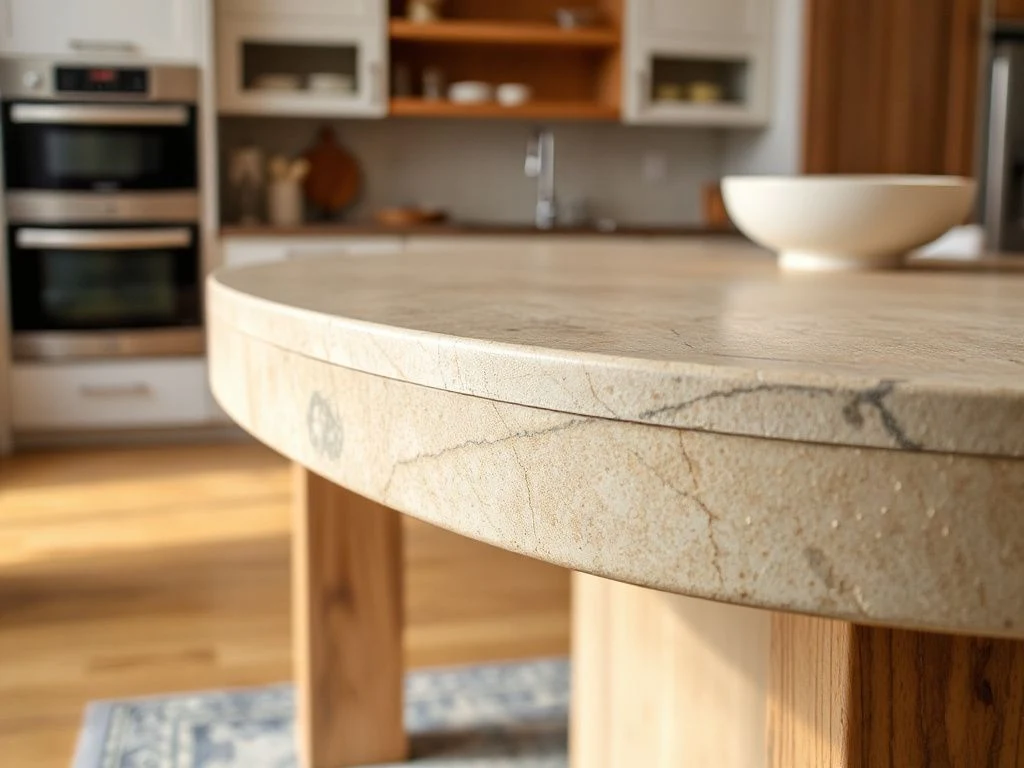
Solid wood, veneer, MDF, glass, and metal: what the material actually changes
Materials get argued about like they are moral positions. For a piece that mostly holds a lamp, the honest answer is more nuanced than “solid wood good, everything else bad.”
The four constructions you will actually see
- Solid hardwood (solid oak, walnut): heavy, stable, refinishable. It resists sagging over a long span better than any panel product, and it is the only option you can sand and re-oil years later. It is also the priciest and the hardest to move alone.
- Veneer over particleboard or MDF: a thin real-wood face glued to an engineered core. It looks like the real thing and holds up fine for light duty, but the core swells if water sits on it and the thin face cannot be sanded much.
- MDF (medium-density fiberboard): dense, smooth, dimensionally stable, and cheap. It takes paint beautifully. It is heavy for its strength and it hates moisture — a swollen MDF edge never goes back.
- Powder-coated steel frame with a tempered glass top: visually light, easy to clean, and stable if the frame is welded rather than bolted. Glass will not sag, but it also will not forgive a dropped ceramic vase.
For something that holds a lamp and a bowl, veneer or MDF is genuinely enough, and you are not being cheated by choosing it. The place material stops being cosmetic is load and span. A long unsupported veneer or thin MDF top with weight in the middle will bow over time; solid wood and a properly framed glass top will not.
If low chemical emissions matter to you — a real concern with engineered wood, which can off-gas formaldehyde — look for GREENGUARD Gold certification, administered through UL. GREENGUARD Gold sets stricter limits suited to schools and healthcare, and it is the clearest signal that an MDF or particleboard console was tested for indoor air quality rather than just assembled cheaply.
Joinery is the tell most shoppers skip
How the parts connect predicts wobble more reliably than what the parts are made of. Two systems dominate:
- Mortise-and-tenon (or doweled, glued frames): the traditional interlocking joint. It gets stronger under load and rarely loosens. You find it on better solid-wood pieces and it is why they survive decades.
- Cam-lock (the round disc and bolt in flat-pack furniture): fast to assemble, but it relies on friction and a bolt biting into engineered board. Repeated tightening chews the hole, and that is where the classic flat-pack wobble comes from.
Cam-lock is not automatically bad. It is bad when it is the only thing holding a long top to a shallow base with no corner bracing. Look under the top: metal corner brackets or a stretcher bar between the legs is what keeps a cam-locked console from racking side to side.

Fitting a console in a real room, walkway included
Getting the fit right is arithmetic, not taste. Do the arithmetic before you fall in love with a finish.
Height relative to the sofa back
A standard console at 30 to 34 inches is designed to land at or just below the top of a typical sofa back. That alignment is the whole point behind a sofa. Measure your sofa’s back height first; if it sits at 32 inches, a 30-inch console reads as intentional, while a 26-inch one looks like it wandered in from a different room.
Walkway clearance in a hallway
The working rule for a comfortable path is about 36 inches of clear walkway. In a tight hall, subtract the console’s depth from your hallway width and see what’s left.
- Measure hallway width wall to wall.
- Subtract the console depth you’re considering.
- If the remainder drops below 30 inches, go shallower or skip the console entirely.
This is also why the tape-on-the-floor trick earns its keep. A 40-inch-wide console fits a 42-inch wall on paper and looks cramped and wall-hugging in person, because you left almost nothing on either side.
Scale above the console
Whatever goes above — a mirror or art — should span roughly two-thirds the console’s width and hang with about 4 to 8 inches of breathing room between the top of the table styling and the bottom of the frame. Removable adhesive strips are recommended for hanging mirrors when the weight allows, and our breakdown of Command Strips versus nails covers the weight limits where strips stop being safe and a real anchor becomes non-negotiable.
Why consoles wobble, sag, and tip — and how to stop it
A console fails in three predictable ways: it racks (twists at the joints), it sags (the top bows), or it tips (the whole thing goes over). Each has a cause you can inspect for.
Wobble and racking
Side-to-side wobble almost always traces to the base, not the top. Four straight legs with no stretcher and only cam-lock joints have nothing resisting the twist. Designs that stay tight share a feature: a lower shelf, an H-stretcher, or a solid trestle base that ties the legs together and turns a wobbly rectangle into a rigid one.
A console with a lower shelf is structurally stiffer than the same console with open legs, because the shelf braces the base against twisting. That shelf earns its place twice — as bracing and as storage.
Sagging tops
Sag is a span problem. A top over about 48 inches with no center support and weight parked in the middle will bow, and thin veneer or MDF bows soonest. If you want a long console that holds real weight, you want either solid wood, a center leg or divider, or a metal frame carrying the top rather than the panel doing all the work.
Tipping — and whether renters and parents should anchor
Anchoring is not just for tall dressers. A shallow, narrow-footprint console is easy to tip forward, and a child pulling up on the edge or a drawer left open changes the math fast. Reputable manufacturers design to the ASTM International tip-over standard ASTM F2057, and many ship an anti-tip wall-anchor kit in the box for exactly this reason.
If there are young kids in the home, anchor it — this is non-negotiable. As a renter, the good news is that a furniture wall strap uses a single small screw into a stud and patches with a dab of spackle when you leave, which is a fair trade for keeping a loaded console from coming down on a toddler. General furniture tip-over safety is worth taking seriously across the whole home, not only for the obvious tall pieces.
Storage, weight limits, and living with the thing
Consoles come in three storage layouts, and the right one depends on what you’re hiding.
- Drawers: best for small clutter you want out of sight — keys, chargers, mail. They add weight and cost and rely on runner quality, so open and close them in the store.
- Lower shelf: the most flexible option and, as noted, a structural bonus. It swallows baskets and stiffens the base at once.
- Open design: lightest and airiest, no hidden storage. It suits small entries where visual bulk is the enemy.
If you go the shelf route, matched bins tame the look; our comparison of fabric bins versus wicker baskets is a useful next stop for sizing the under-shelf storage to what you actually stash there.
How much weight can it really hold
Manufacturers list a top weight rating; when they don’t, treat the number as unknown and load conservatively. A tempered glass or thin veneer top is fine for a lamp, a tray, and books, but it is the wrong surface for a heavy stone sculpture or a stack of cast-iron anything. Weight rating and top material together set the real limit, not the price.
Cleaning without ruining the finish
- Solid wood and veneer: wipe with a barely damp cloth and dry immediately; standing water is the enemy, especially at veneer seams. Re-oil solid wood as it looks dry.
- MDF with a painted or laminate face: mild soap and a damp cloth only — never soak it, since a swollen MDF edge is permanent.
- Glass: any standard glass cleaner; a microfiber cloth avoids streaks.
- Powder-coated steel: damp cloth; skip abrasives that scratch the coating and expose the metal to rust.
The EPA’s guidance on indoor air quality is a reasonable reference if you’re reacting to a chemical smell from a new engineered-wood piece; you can read the agency’s material at EPA.gov. A short airing-out period in a ventilated room usually settles a new console, and low-emission certification cuts that down further.
Flat-pack versus fully assembled, and what it’s worth
Flat-pack from a mass-market maker like IKEA gets a bad reputation it only half deserves. A flat-pack console is not doomed to fall apart — a well-braced one with a shelf and corner brackets can last for years. What fails is the combination of long span, cam-lock joints, engineered board, and no bracing, all at once.
Mid-tier lines from makers such as West Elm and Crate & Barrel sit between flat-pack and heirloom solid wood, often mixing solid legs with veneered tops. For a renter who moves every couple of years, that middle ground frequently makes the most sense: light enough to carry, sturdy enough to survive the move, and cheap enough that a scuff isn’t a tragedy.
The honest read: buy solid wood if you’ll keep it a decade and can lift it; buy a well-braced flat-pack or mid-tier veneer if you move often and value being able to carry it up a stairwell alone. The construction details above matter more than the brand tier.
Frequently Asked Questions
How deep should a console table be for a hallway versus behind a sofa?
In a narrow hallway, stay at 12 inches or less so you keep roughly 36 inches of clear walkway. Behind a sofa, 10 to 14 inches keeps it flush and knee-friendly. Against a solid entryway wall with room to spare, you can go 14 to 18 inches for a more usable surface. Measure the walkway first, then choose depth — never the reverse.
Does solid wood really matter for a console that just holds a lamp?
For light duty, no — good veneer or MDF is genuinely fine and often smarter for renters who move. Material starts mattering when the top spans a long distance or carries real weight, since thin panels bow while solid wood does not. Joinery matters more than the material label: a braced, well-jointed veneer console outlasts a poorly assembled solid-wood one.
Do I actually need to anchor a console table to the wall?
If there are young children in the home, yes. A shallow, narrow console tips forward easily when a child pulls up on it or an open drawer shifts the weight. Reputable pieces are built to the ASTM F2057 tip-over standard and often include an anchor kit. The strap uses one small screw into a stud and patches easily, so even renters can install and remove it cleanly.
What height should a console be relative to the sofa back?
Aim for a console that lands at or just below the top of the sofa back, which is why the 30 to 34 inch standard exists. Measure your sofa’s back height and match it within a couple of inches. A console far lower or higher breaks the horizontal line your eye expects and makes the pairing look accidental, even if the width is correct.
Why does my console look too big even though the width fit the wall?
Because matching the wall’s full width reads as heavy. A console should span about two-thirds of the wall or sofa it sits against, leaving visible space on both ends. Showroom floors also trick the eye into sizing up. Tape the footprint on your floor before buying so you judge it at your room’s real scale, not the store’s.