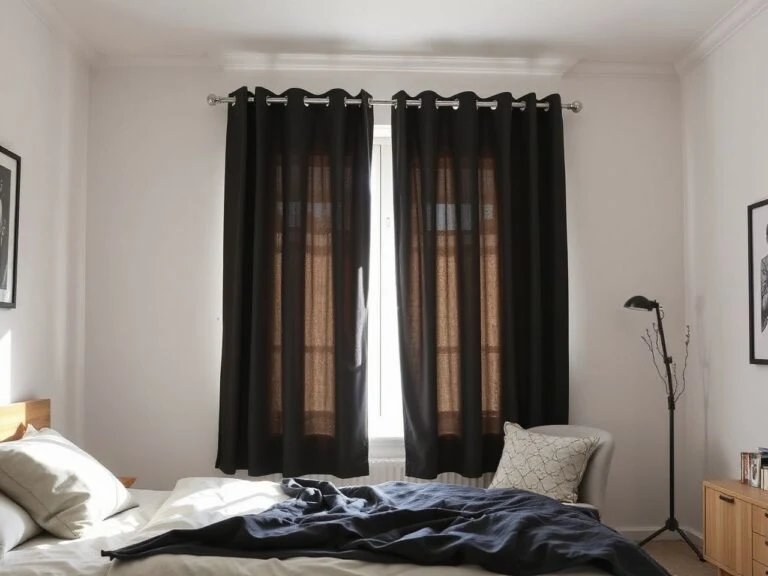

Here’s the short answer: the Petaholic 100% Blackout Curtains are the set suited for when sleep is a priority, and the ChrisDowa Blackout Curtains are the smarter everyday pick for living rooms. Shopping for blackout vs room darkening curtains gets confusing fast because brands use both labels loosely. The real difference lives in the backing layer and whether the panels actually cover the full window frame, not just the glass.
When deciding between blackout vs room darkening curtains for a nursery, master bedroom, or home theater, the Petaholic set is recommended for its silver-coated backing and cut-to-fit design that address the two failure points that let light sneak past most panels.
📌 This article contains affiliate links. As an Amazon Associate I earn from qualifying purchases, at no extra cost to you. Full disclosure.
CERTAIN CONTENT THAT APPEARS ON THIS SITE COMES FROM AMAZON. THIS CONTENT IS PROVIDED ‘AS IS’ AND IS SUBJECT TO CHANGE OR REMOVAL AT ANY TIME.

ChrisDowa Blackout Curtains (Room Darkening Workhorse for Living Areas)
Blackout vs Room Darkening Curtains: Comparison at a Glance
| Product | Best For | Buy Link |
|---|---|---|
| Petaholic 100% Blackout Curtains for Bedroom | Total darkness sleepers | Check Price |
| ChrisDowa Blackout Curtains for Bedroom and Living Room 63 Inches Long | Everyday light control | Check Price |
How We Picked Between Blackout and Room Darkening Curtains
These two picks came from comparing what manufacturers actually publish — fabric construction, backing type, panel dimensions, header style, and care instructions — against the criteria that decide whether curtains work in a real bedroom. The primary failure mode in this category is light leakage at the seams and edges, which shows up when a curtain’s declared width is too narrow for the window or the header doesn’t let panels hug the wall. So we weighed measured coverage relative to window size first, then header type (grommet vs rod pocket) and how well each seals, then fabric weight for drape. The care instruction matters more than most people think: blackout backings often degrade with washing, so a curtain labeled blackout can quietly become room darkening after a few cycles. Before ordering, measure your window frame width and multiply by at least 1.5 — that’s the minimum combined curtain width you need to stop side leakage. The reasoning here draws from specification sheets and the known behavior of these materials, not from a hands-on install.
Petaholic 100% Blackout Curtains (True DIY Light Blocking)
Quick take: This set is for the person who wants actual darkness — a shift worker, a migraine sufferer, a parent of a light-sensitive napper — and is willing to do a little cutting to get it.
When you compare blackout vs room darkening curtains, the difference usually shows up in whether the fabric has a coated backing — and the Petaholic goes all in with a special silver coating on the reverse side. That backing is what puts the “100%” in the blackout claim; it reflects light rather than trying to absorb it through dense weave alone. A coated backing like this gives a slightly stiffer, heavier drape than an uncoated triple-weave, which means the panel is less likely to bow away from the wall at the bottom. The trade-off is that silver-coated backings can crack or flake if you machine-wash them on hot or tumble-dry aggressively — that’s the quiet demotion from blackout to room darkening I flagged earlier.
The DIY cut-to-size feature is the other half of what makes this panel interesting. Most off-the-shelf curtains force you to pick from three or four fixed lengths, and if your rod height falls between them, you either live with a gap or bunch fabric on the floor. With the measure > cut > connect approach, you trim the panels to the exact drop for your window. That’s the single most effective anti-leakage step you can take short of wrapping the rod around the window casing. The annoyance: cutting a straight line through a coated fabric requires patience and a sharp blade. Compare that to the ChrisDowa, which comes in a fixed 63-inch length — no cutting required, but also no fitting to your exact sill.
Pros:
- True 100% blackout claim — the silver-coated backing reflects light rather than relying on weave density alone.
- Cut-to-size flexibility — measure, cut, and connect panels to fit non-standard or oddly placed windows without gaps at the sill.
- Ten-minute install path — the listing’s measure > cut > connect sequence means no sewing or special hardware beyond what’s included.
- Coated-back stiffness helps drape — the firmer fabric is less likely to bow away from the wall at the bottom edge, where light tends to sneak in.
- No fixed length limits — you aren’t stuck choosing between 63 and 84 inches when your window needs 71.
Cons:
- Silver backing is wash-fragile — hot water or aggressive machine cycles can crack the coating, which is how a 100% blackout silently becomes 70%.
- Cutting precision is on you — a wobbly cut along the coated fabric leaves a jagged hem and a visible light gap.
- No grommet or header type specified — the listing stays quiet on the top construction, which matters because certain rod-pocket headers bunch and let light through at the rod.
Our Take
Best for: Bedrooms, nurseries, and home theaters where full darkness is non-negotiable and you’re willing to do the cutting work. Skip if: You want wash-and-hang simplicity or you’re buying for a living room where 80–90% blockage is plenty.
ChrisDowa Blackout Curtains (Room Darkening Workhorse for Living Areas)
The real story: This is the pick for people who want glow-killing privacy without paying for total blackout — renters, living room refinishers, and anyone whose bedroom already has decent blinds.
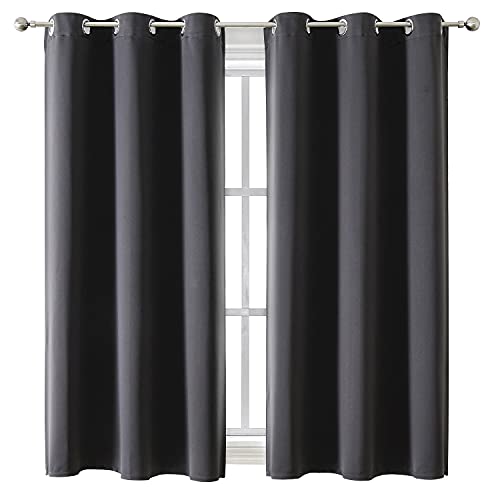
Each package includes two charcoal gray panels, each 42 inches wide by 63 inches long, with six silver metal grommets per panel. Grommets matter here because they let panels slide easily and hang flat, which removes the bunching problem you get with rod-pocket curtains. The fabric is listed as thick, with the same solid color on both sides — a genuine plus, because many cheaper curtains have a printed front and a white back that looks sloppy from the street. The charcoal shade does legitimate work too; the listing notes darker colors block more light, and at 98% sunlight and UV blockage this is what I’d call a room darkening curtain wearing a blackout label. For most living rooms, that 2% gap is genuinely invisible. For a night-shift nurse trying to sleep at noon, it’s a halo of light around every edge.
If you’re still deciding on blackout vs room darkening curtains, the ChrisDowa sits on the room-darkening side of that spectrum at 98% blockage. Where this panel gives up ground compared to the Petaholic is in what it trades to hit its price. There’s no coated backing and no cut-to-fit option — you get 63 inches, period. If your windows are taller, you need a higher rod or a different product. The 42-inch width is the spec to check against your own window: a standard 36-inch window technically fits, but with almost no side overhang, so any warp in the panel or gap at the rod means visible light sneaking past the edges. Buying two pairs and overlapping panels in the middle is the standard fix, and the grommet header makes that layering move easy. The noise reduction and privacy claims are believable based on fabric weight alone, though the listing doesn’t give an ounce-per-yard figure.
Pros:
- 98% light and UV blockage — dark enough for living rooms and media spaces, and the charcoal gray boosts that number by absorbing rather than reflecting.
- Six metal grommets per panel — the smooth-sliding header keeps panels flat against the rod, a big part of why edges stay sealed.
- Same color on both sides — no white-back peeking through your front window, a detail most budget curtains skip.
- Two panels per package — covers a standard window with one order, and the 42-inch width per panel gives layering room if you double up.
- Noise and privacy benefits — the thick fabric dampens street sound better than a light linen or sheer, which matters in ground-floor rooms.
Cons:
- Fixed 63-inch length only — if your rod sits higher, the panels stop short of the sill, and there’s no made-to-measure path.
- No backing layer — the 98% figure comes from dense weave and dark color, not a coated reverse, so performance fades more with sun exposure and washing.
- 42-inch width demands measuring — a wide picture window needs two or even three pairs to avoid side light leakage, which doubles the cost.
The Bottom Line
Best for: Living rooms, dining areas, and bedrooms where a little ambient glow is acceptable in exchange for an easier install and a gentler price. Skip if: You’re dressing a nursery for a nap-fighting toddler or a bedroom for a shift worker — the 2% gap plus fixed sizing will drive you to the DIY route anyway.
Blackout vs Room Darkening Curtains: What Actually Matters
The gap between these two categories isn’t marketing fluff. True blackout curtains — like the Petaholic with its silver-coated backing — are built around a barrier layer that physically stops light. Room darkening curtains, which is what the ChrisDowa realistically is, lean on dense weave and dark color to knock out most but not all of the glow. If you’re styling the window as part of a larger living room refresh, our earth tones living room guide explains how charcoal and neutral panels anchor the palette. The Sleep Foundation has documented how darkness drives melatonin production, which is the whole reason 100% matters for shift workers and naps.
Should You Buy Blackout or Room Darkening Curtains for Your Bedroom?
If the room needs to stay dark at 2 p.m. — for a baby’s nap, a migraine, or a night shift’s daytime sleep — buy the true blackout. The difference is the backing layer, not the color. A dark-colored sheer still leaks light, while a light-colored triple-weave with a coated back can outperform a dark single-layer fabric. That’s the single most misunderstood point in this whole category. Weave density and the presence of a foam or acrylic backing matter more than the panel’s shade. Room darkening curtains in a neutral weave do double duty in a modern farmhouse living room, where light filtering matters less than texture and softness.
What Stops Light at the Edges — Not Just Through the Fabric
Even a 100% blackout curtain leaks if you hang it wrong. The panels must be wider than the window frame — I’d aim for at least 1.5 times the frame width in combined panel coverage — and the rod should extend 6 to 8 inches past the casing on each side. Overlapping the two panels in the middle by a few inches and letting the bottom hem touch the floor or the sill eliminates the rest of the leakage. Grommet headers like the ChrisDowa’s are easier to overlap cleanly than rod pockets, which bunch and create light shafts at the rod line. The U.S. Department of Energy lists insulated window treatments as a measurable way to cut heat gain in summer and loss in winter — a side benefit that coated blackout backings deliver better than uncoated weaves.
Washing and Longevity: The Hidden Cost of Coatings
Blackout backings — the silver coating on the Petaholic and the acrylic backs on many premium panels — degrade with aggressive washing. Hot water, high-heat drying, and repeated cycles crack or flake the coating, and a curtain that started at 100% blockage can drop to room-darkening levels within a year. The ChrisDowa’s uncoated weave survives washing better but loses more blocking power to sun fading over time because there’s no reflective layer to protect the color. If you wash curtains every few months, the uncoated option ages more gracefully; if you rarely wash them and you need total darkness, the coated pick holds its edge longer.
Our Final Recommendation
If you want real darkness — for a nursery, a migraine-prone adult, or a shift worker — the Petaholic 100% Blackout Curtains are the only honest blackout in this comparison, because the silver-coated backing and cut-to-fit sizing attack edge leakage instead of hoping it goes away. The ChrisDowa set is the budget and lifestyle pick: grommets, two panels, and 98% blockage cover most living rooms and secondary bedrooms cleanly. Overall, my money’s on the Petaholic for sleeping spaces and the ChrisDowa for everywhere else — but if you can only buy one and it’s going in a bedroom, get the Petaholic.
Frequently Asked Questions
What’s the actual difference between blackout and room darkening curtains?
True blackout means the fabric carries a dedicated barrier layer — a foam or silver-coated backing like the Petaholic’s — that physically stops nearly all light. Room darkening, which is what the ChrisDowa’s 98% figure represents, relies on dense weave and dark color to block most but not all light. The difference shows up at the edges and in bright daylight, which is why true blackout matters most for nurseries, night-shift bedrooms, and home theaters, while room darkening suits living rooms and dining areas.
Do I need blackout curtains or room darkening curtains for a baby’s nursery?
Go blackout. A baby’s nap schedule doesn’t respect sunny afternoons, and the gap between 98% and 100% is exactly where those naps fall apart. The Petaholic’s cut-to-fit sizing also helps in a nursery, where windows often sit at non-standard heights above changing tables and cribs. Skip the room-darkening route for this room; the two-percent gap will turn a 1 p.m. nap into a 45-minute fight.
How do I measure my window so light doesn’t leak around the edges?
Measure the full window frame width, not just the glass, then multiply by at least 1.5 — that’s the minimum combined curtain width you need for clean side coverage. The rod should extend 6 to 8 inches past the casing on each side so the outer panels can sit flat against the wall. Panel length should run from the rod to the floor or a few inches past the sill. With the ChrisDowa’s fixed 42-inch width per panel, a wide picture window likely needs two pairs.
Can I wash blackout curtains without ruining the backing?
Yes, but gently. Cold water, a mild detergent, and a low-heat or air-dry cycle are the limits for coated backings like the Petaholic’s silver layer. Hot water and machine drying are what crack and flake those coatings, which drops a 100% curtain to room-darkening territory within a few washes. The ChrisDowa’s uncoated weave is more wash-forgiving, but it trades that durability for slightly less blocking power.