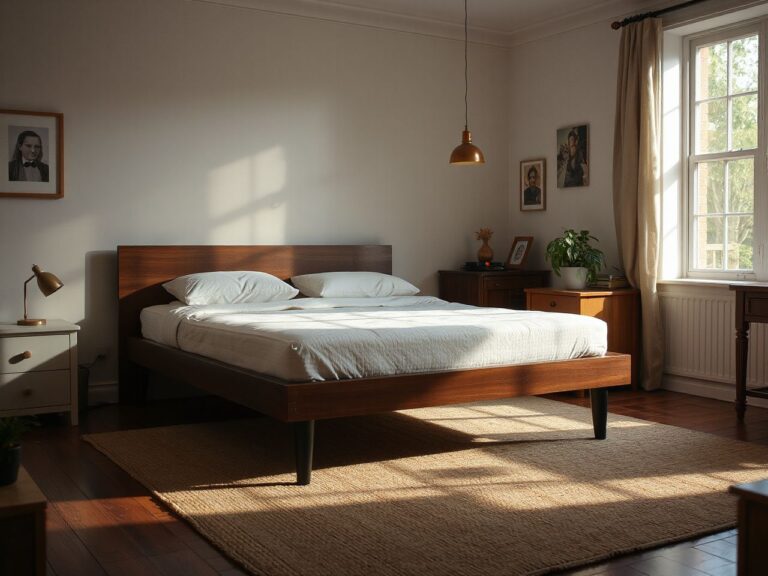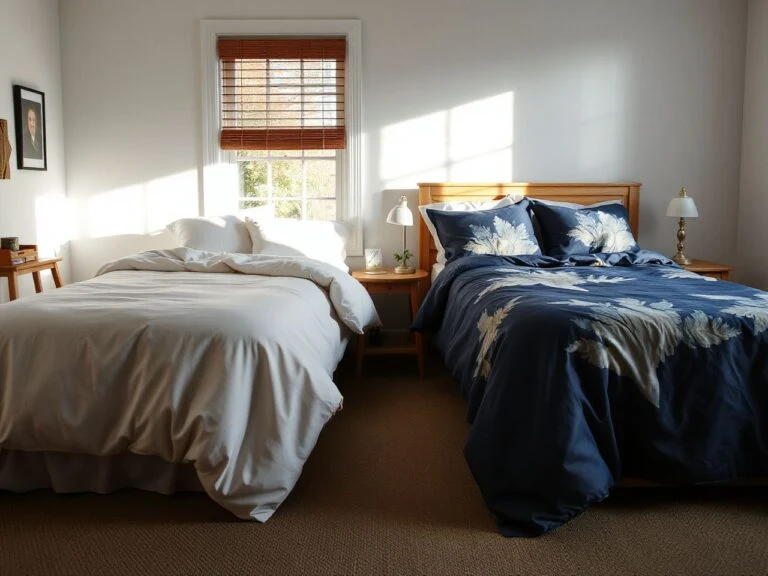
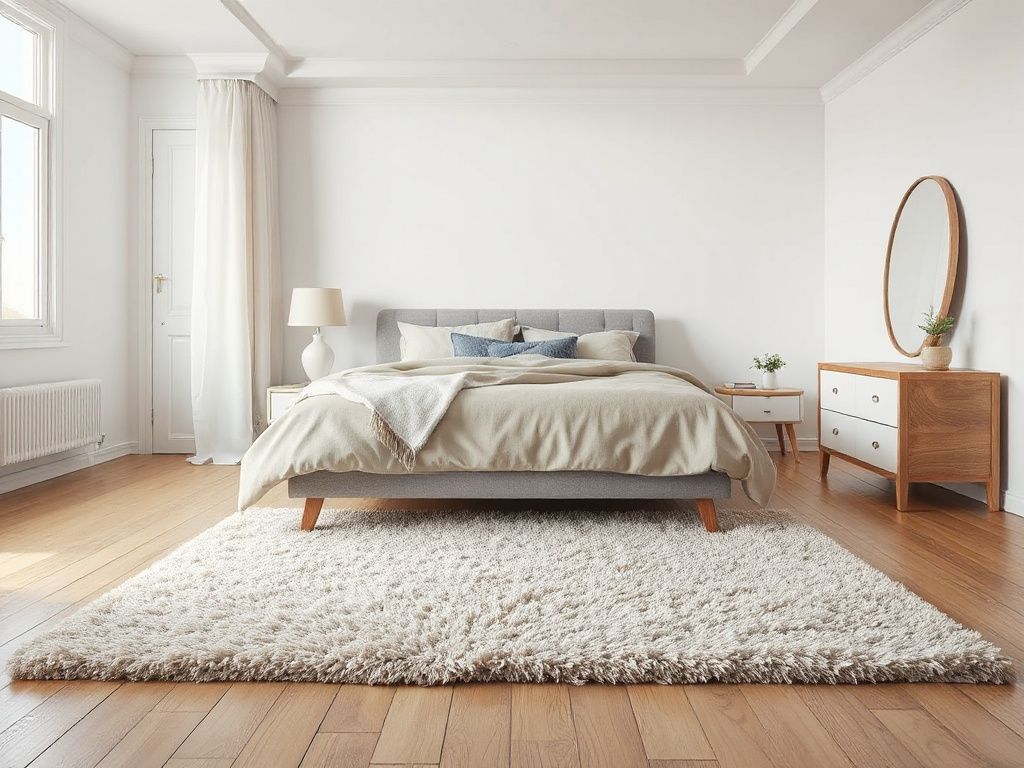
You’ve measured the bedroom twice, taped out three different rug footprints on the floor, and every online chart still gives you a different number. The queen bed sits there—60 inches wide and 80 inches long—and you need a rug that does more than just slide under the footboard. The real question behind “what size rug for a queen bed” isn’t answered by a single number, because the answer depends on whether you want the rug to include your nightstands, how much flooring you want visible, and whether the bedroom door swings over the rug’s edge.
Key Takeaways
- A 5×8 rug is too small for a queen bed; the minimum workable size is 6×9 if you keep nightstands off the rug, or 8×10 to include them.
- The rug should extend 18–24 inches beyond the sides of the bed and at least 24 inches past the foot for safe, balanced stepping.
- Always pair the rug with a non-slip pad, especially on hardwood or tile, and check door clearance before unrolling anything.
What Size Rug for a Queen Bed: The Foundation Numbers
A queen mattress measures exactly 60 inches by 80 inches. That’s the bed, and every other decision starts from those two numbers. But here’s the part most sizing guides skip: your nightstands are part of the equation. Typical bedside tables run 22 to 28 inches wide each, which means a queen bed flanked by nightstands demands a floor footprint of at least 104 inches wide—and that’s before you add any breathing room for rug edges. If the rug doesn’t extend far enough to let both nightstands sit fully on it or fully off it, you’ll end up with legs straddling the rug edge, a look that reads as sloppy no matter how nice the weave is.
Standard rug sizes that matter here are 5×8, 6×9, 8×10, and 9×12. The first one—5×8—is almost always a mistake under a queen bed. A 5-by-8-foot rug covers only the bottom two-thirds of the mattress, leaving the headboard and nightstands floating on bare floor, which makes the bed look smaller than it is. By the numbers, a 5×8 gives you 60 inches of width, which is exactly the bed width, so there’s zero rug visible on either side when you’re standing at the foot. That defeats the entire purpose of a rug in a bedroom: a soft landing zone and a visual anchor.
Why 6×9 Becomes the Baseline for Lower Placement
If you decide to keep nightstands off the rug, a 6×9 rug is the smallest workable option. It measures 72 inches wide, so with the bed centered, you get 6 inches of rug on each side. That’s below the recommended 18–24 inches, but it’s visually acceptable when the rug sits under only the lower two-thirds of the bed and you’ve consciously chosen not to include the nightstands. The key is that the rug must end before the nightstands begin. Position the rug so its top edge sits roughly 12–18 inches in front of the nightstands, under the bed’s lower third, and let the foot of the rug extend about 24 inches past the bed foot. This deliberate placement makes the rug read as an intentional layer rather than a too-small mistake.
Why 8×10 Becomes the Standard for Full Coverage
To get the bed and both nightstands onto the rug, you need an 8×10 rug at minimum. An 8-by-10-foot rug placed with its long axis along the bed provides 18 inches of exposed rug on each side of a queen mattress, which is the minimum width that allows you to step out of bed without touching bare floor. At the foot, the 10-foot length gives you 20 inches of rug beyond the 80-inch bed when the bed is centered along the length. That works, but many people prefer a 9×12 because its 9-foot width delivers 24 inches on each side, and its 12-foot length gives 32 inches at the foot—a much more generous landing zone.
An 8-by-10-foot rug under a queen bed leaves exactly 18 inches of exposed rug on each side of the mattress, which is the minimum width that allows you to step out of bed without touching bare floor.
Two Placement Strategies for a Queen Bed Rug
The decision between full coverage and lower two-thirds placement isn’t about which one is prettier—it’s about how much of the floor you want covered and whether you’re willing to buy a larger rug. Think of it like hardware: you choose a bolt size based on the load, not the finish. The load here is foot traffic, nightstand weight, and visual balance.
Strategy One: Rug Under the Bed and Both Nightstands
This is the cleaner, more anchored look. You need an 8×10 or 9×12 rug, and you position it so the bed sits in the center of the rug with equal overhang on all sides. The rug extends 18–24 inches beyond the left and right edges of the bed, and at least 24 inches beyond the foot. Nightstands sit fully on the rug, which means their legs won’t catch the rug edge. The benefit is that the entire bed area feels like one cohesive zone, and you get a soft landing no matter which side you exit from.
For a 9×12 rug, the math works out to 24 inches of rug on each side of a queen bed (108-inch width minus 60-inch bed = 48 inches, split to 24 inches per side). At the foot, you get 32 inches of exposed rug, which gives ample room for a bench or ottoman at the bed’s end without crowding.
Strategy Two: Rug Under the Lower Two-Thirds
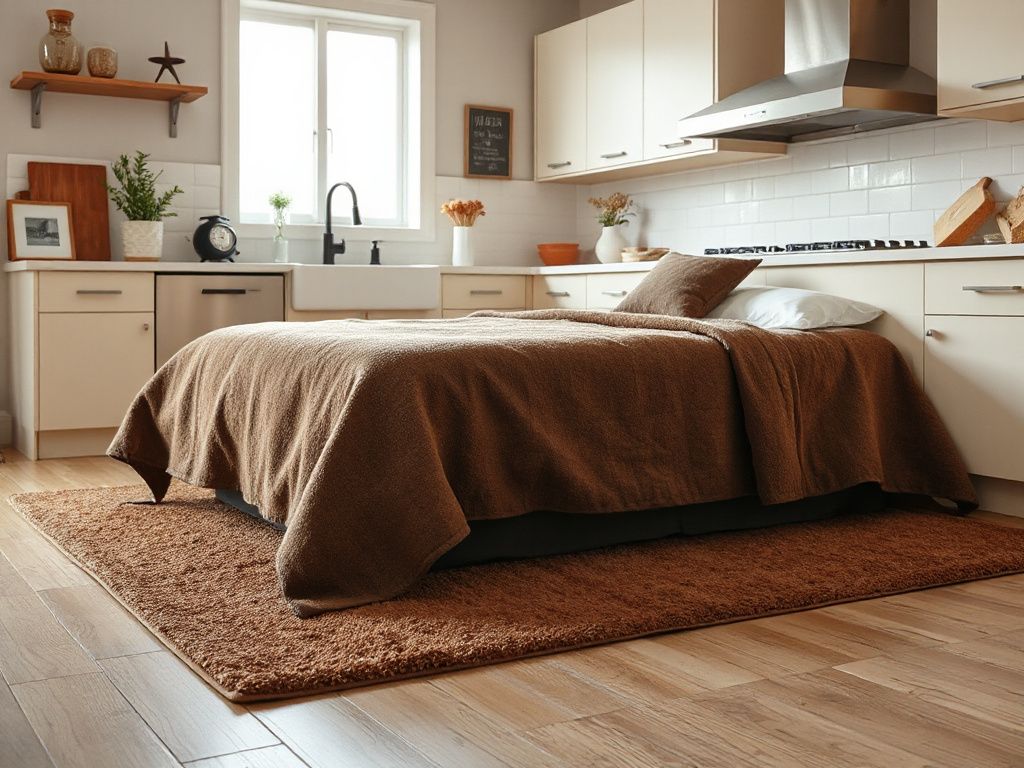
This approach keeps nightstands intentionally off the rug, and it works well in smaller bedrooms or when you want to show off more hardwood or tile. A 6×9 or 7×10 rug sits under the bottom two-thirds of the bed, with its top edge stopping well before the nightstands. The rug must extend evenly on both sides of the bed—at least 6 to 12 inches is the minimum for this style, though more is better. The foot should clear the bed by 24 inches so you have a defined step-out zone.
The trick is to make the rug’s edge clean and parallel to the bed frame. If the rug is slightly crooked, the whole setup looks haphazard. Use a tape measure to align the long edge of the rug with the bed’s side rails, then walk around to check from every angle.
Room Proportions and Shape: Adjusting the Formula
A queen bed doesn’t exist in a vacuum. The same rug size that anchors a spacious primary suite will choke a small guest room. You have to measure the room, not just the bed.
Small Bedrooms (Under 10 x 10 Feet)
In a 10-by-10-foot bedroom, a queen bed consumes a quarter of the floor area, so a 6×9 rug placed under the lower two-thirds leaves enough bare floor around the perimeter to walk without brushing the rug edges. That means the rug should be centered on the bed but pulled toward the foot so the top edge sits just in front of the nightstands. Keep 12–18 inches of bare floor along the walls and at the doorway. If the room is even smaller—say 9×9—consider a 5×7 runner at the foot of the bed instead of a full rug, because anything larger will make the room feel claustrophobic and turn the rug into a trip hazard.
In a 10-by-10-foot bedroom, a queen bed consumes a quarter of the floor area, so a 6×9 rug placed under the lower two-thirds leaves enough bare floor around the perimeter to walk without brushing the rug edges.
Large Bedrooms (Over 12 x 12 Feet)
Here you can afford the full-coverage strategy. A 9×12 rug gives the bed zone a defined footprint while still leaving a 18–24 inch border of bare floor around the rug’s perimeter, which prevents the room from feeling like one giant carpet. If the bedroom opens into a sitting area or walk-in closet, keep the rug away from those transitions so the floor plan stays legible. Layering a smaller accent rug over the main rug at the foot of the bed is also an option in larger rooms, but only if both rugs are secured with pads to prevent shifting.
Odd-Shaped Rooms: L-Shaped, Angled Walls, Doorways
Rooms with angled walls, multiple doors, or a bed placed in a corner require a different kind of measurement. Walk the entire perimeter of the bed and note every door swing, closet track, and furniture leg that could catch the rug. Use the painter’s tape method again, this time marking the rug’s outline and then opening every door fully. If a door hits the tape, the rug is too big. In L-shaped bedrooms, the rug should anchor the bed zone without extending into the secondary leg of the L, because that secondary space is usually a walkway or reading nook that needs to stay clear.
The Hardware of a Rug: Pads, Materials, and Slip Resistance
A rug is only as good as what’s underneath it. You can nail the size and still hate the result if the rug slides every time you get out of bed or the pad is too thin to cushion hardwood.
Rug Pads Are Not Optional
Under a bed, a rug takes concentrated weight from the bed frame and constant foot traffic from the side you exit on. That’s why a 1/4-inch to 3/8-inch felt-and-rubber pad is the right choice for bedrooms. The felt side grips the rug, the rubber side grips the floor, and the combined thickness compresses under the bed legs without letting the rug shift. Avoid cheap foam pads—they disintegrate after a year and leave residue on hardwood.
A 1/4-inch felt-and-rubber rug pad under a bedroom rug prevents the rug from shifting when you get out of bed and adds enough cushion to protect hardwood floors from the weight of the bed frame.
Materials That Behave Under a Bed
Wool rugs hold up best under furniture legs because the natural fibers bounce back after compression. Polyester and polypropylene are more affordable but flatten more easily, especially under a heavy bed frame with narrow legs. Flatweave rugs—cotton, jute, sisal—are prone to sliding and buckling unless paired with a quality pad and sometimes rug tape at the corners. If you’re evaluating durability, our breakdown of Safavieh rugs covers how different weaves hold up under heavy furniture.
Slipping on Hard Floors
On hardwood, laminate, or tile, no rug stays put without a gripping layer. Use the felt-and-rubber pad described above, plus rug tape along the edges if the pad alone still slides. For area rugs over 24 square feet, federal flammability standards apply. The U.S. Consumer Product Safety Commission enforces flammability standards for carpets and rugs under 16 CFR Part 1630, which applies to any rug larger than 24 square feet—including every size recommended for a queen bed. That standard exists to slow the spread of a fire if a rug ignites, and any rug sold in the U.S. should meet it. Meanwhile, the American Society for Testing and Materials publishes test methods for carpet backing strength and pile retention, which manufacturers use to rate how well a rug holds up under furniture wheels and repeated vacuuming.
Your Step-by-Step Sizing Checklist
Use this sequence every time you shop for a queen bed rug. It removes the guesswork and forces you to think about clearances, not just aesthetics.
- Measure the room. Note every wall, doorway, closet, and window that affects floor space. Write down the exact length and width in inches.
- Measure the bed plus nightstands. Queen bed = 60×80 inches. Add each nightstand width (typically 22–28 inches) to the bed’s width. That gives the total furniture footprint.
- Decide on placement. Full coverage under bed and nightstands, or lower two-thirds with nightstands off the rug?
- Pick a rug size. For full coverage, choose 8×10 minimum (18-inch side overhang) or 9×12 for 24-inch side overhang. For lower two-thirds, choose 6×9 minimum or 7×10 if you want a bit more foot coverage.
- Tape it out. Use painter’s tape to mark the rug’s outline on the floor. Walk the room, open doors, pull out drawers, and check for tripping.
- Buy a pad. Get a 1/4-inch felt-and-rubber pad in the same size as the rug. Never skip this step.
- Install and adjust. Unroll the rug with the pad underneath. Align the rug’s long edge with the bed’s side rails. Check that nightstands are fully on or fully off. Trim any pad edges that peek out.
Frequently Asked Questions
Can I use a 5×8 rug under a queen bed?
No, a 5×8 rug is too small. Its 60-inch width exactly matches the queen bed’s width, leaving zero rug visible on either side. The rug would cover only the bottom two-thirds of the bed, making the headboard area look bare and unbalanced. If your room is very small, consider a 5×7 runner at the foot of the bed instead, but don’t try to center a 5×8 under a queen mattress.
How much bigger should a rug be than a queen bed?
The rug should extend 18–24 inches beyond each side of the bed and at least 24 inches beyond the foot. For a queen bed that means a rug at least 8×10 feet for side overhang (18 inches per side) or 9×12 feet for a more generous 24 inches per side. Those numbers allow you to step out of bed onto soft flooring without touching bare floor.
Should a rug go completely under a queen bed or just under the lower half?
Both placements work, but they require different rug sizes. Full coverage—bed and nightstands on the rug—demands an 8×10 or 9×12. Lower two-thirds placement (nightstands off the rug) works with a 6×9 or 7×10. The key is intentionality: either all furniture legs are on the rug or all are off. Half-on, half-off is the mistake to avoid.
What size rug works best if I want it to also go under the nightstands?
You need a rug at least 8×10 feet, and a 9×12 is better for more breathing room. An 8×10 gives 18 inches of rug on each side of the queen bed, which is the minimum to keep nightstand legs fully on the rug without crowding the edge. A 9×12 gives 24 inches per side, which also leaves space to walk around the nightstand without stepping off the rug.
How do I keep a rug from slipping on hardwood or tile under a bed?
Use a 1/4-inch felt-and-rubber rug pad cut to the same size as the rug. The felt grips the rug, the rubber grips the floor. For extra security on slick surfaces, add double-sided rug tape along the rug’s perimeter. Never use a pad with adhesive that could damage the finish, and check the pad’s grip on your specific floor type before committing.
If you prefer washable convenience in an 8×10 size, our look at Ruggable’s lineup explains the trade-offs of that design. And for a more streamlined, low-profile option under a queen bed, the Article rug review covers designs that stay put without bunching.