Modern farmhouse remains one of the most requested kitchen styles for a simple reason: shaker doors, natural wood, and honest hardware don’t carry the kind of date stamp a glossy trend finish does. The style holds up because it’s built from materials and shapes that have already been in continuous use for a century, not from a color or texture that peaks for a few years and then looks dated in photos.
What follows are sixteen ways to build on that foundation — some about color, some about layout, and a few about the practical details, like lighting and backsplash material, that make a farmhouse kitchen function as well as it photographs. A few color ideas from earlier versions of lists like this one get folded together below, since yellow, red, and pink cabinets share the same real technique regardless of which one you pick; it’s more useful to cover that technique once, properly, than to repeat it three times with a different color name.
Two numbers worth keeping in mind throughout: standard base cabinets run about 34.5 inches tall, 36 inches with a countertop on top, and cabinetry typically eats up 35-40% of a full kitchen renovation budget. That’s exactly why several ideas below focus on updating hardware, paint, and lighting rather than replacing cabinet boxes outright.
1. Black-and-White High Contrast
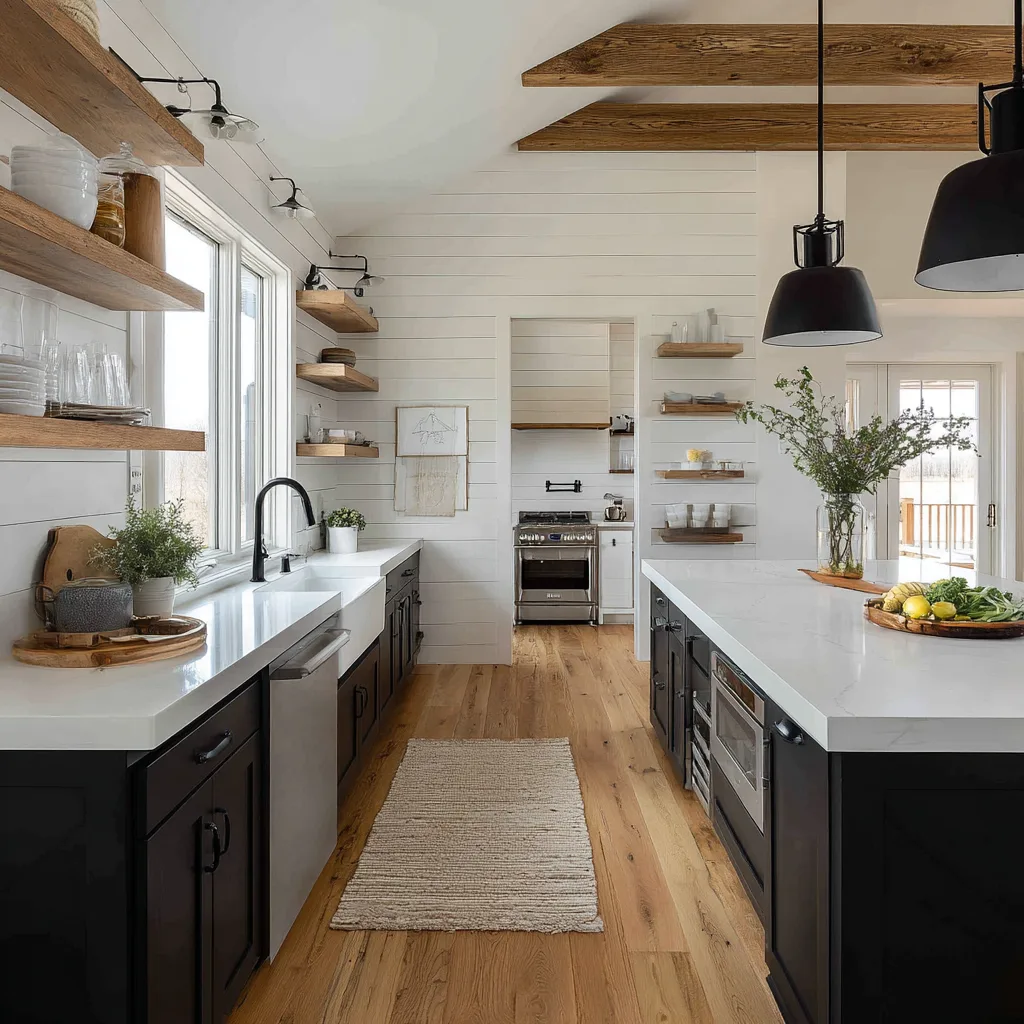
White shiplap or painted walls against black lower cabinets, or the reverse with black uppers and white lowers, is the highest-contrast version of farmhouse style. It reads well in both small and large kitchens because the strong value contrast creates visual structure rather than visual noise. Matte or satin black cabinet paint hides fingerprints better than gloss, which matters on lower cabinets that get touched constantly.
Matte black hardware and fixtures keep the palette cohesive, and a white farmhouse sink becomes the natural focal point against dark countertops or lower cabinets. On cost: painting existing cabinets in a cabinet-grade black enamel runs roughly $300-800 in materials for a DIY job, versus $3,000-7,000 or more for a professional spray-finish repaint on an average kitchen, which is worth factoring in before deciding whether to paint or replace.
2. Two-Tone Cabinets: Upper and Lower Split
Two-tone farmhouse kitchens most commonly put white on top and a deeper color, such as navy, sage, or charcoal, on the bottom, which grounds the room and draws the eye upward in kitchens with taller ceilings. The split works best at a real architectural line: where the upper cabinets meet the lower run, or at an island or peninsula that gets its own distinct color from the perimeter cabinets.
Keep the palette disciplined — one light color, one dark color, one wood tone, and one metal finish is usually enough. A third cabinet color on top of that tends to look unplanned rather than intentional. If you’re painting rather than replacing, note that lower cabinets take more physical wear, from bumped doors and water splashes near the sink, than uppers, so budget for a slightly more durable finish on the bottom run.
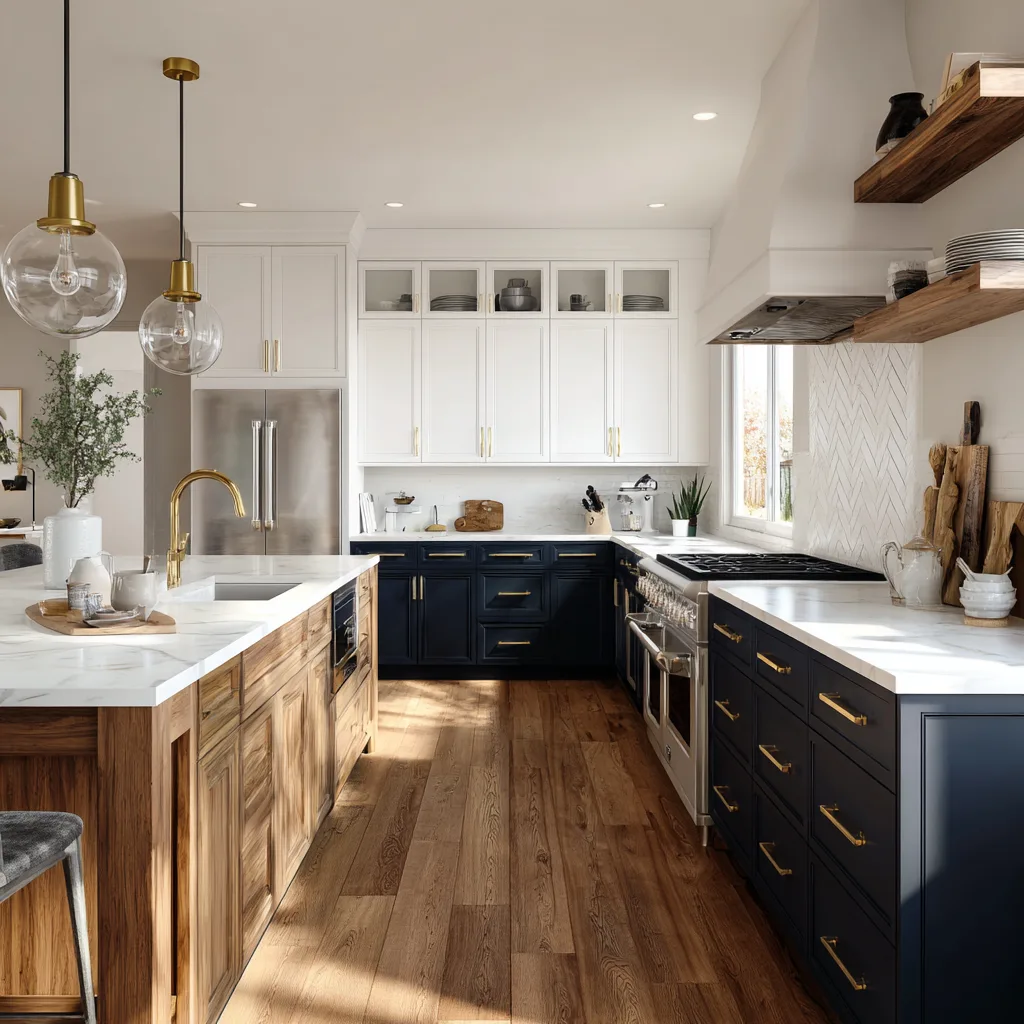
3. Navy Blue Cabinetry
Navy functions almost like a neutral in farmhouse kitchens: dark enough to read as sophisticated, but blue enough to stay warm rather than stark like black. It hides daily fingerprints and water spots better than a flat black or a pale color, a genuine practical advantage in a high-traffic kitchen. Pair it with brass or unlacquered brass hardware for warmth, or black hardware for a cooler, more contemporary read. The undertone of your specific navy, some lean purple and some lean blue-gray, should guide which metal looks best, so test hardware samples against your actual paint chip before ordering anything.
White marble or quartz countertops keep a navy kitchen feeling bright rather than heavy, and a light or medium wood floor does the same job from below. Because navy is such a saturated color, get a large sample board painted and view it in your kitchen’s actual light at different times of day before committing to full cabinets.
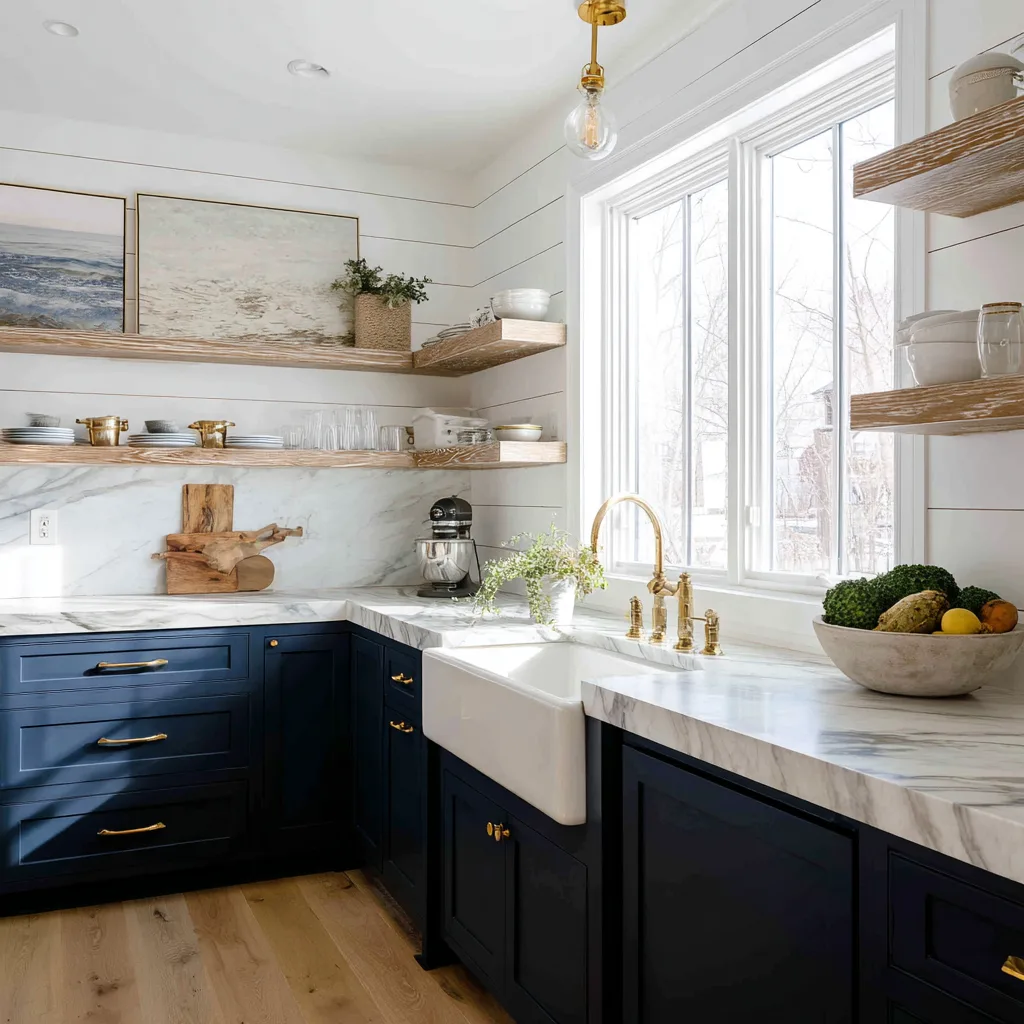
4. Soft Blue for a Lighter Look
Powder blue, robin’s egg, and dusty blue sit at the opposite end of the blue family from navy — instead of grounding the room, they lighten it, making this a strong choice for kitchens that don’t get much natural light and would look cold or dim in a darker color. These lighter blues read differently depending on exposure: north-facing rooms, with cooler indirect light, tend to make blue look grayer and flatter, while south-facing rooms, with warm direct light, let a soft blue stay true to the paint chip.
Because the color is so light, it works equally well as a full cabinet color or as a smaller commitment — a painted island, open-shelf backing, or a run of bar stools — if you’re not ready to commit a whole kitchen’s worth of cabinetry to it. Pair it with white or light gray counters and natural wood open shelving rather than heavy dark stone, which would fight the airy effect the color is going for.
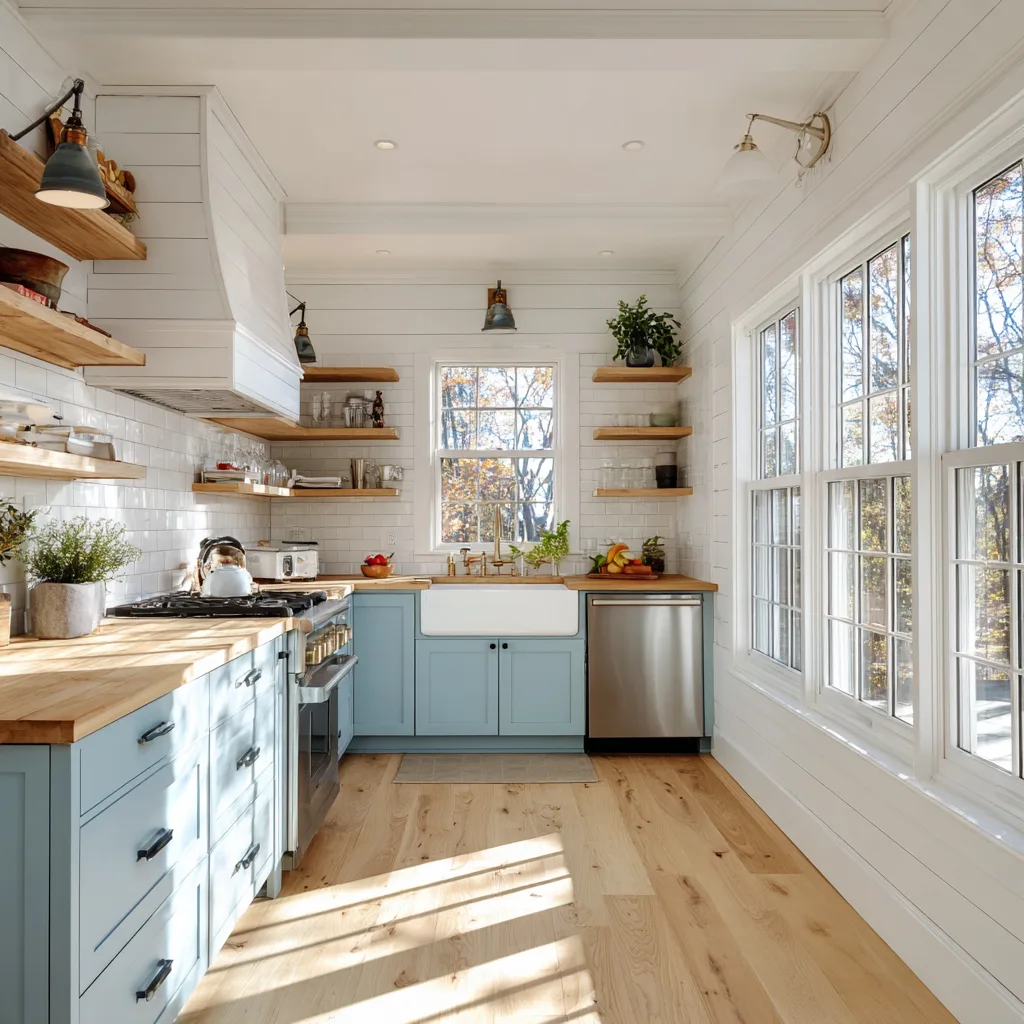
5. Sage and Olive Green Tones
Green has become one of the more popular farmhouse cabinet colors in recent years because it splits the difference between a true neutral and a genuine color statement — sage and muted olive read as calm and organic rather than as a bold design risk. Lighter sage tones behave like the soft blues above, airy and well suited to low light, while deeper forest and olive greens behave more like navy: grounding, good at hiding wear, and better suited to kitchens with strong natural light so they don’t feel cave-like.
Brass hardware is the classic pairing here, since warm brass and green typically share the same undertone family, but the same undertone-matching caveat applies — hold an actual hardware sample against your paint chip rather than assuming it will work. Live herbs or plants on a windowsill reinforce the color story without adding any renovation cost at all.
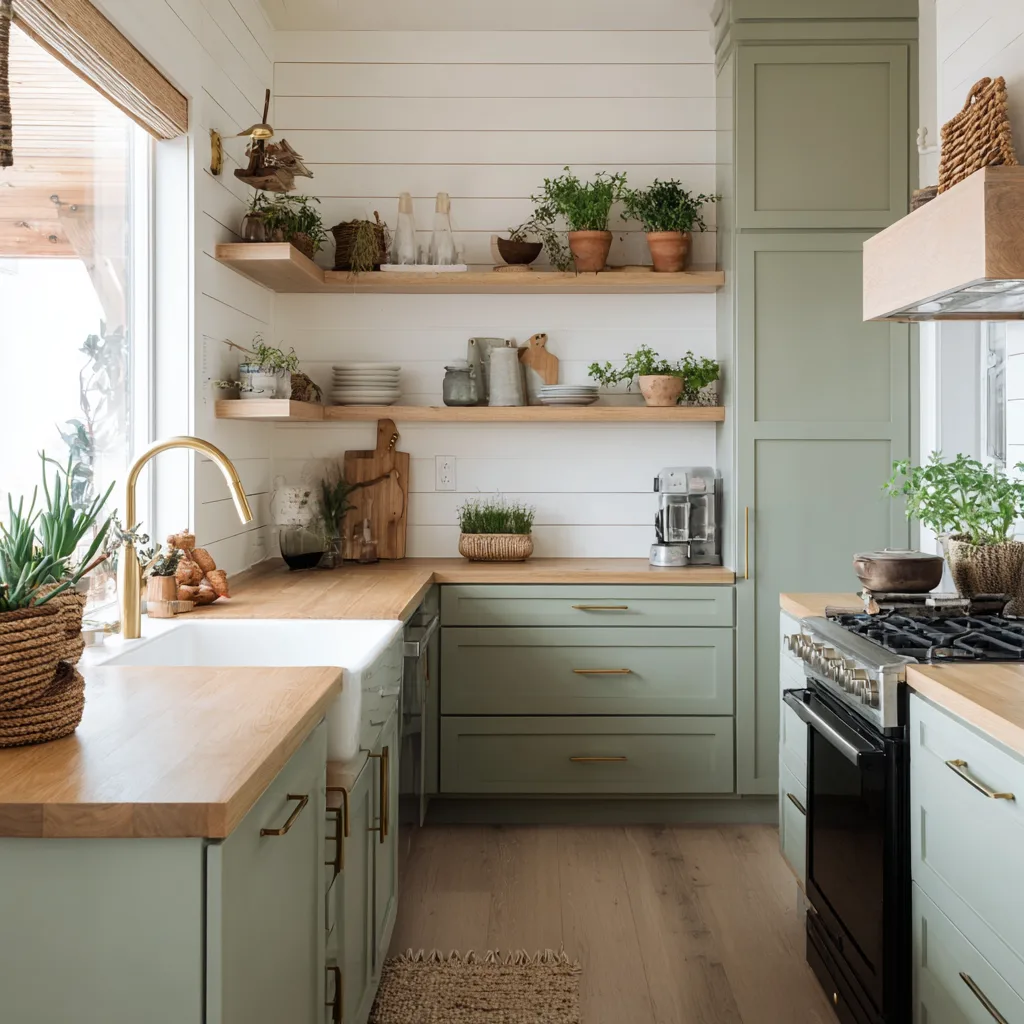
6. Gray as a Flexible Neutral
Gray sits between white and true color, which makes it the most forgiving choice on this list if you’re not sure you’ll want to repaint or replace cabinets again in a few years. Warm grays, with a beige or “greige” undertone, pair naturally with wood tones and brass; cool grays, with a blue undertone, pair better with chrome, stainless, and black hardware. Mixing the two undertone families in one kitchen is a common color mistake, since a warm wood floor next to a cool-toned gray cabinet can look subtly off even when both colors seem neutral on their own.
Two-tone gray — light gray uppers with a darker gray lower run or island — is a common, lower-risk way to add depth without the commitment of a single bold color. White or light quartz counters keep the palette from feeling monochromatic and flat.
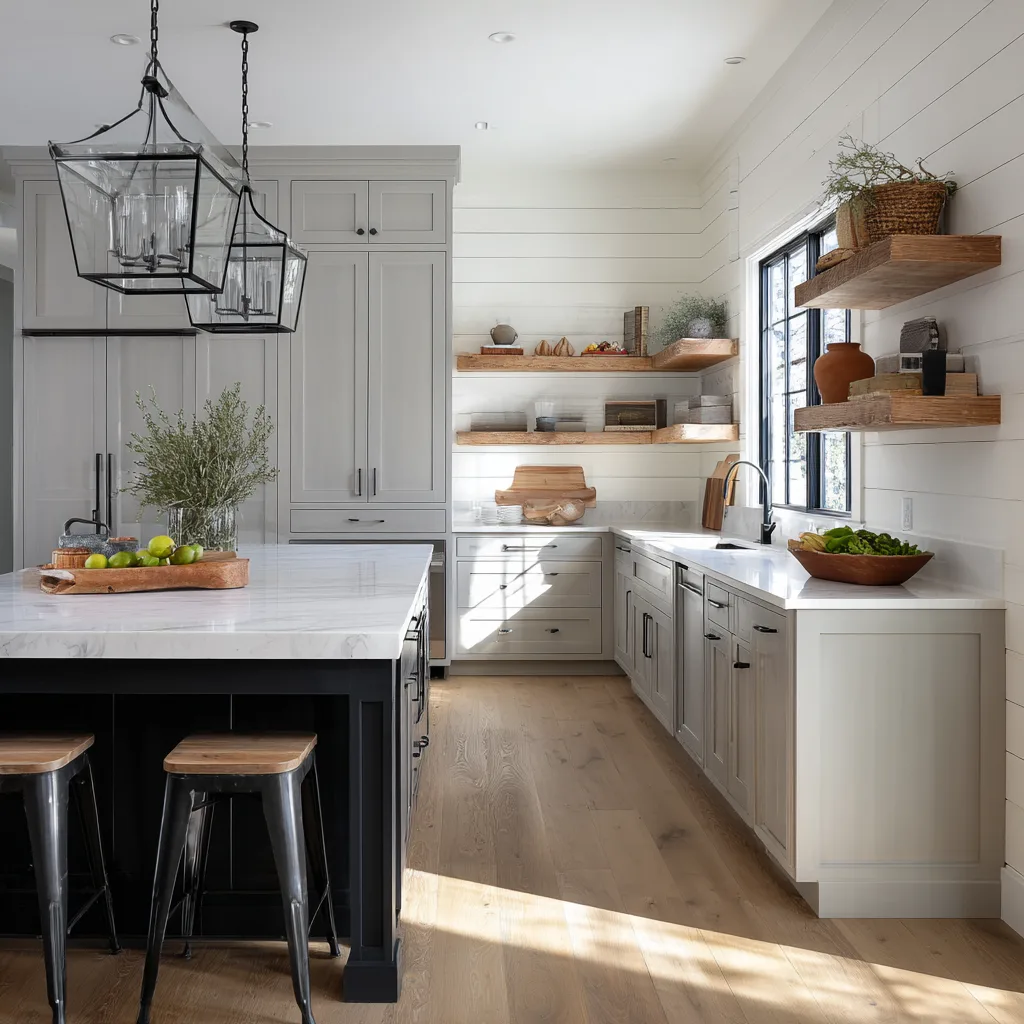
7. Bold Accent Colors Used Sparingly
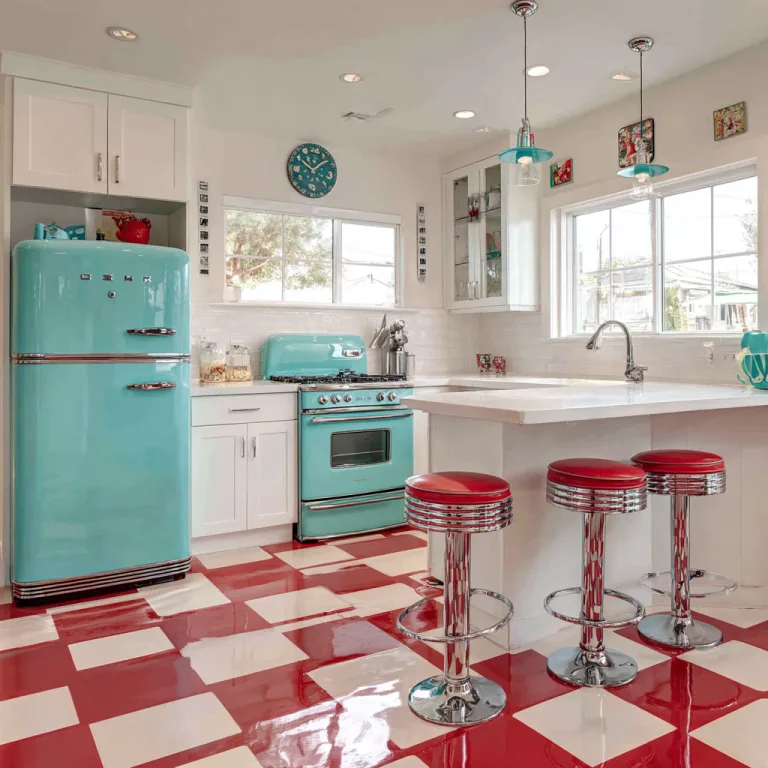
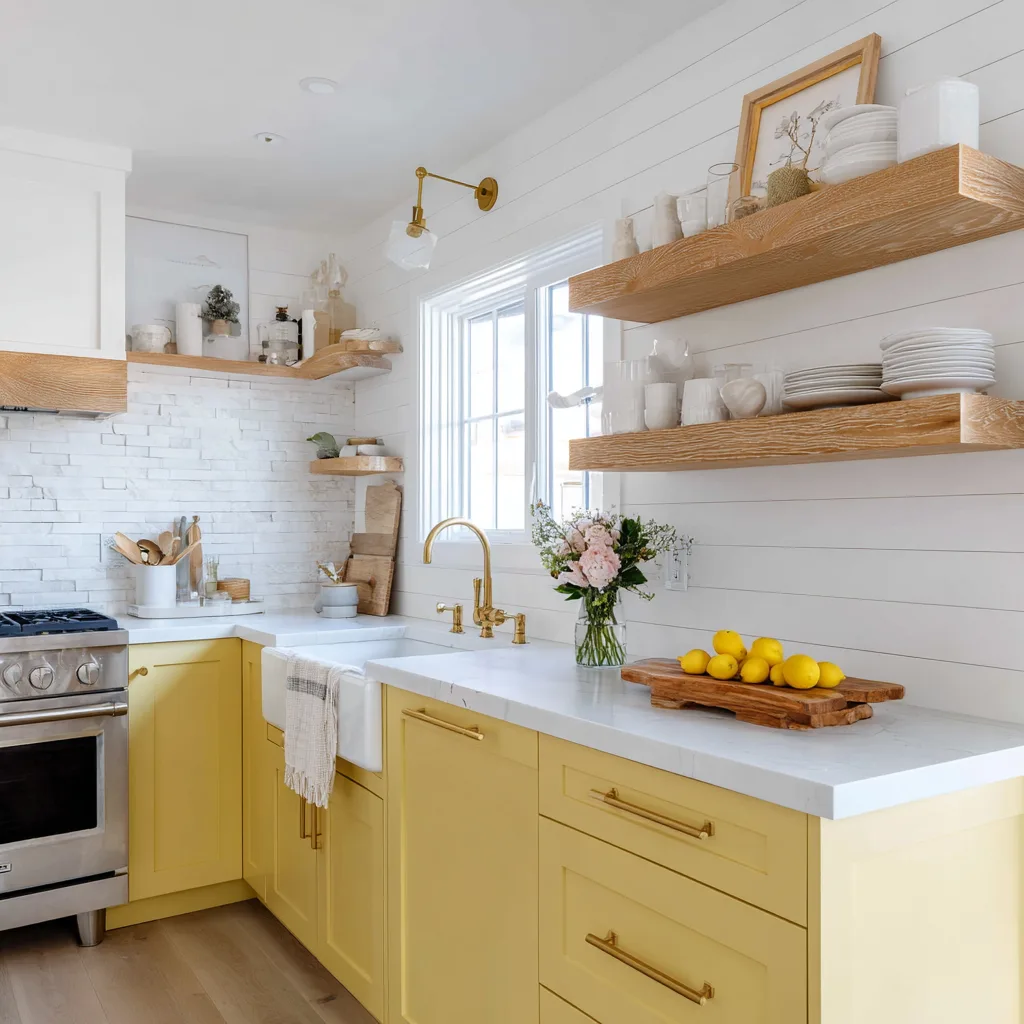
Butter yellow, barn red, and dusty rose pink all follow the same real design logic in a farmhouse kitchen: they work far more reliably as an accent than as the dominant cabinet color, because saturated warm colors read as more intense at full-kitchen scale than they do on a small paint chip. The lower-risk approach is to paint just the island, just the lower cabinets, or a single wall of open shelving in the bold color, while keeping the rest of the kitchen white, cream, or wood-toned.
Muted, slightly grayed-down versions of these colors — butter rather than lemon yellow, barn red rather than fire-engine red, dusty rose rather than bubblegum pink — read as farmhouse-appropriate; bright, saturated primaries tend to read more novelty or nursery than farmhouse. Because repainting a small element like an island is a relatively low-cost, reversible change, typically a few hundred dollars in paint and labor, it’s a reasonable way to test a bold color before ever considering it for full cabinetry.
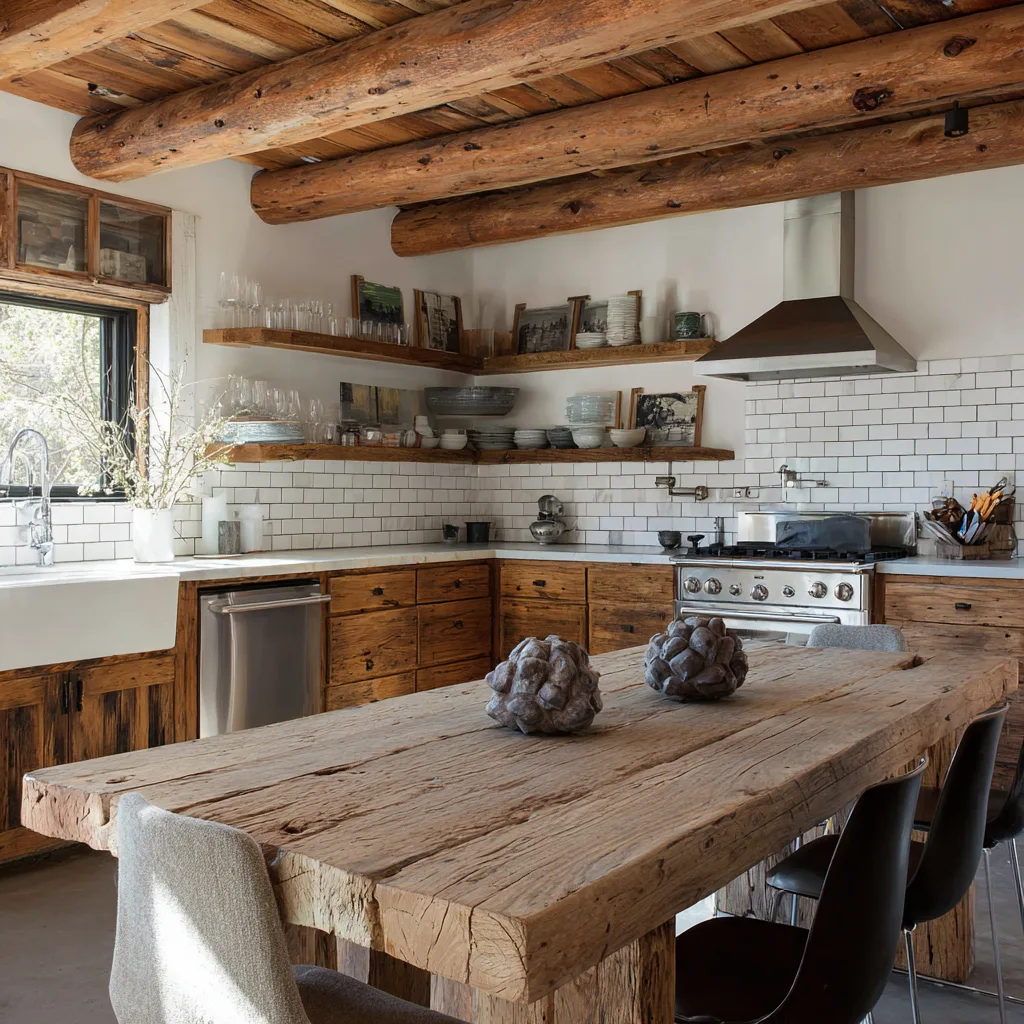
8. Reclaimed and Rustic Wood Elements
Reclaimed barn wood, or new lumber milled to look weathered, adds the single most authentic-feeling texture in farmhouse design, whether it’s a full island, open shelving, or exposed beams. Genuinely reclaimed wood costs more than new lumber, since sourcing, cleaning, and de-nailing take real labor, and it should be kiln-treated or heat-treated before it comes indoors to kill any pests living in the wood — a step worth confirming with your supplier rather than assuming it’s already been done.
Balance the rough texture with smooth, modern counterparts, like quartz or a honed stone counter, stainless appliances, and simple black or brass hardware, so the kitchen doesn’t tip into full cabin territory. A mix of a few different wood tones is fine as long as they share a similar warmth level; mixing a cool gray-toned wood with a warm orange-toned wood in the same room is a common way rustic wood elements end up clashing.
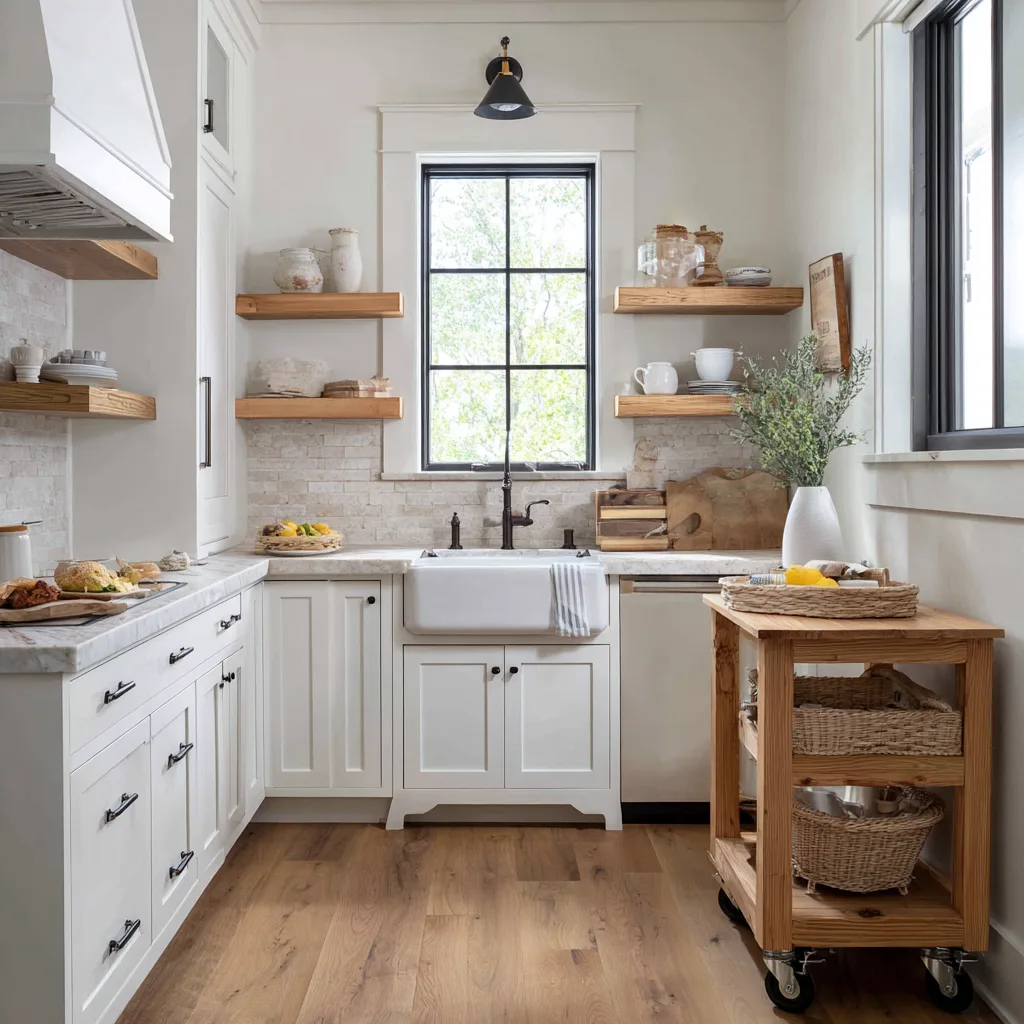
9. Small-Space Farmhouse Layouts
Farmhouse style scales down well because its core elements — shaker doors, a farmhouse sink, open shelving — don’t require the square footage an oversized island or a butler’s pantry does. In a small kitchen, light or white cabinets do more to open up the room than any other single choice, and vertical storage, like tall upper cabinets to the ceiling or a single column of open shelving, makes use of height a small footprint can’t provide horizontally.
A compact apron-front sink, as narrow as 24-27 inches versus the more common 30-36 inch farmhouse sink, keeps the signature farmhouse element without eating into limited counter space. Continuing the same flooring from the kitchen into an adjacent room, where possible, removes a visual break that would otherwise make the smaller room read as even more boxed-in.
10. Galley Kitchen Layouts
A galley layout, with two parallel runs of cabinets and counters and a walkway between them, is one of the more efficient shapes in kitchen design, since every appliance and work surface is within a step or two of the others. The trade-off is that a galley needs a minimum walkway width, generally around 42-48 inches for a single-cook kitchen, to avoid feeling cramped when the dishwasher or oven door is open.
Removing upper cabinets on one side, where structurally possible, and replacing them with open shelving or a pass-through to an adjacent room is a common way to keep a galley from feeling like a hallway. Task lighting matters more here than in almost any other layout — under-cabinet LED strips on both runs, since a galley’s narrow width often leaves the counters in shadow when relying on overhead light alone.
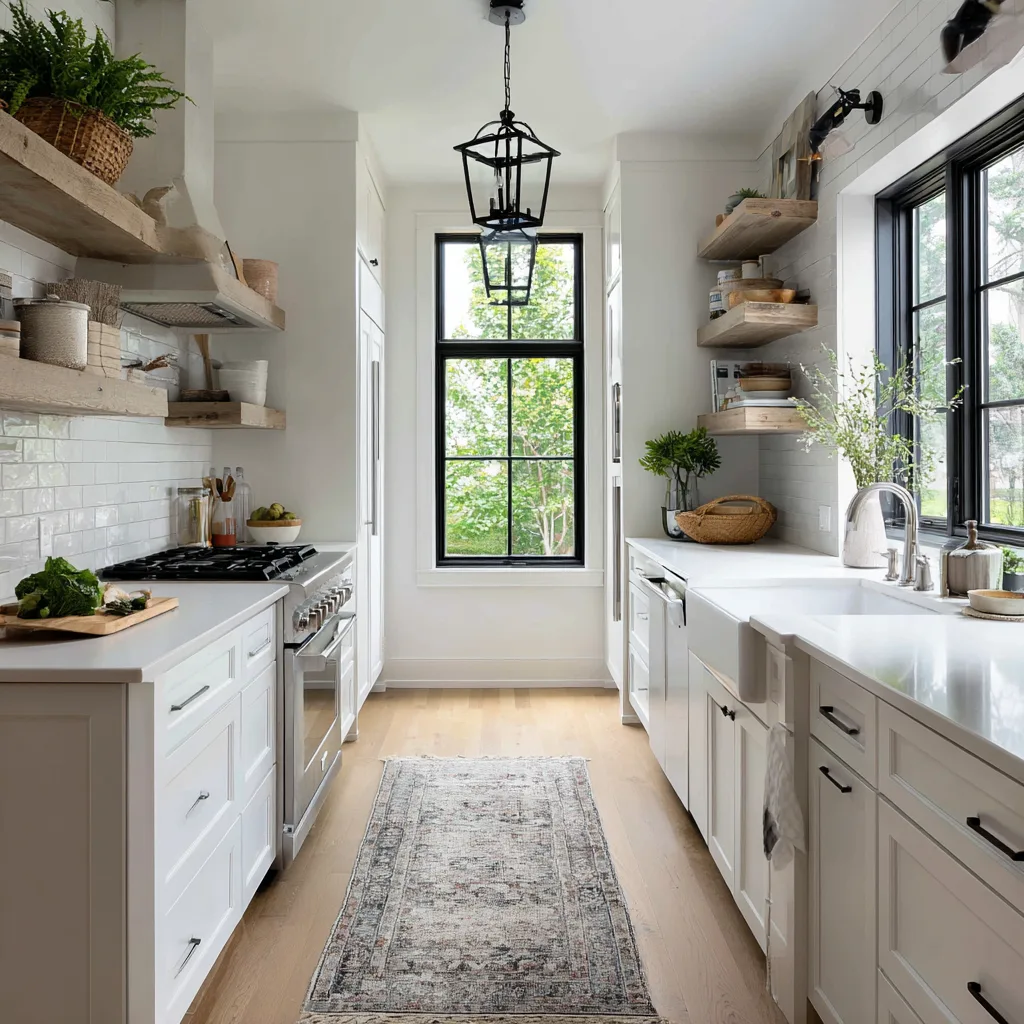
11. European-Influenced Minimal Farmhouse
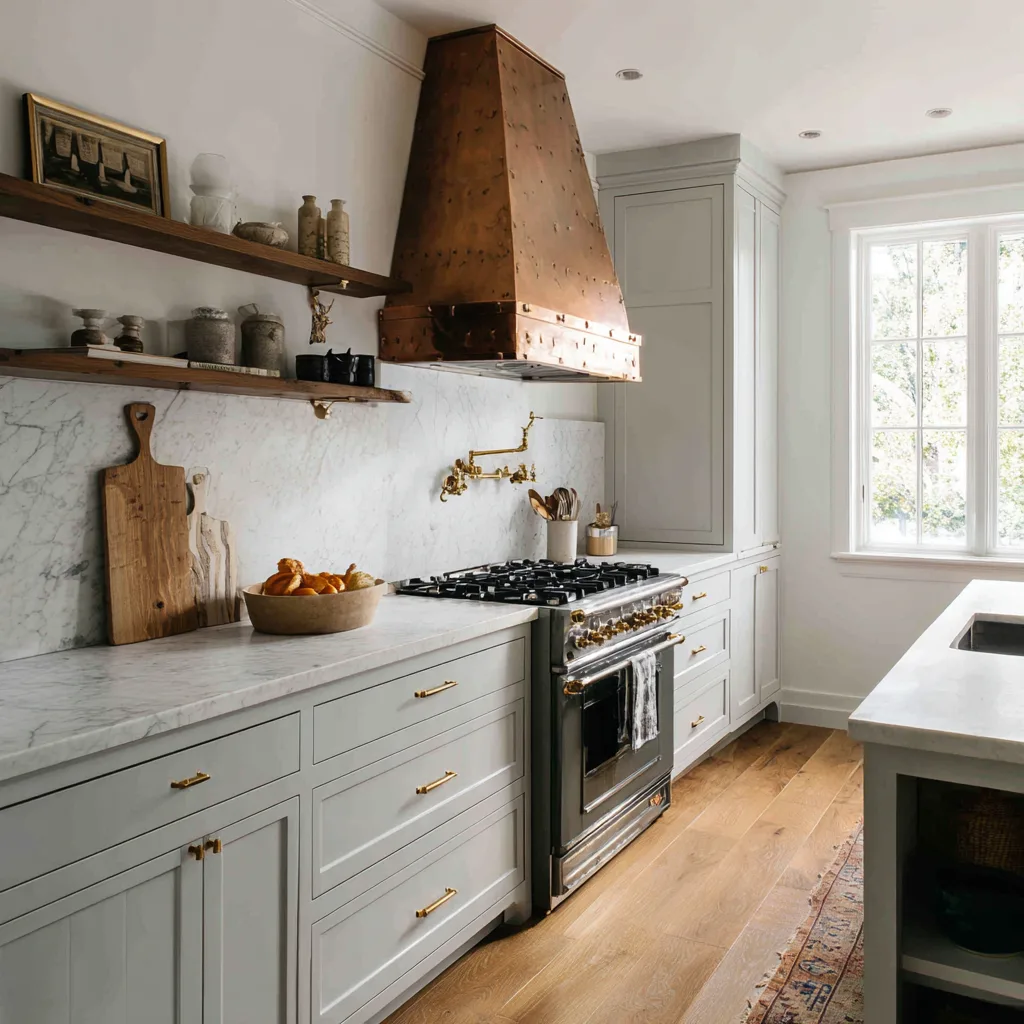
This variation trades some of American farmhouse’s rustic texture, like shiplap, distressed wood, and ornate hardware, for the cleaner lines of Scandinavian and Northern European design: flat or simple shaker-panel cabinets, minimal hardware, sometimes handleless with push-to-open doors, and a tighter, more muted palette of soft grays, warm whites, and one natural wood tone.
A range hood in copper, blackened steel, or a plaster finish typically serves as the room’s one statement piece rather than spreading personality across several elements, which is the core discipline of this style: pick one focal point and let everything else stay quiet. Because the palette is so restrained, material quality — real stone or solid wood rather than laminate or veneer — is more noticeable here than in busier, more pattern-heavy farmhouse variations, so it’s worth prioritizing budget toward fewer, better materials rather than more surfaces.
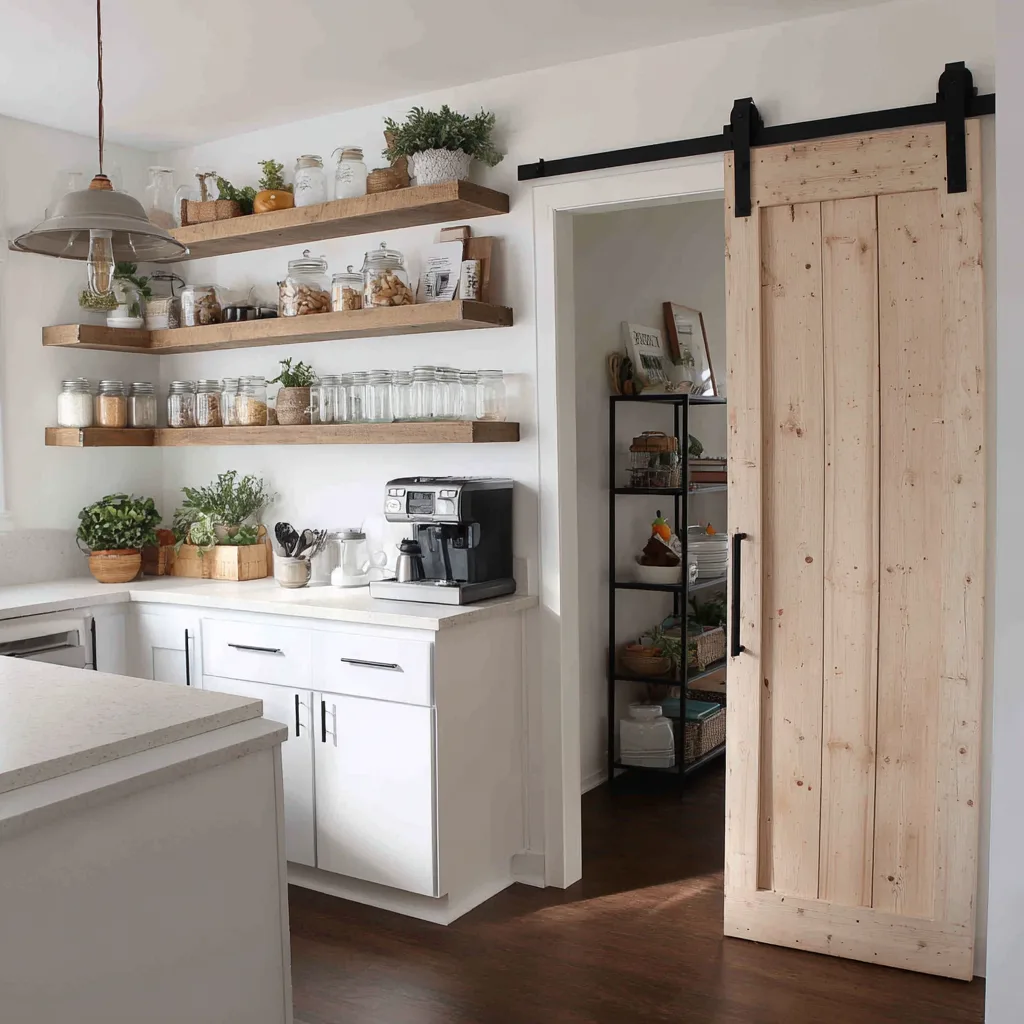
12. DIY-Friendly Budget Updates
Several farmhouse signatures are genuinely achievable as weekend projects rather than full renovations: painting existing cabinets, which means cleaning, sanding or deglossing, priming, and two coats of cabinet-grade enamel, since skipping the primer step is the most common reason a DIY cabinet paint job chips within a year; swapping hardware; and adding a single shiplap accent wall behind open shelving or a range.
Open shelving built from a few pine boards and simple iron brackets costs a fraction of new upper cabinets and can be installed in an afternoon, though it comes with the same open-shelving trade-off as elsewhere on this list: items stored on it need occasional dusting and a rinse before use. Tackling one project at a time and spacing them out lets you spread the cost over months rather than needing a renovation-sized budget all at once.
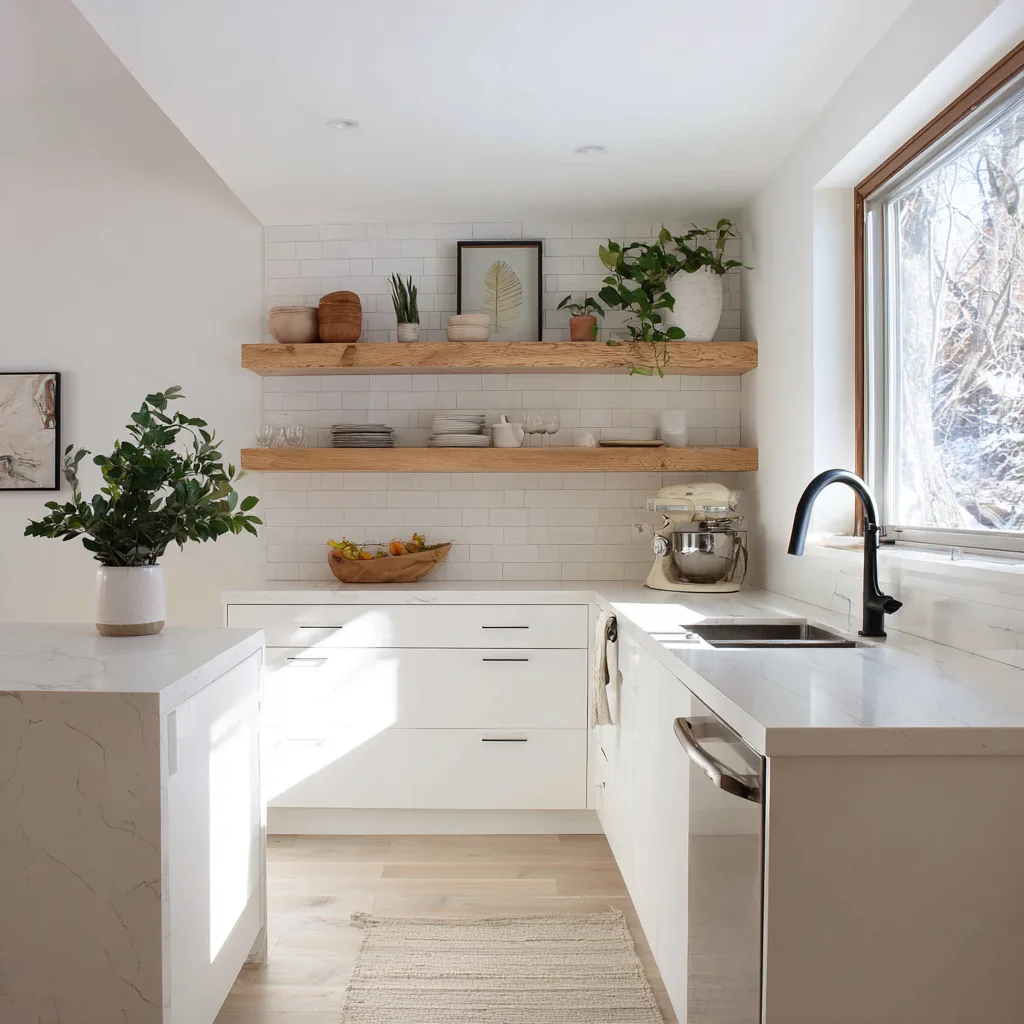
13. Minimalist Farmhouse Approach
A minimalist take on farmhouse style keeps the signature elements — shaker doors, a farmhouse sink, natural wood — but limits decorative accessories to a small handful of genuinely useful or meaningful objects rather than filling every open surface. White or light gray cabinets with simple bar-pull hardware form the backdrop; one or two natural wood elements, like a cutting board left out, an island top, or open shelving, supply the warmth.
Hidden storage does a lot of the work here: deep drawers instead of lower cabinets with a single shelf, a pull-out pantry, and appliance garages that keep small countertop appliances out of sight. A genuinely clear counter is what makes the minimalist version read as intentional rather than just underfurnished. This approach tends to suit smaller households, or anyone who finds a fully decorated farmhouse kitchen visually tiring rather than cozy.
14. Statement Backsplashes
White subway tile remains the standard farmhouse backsplash because it’s inexpensive, roughly $5-15 per square foot for material, and genuinely durable, but there’s real room to vary it: a herringbone layout, colored grout, or a larger-format tile all change the look without changing the base material or cost much. Handmade tile like zellige or a hex pattern runs considerably more, around $15-40+ per square foot, and comes with more grout lines to maintain, since each tile is slightly irregular by nature.
Reclaimed brick or a warm natural stone backsplash adds genuine farmhouse texture but needs sealing to resist grease and staining, similar to a natural stone countertop. Extending backsplash tile to the ceiling behind the range, rather than stopping at the standard 18-inch upper-cabinet line, is a real way to draw the eye up and make a room with standard 8 or 9-foot ceilings feel taller.
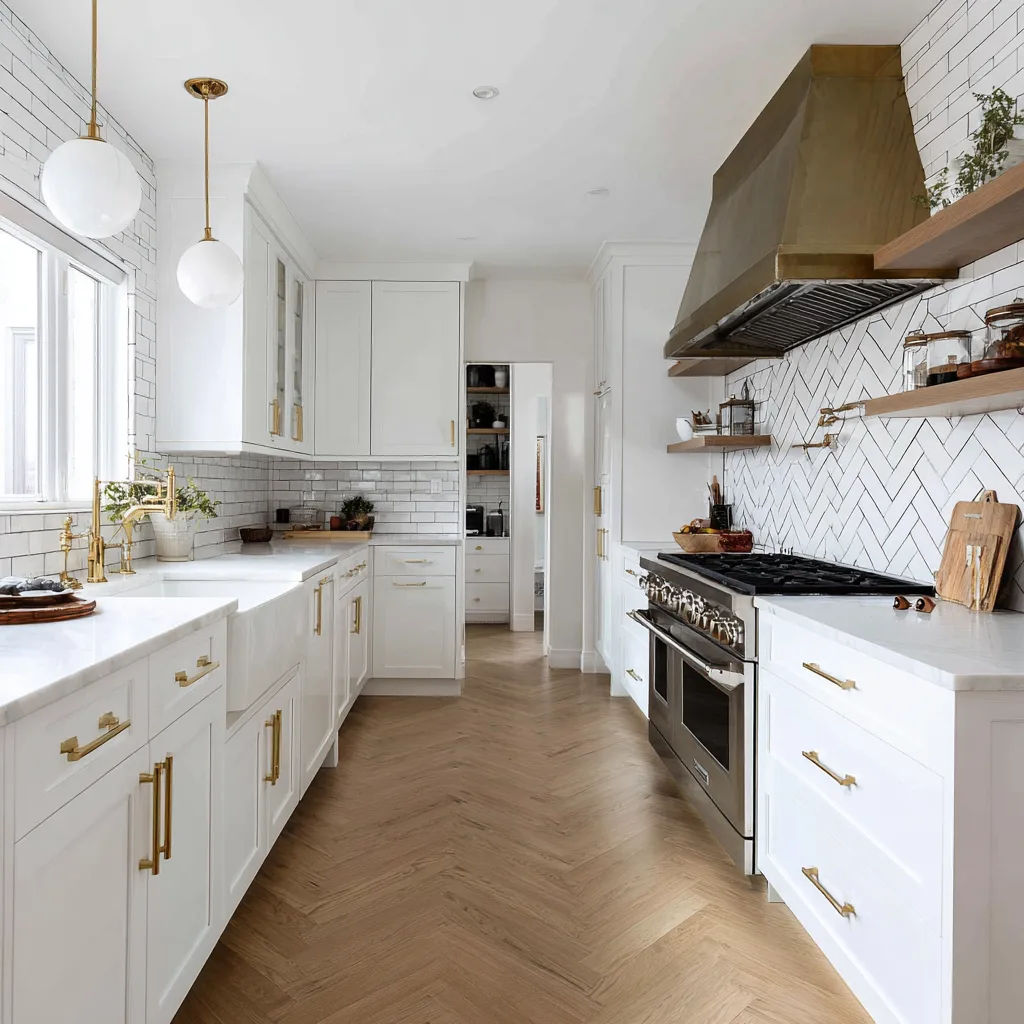
15. Layered Lighting
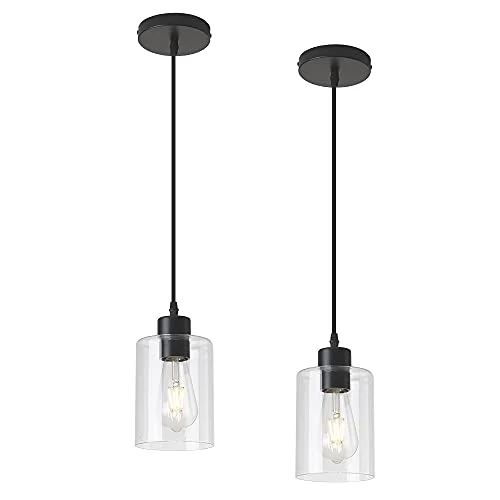
A farmhouse kitchen that relies on a single overhead fixture almost always ends up under-lit at the counters and over-lit everywhere else. The real fix is layering three types: task lighting, meaning LED strips under upper cabinets aimed at the counter rather than decorative; ambient lighting, from recessed ceiling cans or a flush mount for general light; and a focal fixture, one or two pendants over an island sized to the island rather than oversized for drama.
As a rough sizing guide, island pendants are commonly hung with 30-36 inches between the bottom of the fixture and the counter, spaced so they don’t block sightlines when seated at the island. Dimmer switches on the ambient and pendant circuits, though not necessary on task lighting, let the same kitchen shift from bright and functional during cooking to softer for entertaining, without needing separate fixtures for each mood.
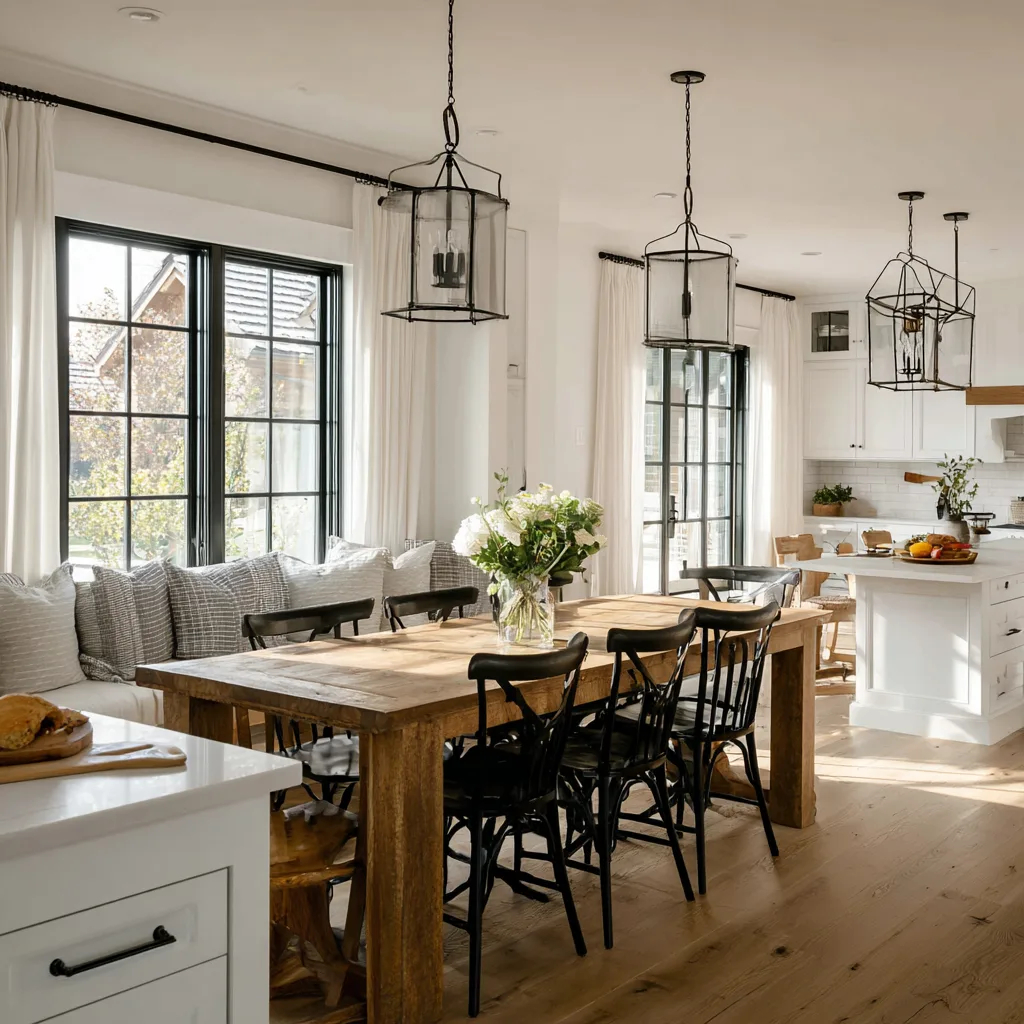
16. Open Shelving for Display and Function
Open shelving is one of the most-requested farmhouse elements and also one of the most misunderstood. It looks effortless in photos because the shelves are freshly styled, but in daily use, everything on an open shelf is exposed to cooking grease and dust and needs more frequent washing than the same items would in a closed cabinet. It works best when what’s on it is what you actually use weekly, not a display collection.
Natural wood shelves on simple black iron brackets are the standard farmhouse combination; keep daily-use items, like glasses and everyday plates, on the lower, more reachable shelves, and reserve the top shelf for lighter, less-used pieces. A practical middle ground many farmhouse kitchens land on: open shelving on one wall only, with the rest of the storage in closed cabinets that keep less attractive daily-use items, like pots, small appliances, and food storage, out of sight.
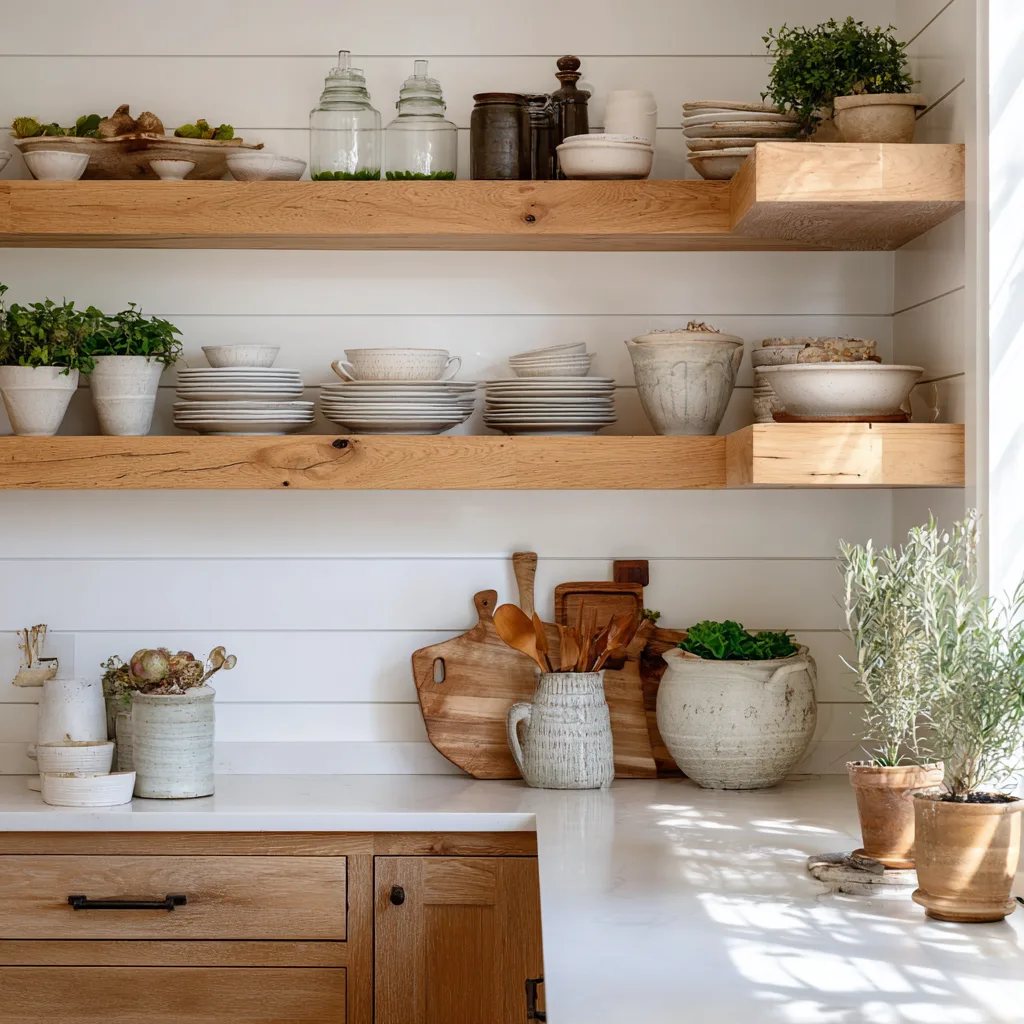
Building Your Own Farmhouse Kitchen
The farmhouse elements that hold up longest are the structural and material choices, like shaker doors, a farmhouse sink, and an efficient layout, rather than a specific paint color, since color is the easiest and cheapest thing to change again later if you get tired of it. If you’re renovating on a budget, prioritize the bones, meaning layout, cabinet quality, and lighting, over decorative extras; a well-laid-out kitchen in plain white cabinets will serve you better long-term than a beautifully styled kitchen with an inefficient layout.
Start with one or two focal points rather than trying to check every idea on this list off at once — a statement backsplash, a cabinet color change, or a lighting upgrade is enough to transform a kitchen’s feel without a full renovation budget. The best farmhouse kitchens tend to look collected over time rather than installed in a single weekend, so there’s no need to rush every element in at once.
Frequently Asked Questions
How much does a modern farmhouse kitchen renovation typically cost?
It varies enormously by scope and location, but a reasonable rule of thumb is $15,000-$30,000 for a mid-range refresh, meaning new cabinet fronts or paint, new countertops, and updated hardware and lighting, and $50,000 or more for a full gut renovation with custom cabinetry. Cabinetry commonly accounts for 35-40% of a kitchen renovation budget, which is why painting or refacing existing cabinet boxes rather than replacing them is one of the most effective ways to control cost.
What are the must-have elements of an authentic modern farmhouse kitchen?
A farmhouse or apron-front sink, shaker-style cabinet doors, and a mostly neutral base palette of white, cream, or gray with natural wood accents are the closest thing to non-negotiable elements. Beyond that, the style is defined more by material honesty — real or convincing wood, real hardware finishes, simple unfussy lines — than by any single required feature.
Does modern farmhouse style work in a small kitchen?
Yes. The style’s reliance on simple shapes and light colors, rather than ornate detail, makes it well suited to small spaces. Light or white cabinets, vertical storage, and a single compact farmhouse sink, available in narrower widths than the standard 30-36 inch size, let a small kitchen read as farmhouse without needing extra square footage.
How do I choose a cabinet color that won’t look dated in a few years?
Neutral tones with a genuine track record — white, warm gray, and navy — have stayed in steady rotation for well over a decade, which is a reasonable proxy for longevity. If you’re drawn to a bolder color like yellow, red, or pink, using it on a lower-cost, easily repainted element, such as an island or an accent wall of shelving, rather than the full cabinet run, limits how expensive it is to change your mind later.