
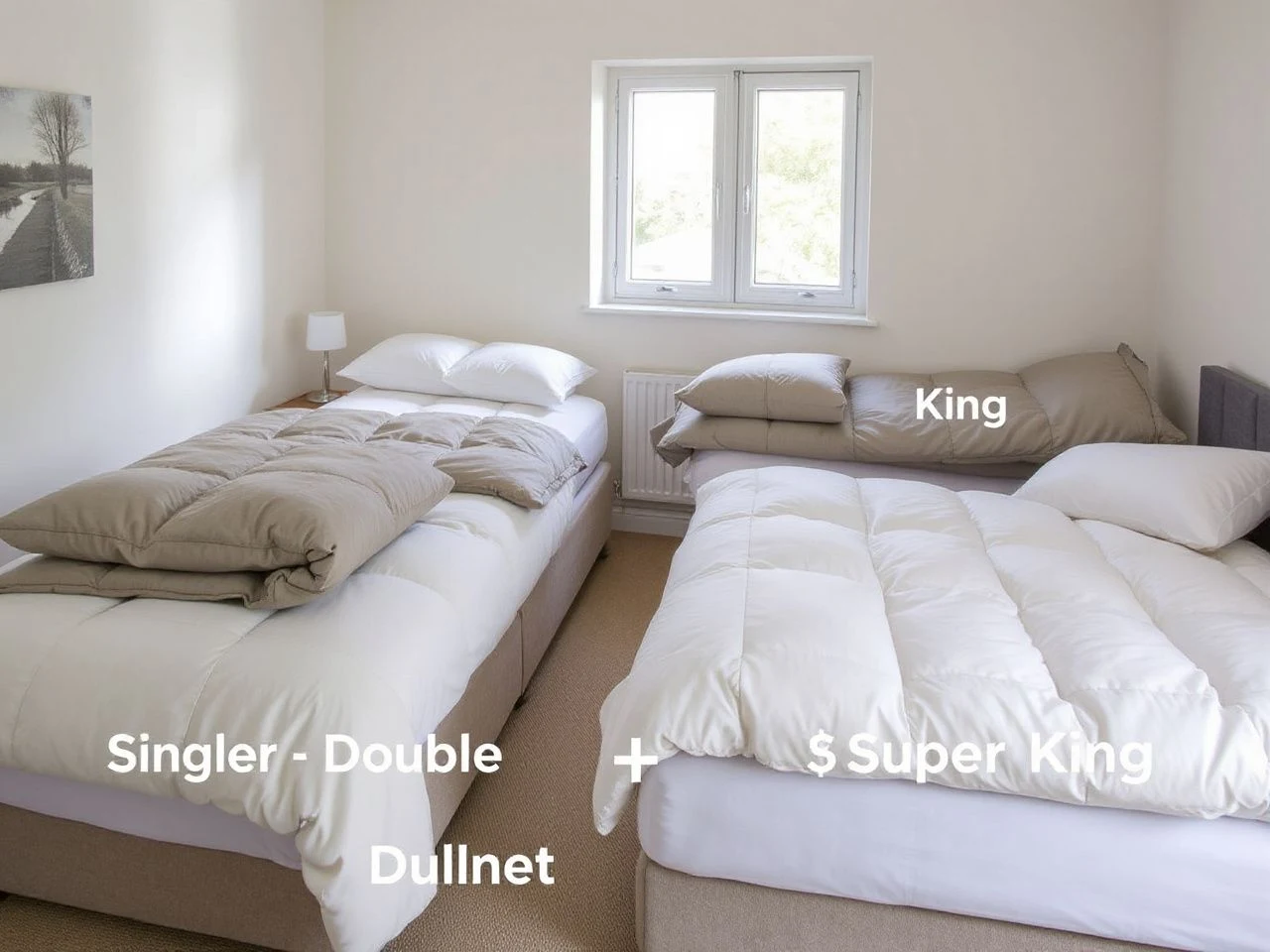
A poor duvet choice leaves uncovered sides, bunches around the mattress, or creates a cover that never sits flat. A useful duvet sizes chart separates the bed’s named size from the duvet’s actual dimensions, because the same label can represent different measurements across countries and manufacturers. It also treats fit as a coverage question: mattress width, mattress depth, side overhang, sharing, and duvet-cover compatibility matter more than the bed label alone.
Key Takeaways
- Use the duvet’s stated dimensions and sizing system, not the bed name alone.
- Choose coverage by considering mattress width, depth, frame height, overhang, and sharing.
- Match the duvet cover to the insert’s actual dimensions and fastening style.
- Check care instructions carefully, especially for larger duvets and down or feather fillings.
How to Read a Duvet Sizes Chart Without Guessing
Start with the sizing system
Duvet size names are not universal. A single bed, double bed, king-size bed, super king-size bed, or emperor bed can refer to different duvet dimensions depending on the country and manufacturer. A chart is useful only when it identifies the sizing system or country it represents.
Read the actual width and length printed on the label, product page, or duvet-cover packaging. If those dimensions are missing, the bed label cannot give you a reliable answer by itself. The same named size can produce a different result in another bedding market.
A duvet chart is reliable only when the chart’s country or sizing system is identified. That statement matters because familiar labels often look more precise than they are.
Separate the bed label from the insert
A duvet is the filled covering that sits inside a duvet cover. The cover protects the insert and gives the bed its visible finish. In some regions, people use comforter for a similar bed covering, while a duvet insert generally refers to the inner covering designed to be used with a removable cover.
Those terms overlap in everyday speech, but the dimensions still matter. A cover marked king must be compatible with the insert’s actual measurements rather than relying only on the shared word king. Check the cover’s stated size, fastening position, and dimensions against the insert label.
The relationship is simple: the duvet insert and duvet cover need compatible dimensions. A cover that is too small can compress the filling and distort the bed’s surface, while a cover that is much larger may leave loose fabric around the insert.
Use mattress measurements as the starting point
Measure or confirm the mattress width and length before reading the chart. Then account for mattress depth, the height of the bed frame, and the amount of side overhang you want. Mattress width alone does not determine coverage.
A shallow mattress on a low frame may look covered with a modest overhang. A deeper mattress or taller frame exposes more of the sides, so the same duvet can appear too small. The desired drop also changes the practical choice: someone who wants the duvet to fall close to the bed frame needs more fabric than someone who prefers a neat, shorter edge.
A clean visual line matters here. I judge bedding by the same standard I apply to anything displayed near a wall: the result should sit cleanly, with no awkward pull, bunching, or unfinished edge that distracts from the room.
Step 1: Choose Coverage for the Mattress and Bed Frame
Check the side overhang
Lay the chart beside the mattress measurements and ask how much fabric must travel from the centre of the bed to the mattress edge. Add the practical depth of the mattress and consider how far the duvet should fall over each side. The chart may not show a perfect choice for every frame, so the label should be treated as a starting category rather than a guarantee.
A duvet that is too small leaves exposed areas along the sides. Sharing then becomes uncomfortable because movement can pull the covering toward one sleeper. A duvet that is much larger can reach farther down the bed, drag against nearby furniture, and become harder to arrange neatly.
A duvet that is too small cannot provide side coverage that its dimensions do not contain. This is why the bed name should never be the only check.
Account for mattress depth and frame height
Mattress depth changes the point at which the duvet reaches the side of the bed. Bed-frame height affects the visible drop as well. A tall frame can make a duvet seem shorter even if the mattress itself is not unusually deep.
Use a tape measure if the fit is close. Record the mattress width, length, and depth, then note the distance from the top of the mattress to the point where you want the duvet to finish. Those observations give you a practical coverage target without pretending that a universal label can settle the question.
Consider pillows and the way the duvet is arranged. A cover pulled high toward the head of the bed leaves less fabric available at the foot and sides. A cover folded back for decoration changes the visible result again. The final fit depends on how the bed is made, not only on the flat dimensions.
Decide whether the bed is shared
A shared bed may need a larger duvet to reduce pulling and exposed areas. That extra width can make sleeping arrangements more forgiving, especially if each person moves independently during the night.
There is a limit to that advantage. Excessive width can make bed making more difficult, catch on nearby furniture, and create more fabric to wash and dry. A larger duvet may also cost more to launder or replace because its care demands and overall material use can increase, although the exact cost depends on the item and local services.
A shared bed may need more coverage, but excessive width can make laundering and bed making harder. Choose enough room to reduce tugging without allowing the duvet to become an unwieldy layer around the frame.
Step 2: Match the Duvet to the Duvet Cover
Compare dimensions, not only labels
Duvet and duvet-cover sizes need to match in a practical sense. Shared labels help with sorting, but actual dimensions decide whether the insert sits properly inside the cover. A cover should be compatible with the duvet insert dimensions rather than relying only on labels such as double or king.
Check the length and width printed for both pieces. If one item uses a country-specific naming system and the other uses a different system, the labels may appear similar while the fit is wrong. Treat a missing dimension as a reason to pause, not as permission to assume.
A well-matched cover helps the insert fill the visible area evenly. An undersized cover may pull at the corners or compress the filling. An oversized cover may leave empty sections that slide around during bed making.
Inspect the duvet-cover fastenings
Look at the cover’s fastening position and compare it with the insert’s loops, ties, or other attachment points if the manufacturer provides them. The fastening method does not change the required insert dimensions, but it affects how securely the two layers stay together.
Turn the cover inside out when checking the construction. Look for openings, corner attachments, and any care label that gives a different measurement from the sales name. The care label is often the clearest place to confirm the item’s identity.
Do not force an insert into a cover simply because both products use the same bed label. Fabric under tension will not create missing room, and loose fabric will not become fitted through fastening alone.
Keep the finish visually balanced
A duvet cover can be technically compatible and still look wrong on the bed if the insert is poorly positioned. Centre the insert so the side edges fall evenly, then check the foot and head of the bed separately. Uneven corners create a lopsided line that is especially noticeable against a plain wall or simple bed frame.
For broader bedding planning, the guide to sheet sizes for different beds helps separate mattress dimensions from linen labels. Sheets and duvets do not use the same fit logic, but both reward checking the actual measurements.
Step 3: Account for Warmth, Filling, and Care
Keep warmth separate from size
Size controls coverage; it does not determine warmth. Greater warmth is provided by a higher tog rating, so the duvet’s tog rating should be considered separately from its width and length. A large duvet can still be a light covering, while a smaller duvet can carry a higher warmth rating.
Some manufacturers offer sets combining one 4.5 tog duvet and one 9.0 tog duvet. Snapping those layers together achieves a total of 13.5 togs, intended for winter use. Other duvet options reach as high as 15 tog.
Warmth is measured in grams per square metre, written as g/m2, rather than togs in certain nations, including France. An all-season configuration can comprise a 200 g/m2 duvet and a 300 g/m2 duvet. These figures describe warmth systems, not bed dimensions.
Read the filling information separately as well. Duvet filling materials affect care instructions, feel, and the way the covering occupies the duvet cover. The size chart cannot answer those questions for you.
For a clearer explanation of the warmth system, see how tog ratings for duvets work in everyday bedding. Keeping warmth and coverage in separate columns prevents a common chart-reading error.
Plan for washing and drying
Check the care label before choosing a larger duvet for convenience. Larger items require more room to wash, rinse, and dry properly, and the available home machine may not be suitable. Do not assume that a household machine can handle every duvet simply because the item fits inside the drum.
Home machine washing is not suitable for duvets containing down and/or feathers. Follow the manufacturer’s care instructions instead of substituting a general laundry routine. If the label directs specialist cleaning, use that direction.
A larger duvet can cost more to launder and replace because it may require more care resources and may be harder to process at home. The exact amount depends on the duvet, the care method, and local charges, so a chart cannot provide a universal cost figure.
Drying deserves equal attention. A duvet that remains damp can feel heavy and uneven, but the correct drying method depends on the manufacturer’s instructions and filling. Do not guess at a temperature, cycle, or drying time that the care label does not give.
Keep infant bedding separate
Adult duvets are not automatically suitable for cots or infant sleep spaces. Cot and infant bedding has separate safety requirements, so adult duvet sizing should never be used as a substitute for infant sleep guidance.
The U.S. Consumer Product Safety Commission publishes consumer safety information for products and infant sleep environments. Check the relevant guidance before placing any duvet or loose bedding in an infant space, and follow the instructions supplied with the cot and bedding.
Adult duvet sizes do not establish that a duvet is suitable for an infant sleep space. The safety context is different from the coverage question.
Causes of Poor Duvet Fit and Practical Solutions
Cause: the chart hides its country of origin
A chart without a named sizing system can make two unrelated measurements look interchangeable. The solution is to identify the country or manufacturer system first, then compare the stated dimensions with your mattress and cover.
Save the chart’s source with the product information if you are coordinating several pieces of bedding. A bed frame may use one market’s label while the duvet cover comes from another. Names alone cannot resolve that mismatch.
Cause: the mattress is treated as a flat rectangle
Mattress depth and bed-frame height alter the visible drop. The solution is to measure the mattress depth and decide where the side edge should finish before choosing a chart category.
Check both sides after the bed is made. If one side is against a wall, the open side still determines how much overhang the room will show. A duvet that looks fine from above can appear short from the doorway.
Cause: sharing is ignored
A single sleeper can often keep a duvet centred more easily than two people sharing a bed. Movement can draw a smaller duvet toward one side, leaving the other exposed. The solution is to consider a larger size where the mattress, frame, and laundering arrangements can accommodate it.
Do not solve every sharing problem by choosing the largest available duvet. A cover that reaches furniture or gathers on the floor creates a different set of practical problems.
Cause: the cover is purchased by its name alone
The solution is a two-label check. Compare the insert dimensions with the cover dimensions, then confirm the closure and attachment arrangement. If the numbers or dimensions do not appear, choose a different listing or ask the manufacturer before ordering.
For terminology and the difference between a duvet and a comforter, read the explanation of duvet versus comforter. The words may overlap in conversation, but the cover-and-insert arrangement still needs a compatible fit.
Preventive Checks Before You Commit to a Size
Use a five-part measurement checklist
- Identify the system: Confirm the country or manufacturer sizing system shown by the chart.
- Confirm the mattress: Record its width, length, and depth from the label or a tape measure.
- Assess the frame: Note the visible height and the sides where the duvet must fall.
- Choose the overhang: Decide how much coverage you want before comparing duvet dimensions.
- Match the cover: Compare the insert and cover dimensions, closure, and attachment points.
That sequence keeps the decision grounded in observable details. It also prevents the bed label from taking over the entire calculation.
Check the room before choosing extra width
Look at the space around the bed. A larger duvet may brush a wall, bedside table, bench, or other furniture. If the bed sits close to a wall, excess fabric can bunch at the side rather than falling evenly.
The room’s visual lines matter. A duvet should frame the mattress without obscuring the bed frame in an unintended way. A clean edge comes off the wall cleanly in the broader room composition: no accidental pile, no trapped corner, and no distracting pull.
Review care before choosing extra fabric
Ask how the duvet will be washed, dried, stored, and replaced. A larger covering may provide more sharing room, but it also creates more bulk during handling. The care label should guide the decision, particularly for down and/or feather-filled duvets.
Do not use tog rating as a substitute for care information. Do not use the cover label as a substitute for insert dimensions. Each label answers a different question.
Check every label at home
Keep the packaging until the duvet and cover have been compared. Check the stated dimensions, country or sizing system, filling description, warmth information, fastening details, and care instructions. If the insert is visibly too short or the cover cannot close without strain, stop before washing or altering either item.
A mismatch is easier to resolve while the labels are still attached. Once the bedding has been used, cleaned, or modified, the original fit question becomes harder to separate from later changes.
Frequently Asked Questions
How do I choose the right duvet size for my mattress?
Start with the chart’s country or sizing system, then compare the duvet’s actual dimensions with the mattress width, length, and depth. Add the side overhang you want and consider the bed-frame height. Sharing may justify more coverage, but excessive width can make bed making and laundering harder. Match the final insert dimensions to the duvet cover rather than relying on a shared label.
Should the duvet be wider than the mattress?
A duvet generally needs enough extra width to cover the mattress sides and provide the desired overhang. The amount depends on mattress depth, bed-frame height, and how far you want the duvet to fall. A duvet that is too small leaves exposed areas, while one that is much larger can bunch against furniture and become harder to handle.
Why does the same bed size have different duvet measurements in different countries?
Bed and duvet size names are not universal. Manufacturers and countries use different sizing systems, so a label such as double or king can represent different actual dimensions. A useful chart identifies the system it represents. Compare those dimensions with the mattress and cover rather than treating a familiar name as a fixed international measurement.
Can I wash a larger duvet at home?
Check the care label and the capacity guidance for the machine before washing. A larger duvet may require more space than a household machine can provide. Home machine washing is not suitable for duvets containing down and/or feathers. Follow the manufacturer’s instructions for cleaning and drying instead of choosing a cycle, temperature, or drying time by guesswork.
Are adult duvets suitable for cots or infant sleep spaces?
Adult duvets are not automatically suitable for cots or infant sleep spaces. Infant bedding has separate safety requirements, so adult sizing charts cannot establish suitability. Review guidance from the U.S. Consumer Product Safety Commission and follow the cot and bedding manufacturer’s instructions before placing any duvet or loose bedding in an infant environment.