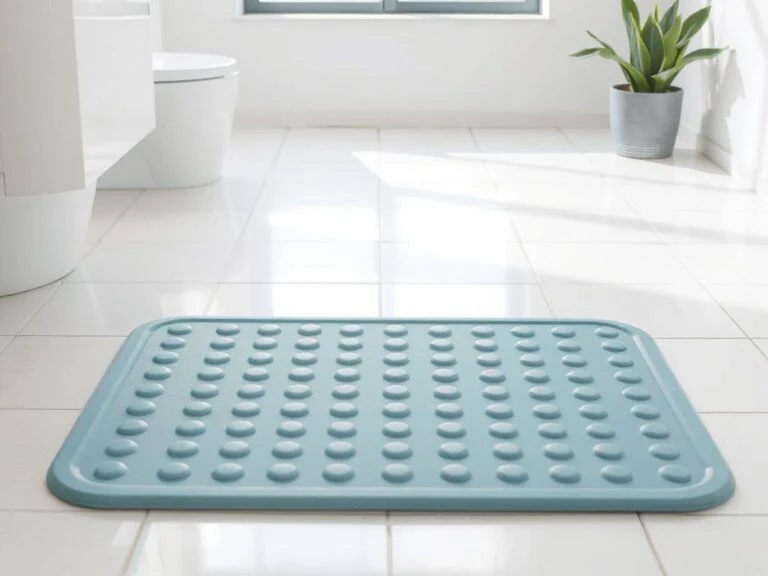
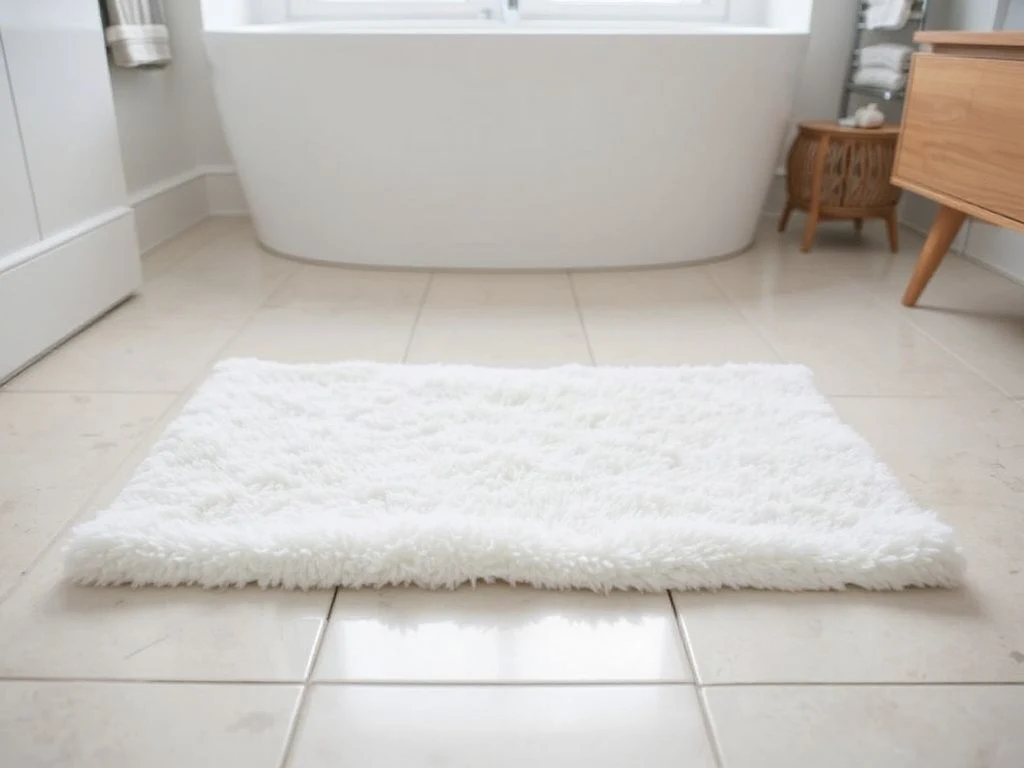
You step out of the shower, plant one wet foot on the bath mat, and the other lands on cold tile because the mat is three inches too short. That’s the exact frustration behind the question what size bath mat do you need, and the answer starts with a distinction most people miss. A bath mat meant for inside the tub relies on suction cups and slip resistance; a bath rug for the floor relies on a non-skid backing and absorbs water. Sizing a floor mat correctly means measuring the clear floor area, not the tub’s perimeter, and accounting for door swing, toilet clearance, and the natural stepping-out path. A beginner often picks a huge runner-style mat that creates a moisture-trapping hazard, while the right size is defined by the space you walk on, not the area you want to cover for looks.
Key Takeaways
- Measure the clear floor area, not the tub’s outline — the mat only helps where you actually step, and overhang into the toilet or door swing creates a trip hazard.
- A standard 60-inch tub needs a mat at least 24 by 40 inches placed so it extends 6–8 inches beyond the tub edge in the stepping-out zone, but your specific clearances matter more than the tub length.
- Backing material dictates safety and floor damage — rubber or latex degrades on damp tile and can stain grout, while TPE or PVC is more waterproof and less likely to warp vinyl or floating floors.
Step 1: Measure the Actual Floor Space You Walk On
Before you look at a single mat, grab a tape measure and a piece of paper. The only measurement that matters is the rectangle of floor where your bare feet actually land between the tub, the toilet, and the door. Do not measure the tub’s length or the vanity’s width. A 60-inch tub does not automatically mean a 60-inch mat; in most bathrooms, the toilet or a swinging door cuts that usable zone down to 30 inches or less.
Start by identifying the primary stepping-out zone — the strip of floor directly in front of the tub where you plant your first foot after showering. Stand where you naturally step out, mark that spot with a coin or a piece of tape, then measure from the tub edge outward to the farthest point your foot lands. That distance, plus your foot length, defines the minimum depth of the mat. For most adults, the stepping-out zone is 18 to 24 inches from the tub, which means a mat that is 16 inches deep fails, while one 20–24 inches deep works.
Then measure the width of the clear floor parallel to the tub. If the toilet sits within 4 inches of the tub, you might only have a 28-inch corridor between the toilet base and the tub edge. A 36-inch-wide mat would bunch against the toilet or get kicked sideways every time you sit down. The ADA Standards for Accessible Design recommend at least 30 by 48 inches of clear floor space at a bathtub, but that’s an accessibility minimum, not a sizing formula. Your actual space dictates the mat dimensions.
Check the door swing last. A hinged bathroom door arcs through a fixed radius; if the mat extends across that radius, the door will catch the edge, fray the fibers, and shove the mat into a corner. Measure the distance from the door hinge to the farthest point the door sweeps over the floor, then subtract 2 inches from that radius for the mat’s outer boundary. A mat that clears the door by half an inch will still snag when you open the door while holding a towel.
Step 2: Choose a Mat Size Based on Your Tub and Clearances
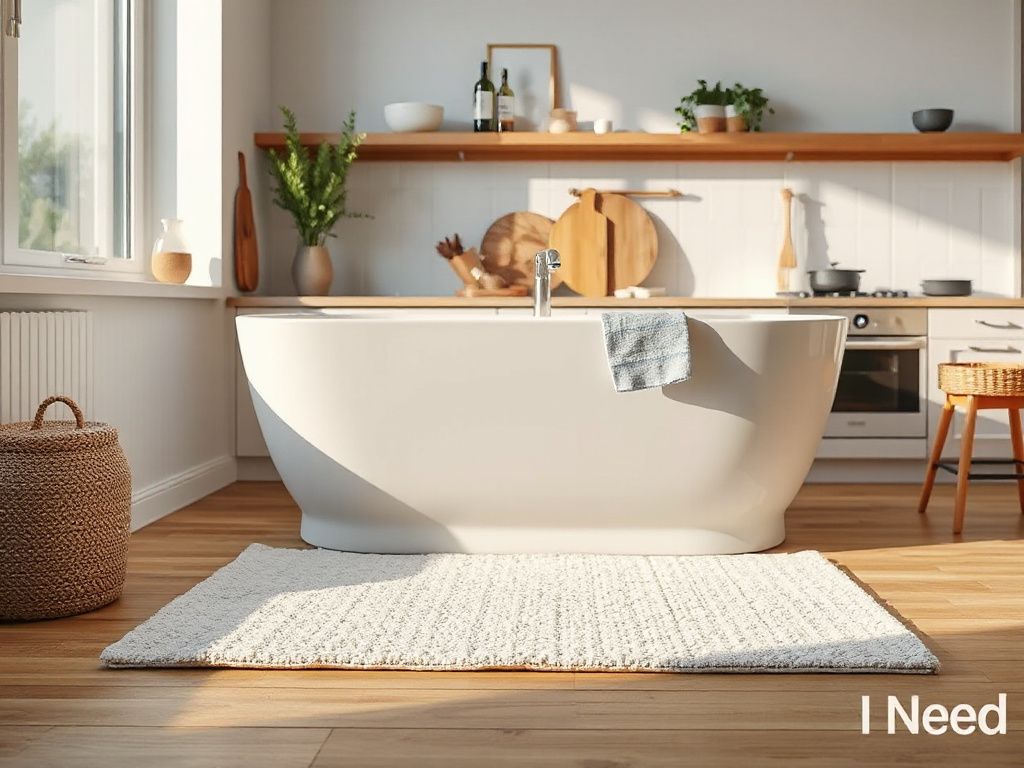
Once you have the clear floor measurements, you can match them to standard bath mat dimensions. The most common sizes on the market are 17 by 24 inches (small, often called a step-out mat), 21 by 34 inches (medium, the typical default), and 24 by 40 inches or larger (large, sometimes sold as a bath rug). A standard 60-inch tub pairs with a mat 24 by 40 inches placed lengthwise in front of the tub, but only if the clear floor zone is at least 26 by 42 inches. If your measured zone is narrower, drop the width.
For a small bathroom, a 21 by 34 inch mat is often the largest size that still clears the toilet and the door swing. In a space where the tub and toilet sit side by side, a 34-inch-long mat can run from the tub edge to within 4 inches of the toilet base, which is enough for your foot to land safely but not so wide that the mat bunches. If you want a visual reference, many guides list a bath mat buying guide that breaks down typical dimensions for different bathroom layouts, but the rule remains: clear floor space beats catalog size every time.
Do not buy a mat that extends beyond the tub’s footprint on the side opposite the stepping-out zone. That extra fabric does nothing except collect dust, block the toilet, or curl against the baseboard. A mat should overlap the floor in front of the tub by at least 6 to 8 inches beyond the tub’s outer edge so your foot lands fully on fabric, not on a seam between mat and tile. If your tub has a curved apron, measure from the outermost point of that apron outward; the mat must start under your foot, not behind the tub’s projection.
For a walk-in shower with no tub, the sizing logic changes. A shower pan is typically 32 to 36 inches square, but the stepping-out zone is the same 18 to 24 inches in front of the shower door. A 24 by 36 inch mat placed parallel to the shower opening works well in most bathrooms. For a double vanity or a long wall, a runner mat 24 by 60 inches can work, but check the door swing first — a runner that crosses the room’s main aisle will trip everyone, not just the wet person exiting the shower.
Step 3: Match the Mat’s Backing to Your Floor Type and Moisture Level
Size is only one variable; the backing material determines whether the mat stays put and whether it damages your floor. A rubber latex backing feels grippy on dry tile, but on a damp floor it can break down, leaving black marks on grout lines and a slippery residue. PVC (polyvinyl chloride) backing is more waterproof and resists that degradation, while TPE (thermoplastic elastomer) is even more durable and less likely to stain porous surfaces. For a bathroom that stays humid for hours after a shower, avoid latex-backed mats entirely.
If you have a floating vinyl floor or a sealed hardwood floor, a mat with a solid rubber backing can trap moisture beneath it and cause discoloration or warping over time. The American Society for Testing and Materials publishes ASTM E303, a standard for measuring surface frictional properties, but your practical test is simpler: after a shower, lift the mat and check the floor underneath. If you see moisture beading or a dark patch, the backing is trapping water against the floor. Switch to a mat with a breathable mesh or a woven cotton backing, or hang the mat to dry between uses.
For slip resistance, the backing is not the only factor. A mat with a washable non-slip rug tape applied to the underside adds grip without changing the mat’s size, but the tape must be repositionable; permanent tape ruins the floor finish. The best approach is a mat with a TPE or PVC backing that grips on its own, plus a mat that’s heavy enough not to skate when you step on it. A lightweight chenille mat slides on glossy tile even with a latex backing because there’s not enough mass to anchor it. Choose a mat with real heft and a full rubber or TPE backing rather than a thin, lightweight one; a mat that feels flimsy in your hands is the one that slides and curls at the edges.
Absorbency also affects the practical size. A cotton terry cloth mat absorbs water but dries slowly, which means a larger terry mat stays wet longer and becomes a mildew source. Microfiber absorbs faster and dries quicker, allowing a slightly larger mat without the mold risk. Chenille is plush and absorbent but holds water for hours; if you want a chenille mat, keep it to a small step-out size and hang it over the tub edge after each use. No mat, regardless of material, is a substitute for a squeegee or a quick towel-down of the floor.
Step 4: Decide Between a Single Large Mat, a Multi-Piece Set, or a Custom Cut
The floor space in front of a tub is rarely a perfect rectangle. Pedestal sinks, toilet bases, radiator pipes, and angled walls all eat into the usable area. A single large mat that covers the entire bathroom floor looks cohesive but fails for two reasons: it traps moisture in the low-traffic corners and it forces you to walk around it to use the toilet. A multi-piece set — a small mat in front of the tub, a smaller one near the sink — lets you cover only the zones where water actually lands. For a standard bathroom, two mats, each 20 by 30 inches, placed at the tub and the sink, outperform one 30 by 50 inch runner that blocks the door swing.
If your floor has an irregular shape, a runner cut to follow the wall line works only if the backing is cohesive. Some bath mats can be cut to size with a utility knife if the backing is felt or non-woven, but a rubber or TPE backing will fray and lose its grip once cut. The safer option is to buy a mat slightly smaller than the irregular zone and fill the gap with a washable non-slip bathmat pad that sits under the main mat. That pad also solves the curling-edge problem: a mat that’s too wide for its space curls at the edges because it has nowhere to lie flat. Trim the clearance or choose a narrower mat instead of trying to flatten the curl.
Washing frequency plays a role in sizing too. A mat that’s too heavy to lift and wring out by hand will stay damp, and a large mat won’t fit in a standard washing machine without bunching. Most home machines can handle a mat up to 24 by 40 inches if you wash it alone; anything larger needs a commercial machine or a trip to the laundromat. If you can’t wash it, you won’t, and a permanently damp mat is a slip hazard regardless of its non-skid claims. Choose a size you can actually clean.
For a small bathroom where every inch counts, our guide to best bath mats for small bathrooms walks through the trade-offs between absorbency and footprint, but the conclusion is simple: a 17 by 24 inch step-out mat in front of the tub plus a matching 13 by 18 inch mat in front of the sink covers 95% of the splash zones without crowding the floor. Skip the vanity mat entirely if you have a pedestal sink — water drips straight down and a mat under the pedestal just collects dust against the curved base.
Step 5: Account for Door Swing, Toilet Clearance, and the Stepping-Out Path
The most common sizing error is ignoring the door swing radius. A mat that fits perfectly when the door is closed can become a wedge when the door opens, forcing the mat to bunch against the door stop or slide under the vanity. Measure the distance from the hinge pin to the outermost edge of the door, subtract 2 inches, and keep the mat inside that radius. If your bathroom door opens inward and the mat would sit in the swing path, either shorten the mat or move it toward the tub by a few inches — those few inches matter more than extra absorbency.
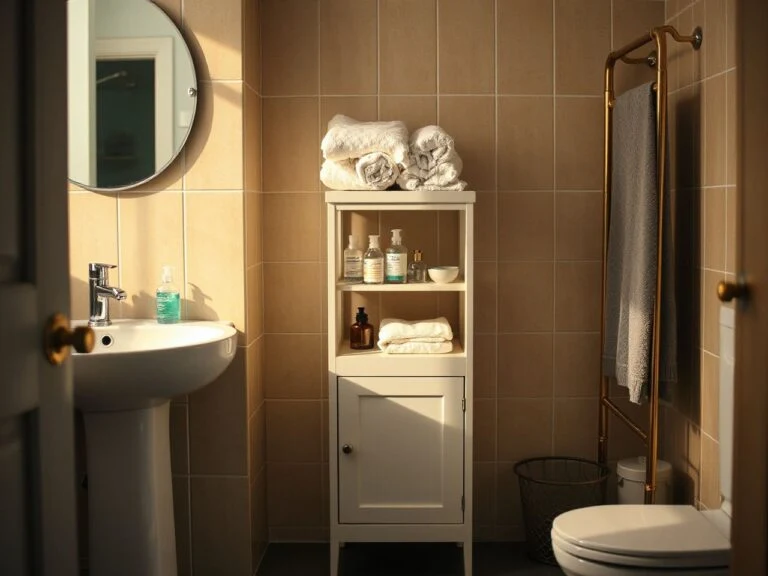
Toilet clearance follows a similar rule. The ADA guidelines require 16 to 18 inches of clear space from the toilet centerline to any side wall or obstruction, and a bath mat can act as that obstruction if it runs too close to the toilet base. A mat that touches the toilet base will wick moisture up against the porcelain, discolor the grout, and make the toilet area smell musty. Keep at least 3 inches of bare floor between the mat edge and the toilet base on all sides. That gap also prevents the mat from getting caught under the toilet seat hinges when someone lifts the lid.
The natural stepping-out path is not always a straight line. If the shower head is on the left, you step out and turn right to reach the towel bar; your wet foot traces a short diagonal. A rectangular mat placed parallel to the tub will miss that diagonal entirely, so your foot lands on bare tile at the corner of the mat. To test your own path, stand in the tub, close your eyes, and step out exactly as you would after a shower. Mark where your foot lands. Repeat three times. If the marks form a diagonal or a curve, rotate the mat to follow that line or choose a square mat that covers both the straight and the angled step.
For households with multiple users, average the paths. A taller person steps farther from the tub than a shorter one; a child steps closer. A mat that’s 24 inches deep satisfies most adults, but if a child or an elderly person uses the bathroom, extend the mat to 30 inches deep in the stepping-out zone. At that point, check the door swing again — a 30-inch-deep mat often collides with an inward-opening door.
Frequently Asked Questions
How do I measure my bathroom floor to figure out what size bath mat I need?
Measure the clear floor rectangle between the tub edge, the toilet base, and the door’s swing radius. Start at the tub’s outermost point, extend outward 18 to 24 inches (your natural step-out distance), then measure the width parallel to the tub, subtracting 2 inches from any obstruction. The mat must fit inside that rectangle without touching the toilet or the door arc. A tape measure and a coin as a foot marker are all you need; write down both the depth and the width, then choose the largest standard mat that stays 2 inches inside both limits.
Should the bath mat extend beyond the bathtub edge or sit fully inside the tub?
A floor bath mat should always sit fully outside the tub and extend beyond the tub’s outer edge by at least 6 to 8 inches so your foot lands on fabric, not on the joint between mat and floor. A bath mat designed for inside the tub is a different product — it has suction cups and is meant to be stepped on while standing in water, not to absorb floor moisture. The two are not interchangeable. If you see a mat with suction cups, it goes inside the tub; a mat with a non-skid backing and no cups goes on the floor.
How much clearance do I need around the toilet when placing a bath mat there?
Keep at least 3 inches of bare floor between the mat edge and the toilet base on all sides. This gap prevents the mat from wicking moisture up against the porcelain, discoloring the grout, or getting caught under the toilet seat hinges. If your bathroom is so narrow that a 3-inch gap is impossible, use a smaller mat or a round step-out mat placed only in front of the tub, leaving the toilet area completely bare. A mat touching the toilet is worse than no mat at all.
Will a larger bath mat create a trip hazard or block the bathroom door?
Yes, and it does so in two ways. First, a mat that extends into the door’s swing radius gets caught under the door and bunches, creating a raised edge that catches your toe. Second, a mat that’s too deep for the stepping-out zone forces you to walk across its entire width to reach the toilet, which is slippery when wet and unnecessary when dry. The right size covers only the 18 to 24 inches where your wet foot lands; anything larger adds risk without adding safety. Always subtract 2 inches from the door’s swing radius before buying.