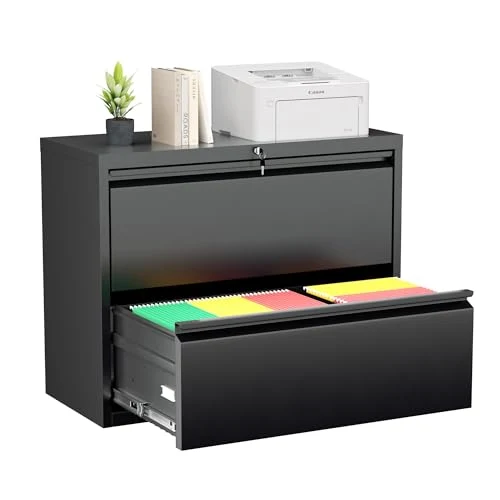

Can another person find a document in your filing cabinet without asking where you put it? Effective filing cabinet organization distinguishes a retrieval system from a storage pile: broad categories belong at the drawer level, while consistent subcategories belong inside folders. The practical test is whether a different person can predict where a document belongs and return it there without relying on personal memory; systems that depend on color alone, vague labels, or undocumented exceptions tend to decay.
Key Takeaways
- Choose drawer categories based on how documents are retrieved, then use consistent interior folders for detail.
- Separate active records, archived records, and documents ready for disposal before the cabinet becomes crowded.
- Check rails, hanging folders, paper format, labels, and drawer movement before committing to a filing arrangement.
Filing Cabinet Organization Starts With Retrieval
A filing structure should reflect how documents are retrieved, not merely how they are created or received. A bank statement may arrive by mail, an invoice by email, and a warranty through a website, yet the useful question is usually the same: what subject will someone remember when looking for that paper later?
Start by listing the documents that actually need paper storage. Include household records, financial papers, property documents, employment records, insurance material, school paperwork, project files, and any records that must remain available in their original form. The list reveals the subjects that deserve space and exposes papers that can be scanned, securely disposed of, or kept elsewhere.
Choose categories from real retrieval habits
Broad categories work at the drawer level because they give each drawer a clear purpose. Interior folders then provide the detail without forcing the entire cabinet into a long chain of narrow divisions. A drawer labelled Household Finance might contain folders for banking, tax material, insurance, and recurring bills, while a drawer labelled Home Records might hold property, utilities, repairs, and warranties.
Household filing categories should be named for the question a person asks while searching. “Car” may be less useful than “Vehicle Records” if the drawer contains registration, insurance, service papers, and purchase documents. “Miscellaneous” is rarely a category; it is usually a sign that the system has not yet described the papers clearly.
- Use a drawer category when several related subjects need to be reached together.
- Use a hanging file folder for a major subject within that drawer.
- Use manila file folders for smaller subjects, individual accounts, projects, or people.
- Use an exception folder only when its contents share a retrieval reason, not simply because they do not fit elsewhere.
Broad categories belong at drawer level because drawer labels act as the cabinet’s map. A drawer with unrelated subjects forces memory to do the sorting work, which makes the arrangement fragile.
Choose alphabetical, chronological, project, or client filing deliberately
Alphabetical filing suits records that are retrieved by a stable name, such as companies, people, vendors, or accounts. Chronological filing suits a continuing record where the latest or earliest event matters, but dates alone can make a folder difficult to identify if the subject is not also clear.
Project filing works when documents are repeatedly used together for one defined piece of work. Client filing works when the client is the main retrieval cue and the contents for each client follow the same internal order. A mixed system can work, but the rule must be written on a drawer divider or filing guide so another person does not have to infer it.
Alphabetical order is useful only when the alphabet is applied consistently. Decide whether a folder is filed under a person, company, household, property, or account name, then use the same choice throughout the relevant drawer.
Keep categories broad enough to remain useful
Too many categories create empty-looking divisions and slow down filing. Too few categories create crowded folders that hide the document being sought. The right level is reached when a person can identify the destination from the document’s subject without scanning every folder in the drawer.
A category should earn its place by answering a recurring retrieval need. If a folder receives only occasional papers and those papers have a clear home elsewhere, merge it. If a folder becomes thick enough that the label no longer describes its contents, divide it by a stable subcategory rather than by an arbitrary date.

How to Build the Cabinet in Clear Steps
Step 1: Empty and sort without filing immediately
Remove the papers from one drawer at a time and place them into temporary subject groups. Do not start by making labels, because early labels can preserve a weak structure. First identify active records, archived records, duplicates, papers awaiting action, and documents ready for disposal.
Active records support a current task or may be needed soon. Archived records are kept for reference or because a retention requirement still applies, but they do not belong in the everyday working area. Disposal papers have reached the end of their useful or required life and should leave the filing system through an appropriate method.
Active records need a visible and convenient location because delay encourages papers to collect on desks. Archived records need clear separation because they can crowd out current work. Disposal records need a separate path because confidential papers should not drift back into ordinary files.
Step 2: Create drawer-level sections
Place the broadest categories in the hanging file folders or drawer dividers. The front of each divider should be easy to read while the drawer is open. Labels should describe the subject in ordinary language and should match the terms used in the household’s paperwork or digital document management system.
Keep active and archived material in separate drawers when the cabinet permits. If they must share a drawer, use a strong divider and a plainly labelled archive section. Documents ready for disposal should not remain mixed with records that are still under review.
Drawer dividers are useful because they provide structure before individual papers are handled. A divider labelled “To Review” can hold temporary work, but that section needs a clear next action and should not become a permanent holding area.
Step 3: Add interior folders in a repeatable order
Hanging file folders create the main compartments that sit on the drawer rails. Manila file folders sit inside them and divide the broad subject into smaller units. For example, a hanging folder labelled Home Records may contain interior folders for property, repairs, utilities, and warranties.
Keep the same internal order wherever a category repeats. If every project folder begins with agreements, then correspondence, invoices, and closing material, that pattern should be used for each project. Consistency matters more than the particular order chosen.
Hanging file folders work as the visible framework, while interior folders hold the finer subjects. Mixing those roles can produce a drawer filled with loose papers and labels that do not show the true structure.
Step 4: Label the system and its exceptions
File folder labels should be readable, specific, and consistent in wording. A label such as “Insurance” gives a useful subject; a label such as “Important” does not explain what the folder contains or why it matters. If a document is filed under an exception, label that exception instead of expecting personal memory to preserve the rule.
Color coding can support recognition, but color should not carry the meaning by itself. A blue folder may help distinguish household finance from home records, yet the written label remains necessary if the system is used in poor light, by another person, or after folders are moved.
A readable written label remains useful when color coding is unavailable. Color supports a filing system; color alone does not explain one.
Step 5: Test retrieval with an unfamiliar document
Choose a document and describe the search path in plain language: drawer, hanging folder, interior folder, then position within that folder. If the path depends on a personal exception, revise the label or record the rule on a drawer guide.
The retrieval test should also work in reverse. A person holding a new document should be able to identify where it belongs without opening every drawer. That is the difference between a filing structure and a pile arranged by habit.

Fit, Hardware, and Drawer Capacity
A filing arrangement can fail even when its categories are sensible. Folders must fit the drawer rails, and the paper format must match the folders being used. Foolscap, A4, and A3 are recognized paper sizes used in the United Kingdom, while cabinets and suspension files may be designed around different regional formats.
The rails used to hold suspension files are wider in UK filing cabinets than in US versions, which feature narrower rails. That difference matters because a folder made for one rail arrangement may not sit properly in another cabinet.
Check the cabinet and folder information before transferring a full set of records. Look for the supported paper format, rail arrangement, and whether the hanging frames rest securely. A folder that twists, drops, or catches is a warning that the hardware and filing material are not working together.
Double file cabinets use drawers designed to hold two separate rows of folders positioned side by side. The two-row layout needs a clear front-to-back retrieval path, or the rear row can become difficult to reach and easy to forget.
Recognize an overcrowded drawer
An overloaded drawer makes folders difficult to retrieve and may interfere with drawer operation. Signs include labels turned sideways, folders that cannot remain upright, papers spilling above the folder edge, or a drawer that resists opening and closing.
Reduce pressure by removing duplicates, transferring inactive records to an archive section, and merging folders that do not represent distinct retrieval subjects. Do not solve crowding by removing labels or compressing papers until they cannot be handled individually.
A crowded drawer needs a records decision before it needs another divider. If the papers are active, improve the category structure; if they are archived, move them; if they are no longer required, dispose of them securely.
Check standards and safety information
The General Services Administration maintains specifications for lateral and vertical steel filing cabinets designated as A-A-3187 and A-A-3186; its official information is available at GSA.gov. The United Kingdom uses filing-cabinet requirements associated with BS 4438:1969 and BS EN 14073-2:2004, while EN 14073-2:2004 is adopted across other EU states by local agencies such as DIN in Germany.
Australian filing cabinets are expected to comply with AS 5079, an adaptation of ANSI BIFMA X5.2-1997. These designations matter when a cabinet is being specified for a workplace or a regulated setting, but they do not replace checking the actual cabinet, rails, paper format, and installation instructions.
The U.S. Consumer Product Safety Commission provides consumer information about furniture tip-over hazards at CPSC.gov. Follow the cabinet maker’s safety instructions and keep access to drawers clear, especially where children or people with limited mobility may use the room.
Active Records, Archives, and Disposal
Separate records by status
Active records belong where they can be reached during normal work. Archived records belong in a clearly marked area with a simple retrieval path. Documents ready for disposal belong outside the active filing route, with their destruction decision recorded when the setting requires accountability.
Retention schedules should guide the decision to keep or dispose of records. The appropriate period depends on the legal, financial, tax, employment, property, or organizational requirement that applies to the record. If the requirement is unclear, do not guess from the document’s age; identify the responsible authority or policy first.
Retention decisions should be recorded in plain language. A folder label can state the record type and the review trigger, while an archive index can identify where older material moved.
Handle confidential papers with care
Confidential documents should be stored with access controls suited to the information. A lock may be appropriate in a shared room, but a lock alone does not solve every access issue; control who has the key or combination and keep sensitive folders away from casual view.
Use a document shredder for discarded sensitive records rather than ordinary recycling. Papers containing account details, identity information, medical information, employment details, or private correspondence deserve a disposal method that prevents casual reading.
Confidential records require control during filing as well as disposal. Avoid leaving an open folder unattended on a shared desk, and return papers to the cabinet after the filing task is complete.
Protect paper from room conditions
Paper records can be affected by fire, water, and unsuitable storage conditions. Keep irreplaceable originals in the location and protective arrangement specified by the responsible organization or document issuer. Scanning can provide a working copy and support digital document management, but a scan does not automatically replace an original record when the original has legal or practical importance.
Paper records need a clear protection plan when their loss would be difficult to correct. The filing cabinet is one part of that plan, not the entire plan.
Maintenance That Prevents Filing Drift
Review, purge, and relabel on a repeating cycle
A filing system needs review whenever the household, office, project load, or retention policy changes. Set a recurring review point that suits the volume of records, then check whether active folders remain active, archive folders remain necessary, and labels still describe the papers inside.
Reviewing too rarely allows outdated categories to harden. Reviewing too often can turn filing into an interruption. A practical review includes removing duplicates, checking unfinished paperwork, moving completed projects to archive, and identifying papers ready for secure disposal.
Relabel a folder when its contents change in a meaningful way. Do not preserve an old label simply because the folder already exists; a misleading label creates retrieval errors that can spread to every later filing decision.
Use a simple intake workflow
Incoming papers should move through a small number of visible stages: action needed, file, scan, archive, or dispose. A temporary inbox or review folder can support this workflow, but it must remain separate from permanent records.
File a paper after deciding its subject and status. Filing an item without deciding whether it is active, archived, or disposable merely moves uncertainty from the desk into the drawer.
A clear intake workflow prevents unclassified papers from becoming permanent residents of the cabinet. Digital copies should use matching subject names where practical, so paper and digital records can be found through the same mental route.
Keep the cabinet visually calm
Interior design matters because a cabinet that looks chaotic invites avoidance. Align labels, keep divider positions consistent, and leave enough space for folders to move without force. A restrained color-coding system can make broad categories easier to spot while preserving written labels for clarity.
If the cabinet is part of a home office, place active paperwork close to the work surface and archives farther from daily reach. For a room-planning perspective, the broader principles in this filing cabinet buying guide can help connect cabinet shape with the available workspace before the storage system is rebuilt.
A filing cabinet should support the room’s workflow rather than become a visual barrier. Its finish may coordinate with surrounding furniture, but its rails and drawer action determine whether the arrangement remains usable.
Common Filing Errors and Their Fixes
- Vague labels: Replace “Miscellaneous” or “Important” with a subject that tells the next person what belongs there.
- Color without words: Keep a readable written label on every folder, even when color coding is part of the system.
- Mixed record status: Move active, archived, and disposal-ready records into clearly separated sections.
- Too many categories: Merge folders that do not represent different retrieval needs.
- One folder for everything: Divide a broad subject into stable subcategories when documents can no longer be scanned easily.
- Unmarked exceptions: Add a label or guide explaining why an item belongs in an unusual location.
- Ignoring hardware: Confirm that hanging folders fit the rails and that the paper format matches the cabinet.
- Using recycling for sensitive papers: Shred confidential documents through an appropriate secure process.
The most persistent filing errors come from undocumented decisions. Write the rule where the decision is made, whether that means a drawer divider, folder label, archive index, or digital filing guide.
Frequently Asked Questions
How should I decide what categories to use in my filing cabinet?
Choose categories based on how a document will be retrieved, not the way it arrived. Start with broad subjects at drawer level, then use hanging file folders and manila folders for detail. A category should have a clear search purpose. If the label requires personal explanation, rename it or add a written filing rule.
Should files be organized alphabetically, chronologically, by project, or by client?
Use alphabetical filing when a stable name is the main search cue. Use chronological order for a continuous record where dates guide retrieval, and use project or client filing when documents are repeatedly handled as a group. A mixed approach is acceptable if each drawer states its rule and the interior order repeats consistently.
How do active files and archived records stay separate?
Give active records a convenient drawer or clearly marked section, then move completed or infrequently used records to an archive section. Keep disposal-ready papers out of both areas. Retention schedules and the relevant legal, financial, or organizational requirements should guide the decision to retain or destroy a record.
How do hanging file folders and interior folders work together?
Hanging file folders provide the main sections and rest on the cabinet rails. Interior manila folders divide each section into subjects such as accounts, projects, or properties. Keep the internal order consistent, and check that the folder size and hanging frame match the drawer rails and paper format before loading the cabinet.
How can files be found quickly without creating too many categories?
Use broad drawer categories, then divide only when a folder contains different retrieval subjects. Labels should state the subject plainly, while a short written guide can explain exceptions. Color coding may support recognition, but alphabetical or subject labels must carry the meaning so the system remains clear to another person.
What should I do when a drawer becomes overcrowded?
First separate active, archived, duplicate, and disposal-ready papers. Then merge weak categories, remove duplicates, transfer inactive records, and securely dispose of documents that no longer need to be kept. Check whether the drawer catches or resists movement, because overcrowding can interfere with operation as well as retrieval.
How often should filing cabinets be reviewed?
Review the cabinet at a frequency suited to the amount and type of paperwork, and revisit it whenever a retention policy, household responsibility, or project changes. A review should check labels, active status, archive placement, duplicates, and disposal decisions. A short written filing guide reduces the need to reconstruct the system each time.
Is color coding better than alphabetical labeling?
Color coding and alphabetical labeling serve different purposes. Color can help the eye distinguish broad subjects, while alphabetical or subject labels explain where a document belongs. Written labels should remain the primary guide because color alone cannot describe exceptions, clarify names, or help a different person file a new document.
What does it cost to maintain an organized paper filing system?
Maintenance costs depend on the supplies and services already available, including folders, labels, replacement dividers, scanning, secure shredding, and archive storage. The important planning point is recurring upkeep rather than a single setup expense. A clear retention process can reduce unnecessary paper storage and limit the need for repeated reorganization.
How can confidential records be stored safely?
Use access controls appropriate to the information and the room, and keep sensitive folders out of casual view. Limit access to people who need it, return open folders after use, and securely shred sensitive documents that are ready for disposal. Ordinary recycling is not an appropriate destination for confidential papers.
How can I make sure folders fit the drawer rails and paper size?
Check the cabinet documentation, rail arrangement, and folder format before transferring records. Regional designs can differ: UK filing cabinets use wider suspension-file rails than US versions, and paper formats may include Foolscap, A4, or A3. Test that the folders sit securely, remain upright, and allow the drawer to open and close normally.